Top Hanbok Making Workshops 2026: Learn Jeogori and Chima Tailoring
The Resurgence of Slow Fashion: Why Learn Hanbok Making in 2026?
In 2026, the global shift toward sustainable, slow fashion has brought traditional garment construction to the forefront of the textile world. Among the most sought-after skills is the art of Hanbok making. The traditional Korean dress, characterized by its vibrant colors, graceful lines, and zero-waste pattern drafting, offers a masterclass in structural tailoring without the use of darts or complex western seaming. According to the Korean Culture and Information Service, international interest in Hanbok sewing seminars has surged by over 40% this year, driven by designers and hobbyists eager to preserve intangible cultural heritage while applying its principles to modern wardrobes.
Learning to construct a Hanbok is not merely about sewing a historical costume; it is about mastering the geometry of fabric. The jeogori (upper garment) requires precise manipulation of the git (collar) and the tying of the goreum (chest ties), while the chima (skirt) teaches advanced pleating and waistband engineering. Whether you are a seasoned tailor looking to expand your repertoire or a beginner seeking a meditative crafting practice, the 2026 workshop landscape offers unprecedented access to master artisans.
Top In-Person Hanbok Workshops in Seoul (2026 Guide)
Seoul remains the undisputed epicenter for traditional Korean garment education. The city's 2026 cultural initiatives have heavily subsidized heritage workshops, making them more accessible to international students than ever before. Here are the premier institutions offering hands-on Hanbok tailoring seminars this year.
1. Bukchon Hanbok Culture Center: The Beginner’s Jeogori
Located in the historic Bukchon Hanok Village, this center is the gold standard for introductory seminars. Their flagship 2026 program, The Anatomy of the Jeogori, is a four-week intensive course. Students learn traditional flat-pattern drafting using the gija (traditional L-shaped ruler) and construct a basic daily-wear jeogori from cotton and myeongju (raw silk). The curriculum emphasizes the baerae (the curved underarm seam), which is crucial for the garment's signature silhouette and arm mobility. Classes are conducted in Korean with simultaneous English translation headsets provided to international registrants.
2. Seoul Hansang Museum of Embroidery & Hanbok: Advanced Techniques
For those who already possess foundational sewing skills, the Hansang Museum offers advanced masterclasses focusing on ceremonial wear and surface embellishment. Their 2026 spring cohort focuses on the wonsam (a ceremonial robe for women) and the intricate geumbak (gold leaf imprinting) technique. According to the Cultural Heritage Administration of Korea, institutions like Hansang are vital for preserving the skills of designated Intangible Cultural Heritage holders. Students here spend up to 60 hours on a single garment, learning how to pad the git collar with traditional mulberry paper to maintain its crisp, upright structure.
3. Dongdaemun Design Plaza (DDP) Modern Hanbok Labs
Bridging the gap between antiquity and contemporary fashion, the DDP Modern Hanbok Labs cater to fashion design students and indie brands. The 2026 seminar series, Deconstructing Tradition, teaches students how to adapt traditional Hanbok silhouettes for modern, machine-washable textiles. You will learn how to engineer hidden zippers into the chima waistband and use modern interfacing to mimic the structural properties of traditional ramie (mosi). This is the ideal environment for those looking to launch a modern Hanbok-inspired fashion line.
Virtual Seminars: Learning Traditional Tailoring from Anywhere
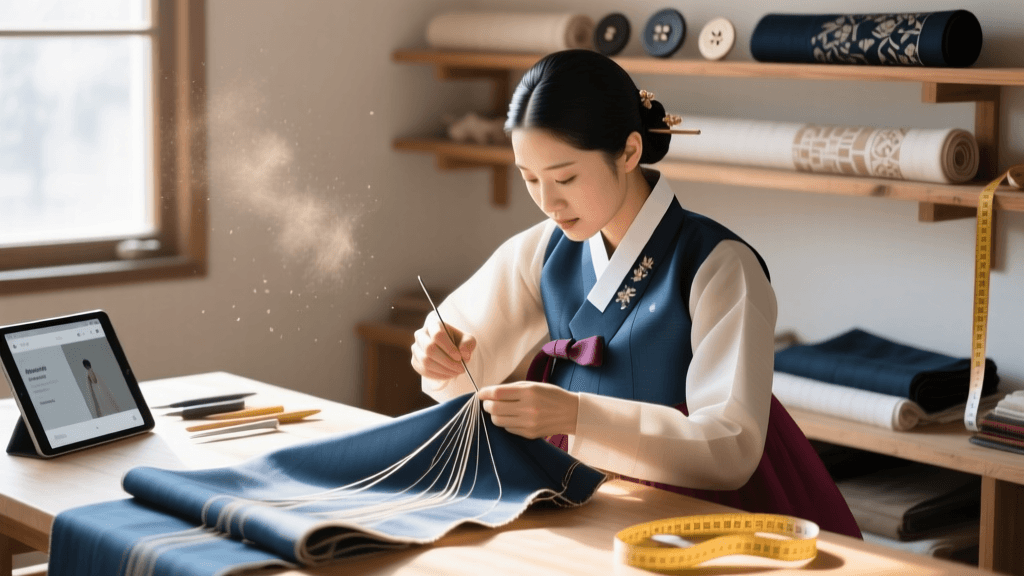
If traveling to South Korea is not feasible, 2026 has seen a massive upgrade in virtual textile education. The Seoul Tourism Organization has partnered with several heritage guilds to offer hybrid learning experiences. The Global Hanbok Jangin Virtual Academy provides a comprehensive 12-week online syllabus. Students receive a physical kit shipped internationally, containing pre-measured myeongju silk, traditional curved rulers, and specialized thimbles. Live-streamed sessions from master tailors in Jeonju allow for real-time stitch correction via multi-angle webcams, ensuring that your tension and seam allowances meet traditional standards.
Curriculum Breakdown: What You Will Actually Sew
A standard comprehensive Hanbok making workshop will guide you through the creation of a complete female or male ensemble. Below is the standard 2026 curriculum breakdown for a foundational women's Hanbok set.
| Garment Component | Key Tailoring Techniques | Traditional Fabric Used | Estimated Lab Hours |
|---|---|---|---|
| Jeogori (Jacket) | Curved baerae sleeve drafting, git collar padding, dongjeong (white collar strip) attachment | Myeongju (Raw Silk) or Cotton | 25 - 30 Hours |
| Chima (Skirt) | Cartridge pleating, hidden pocket construction, waistband binding and tie integration | Yangdan (Silk Satin) or Ramie | 15 - 20 Hours |
| Sokgot (Undergarments) | Volume-building layering, drawstring casing, lightweight hemming | Mosin (Fine Ramie) or Muslin | 10 - 12 Hours |
| Goreum (Chest Ties) | Bias cutting, invisible slip-stitching, traditional saengchoreum knot tying | Silk Taffeta | 4 - 6 Hours |
Essential Tools and Textiles for the 2026 Student
To succeed in a Hanbok making seminar, you must familiarize yourself with the specialized tools of the trade. Western sewing kits are insufficient for the precise, invisible hand-stitching required in traditional Korean tailoring.
- The Gija (기자): A traditional L-shaped wooden ruler used for drafting the uniquely angled collars and underarm curves. While modern acrylic versions are available, workshops in 2026 highly recommend the weighted rosewood versions for fabric stabilization during drafting.
- Chim (침) Needles: Traditional Hanbok needles are significantly shorter and finer than western sharps, allowing for the microscopic slip stitches used to close the goreum ties invisibly.
- Myeongju (명주) Silk: The backbone of traditional Hanbok. Woven from domestic silkworms, it has a matte finish and a crisp hand-feel. In 2026, sustainable, eco-dyed myeongju sourced from the Naju region is the preferred material for student projects.
- Pul (풀) - Traditional Paste: Unlike western tailoring which relies on fusible interfacings, traditional Hanbok collars are stiffened using a natural rice or wheat paste. Learning to apply and iron this paste without staining the silk is a core module in any advanced seminar.
Costs, Certification, and the Path to Hanbok Jangin
The investment required for Hanbok education varies wildly depending on the depth of the seminar. As of early 2026, a beginner four-week weekend workshop in Seoul averages around 850,000 KRW (approximately $630 USD), which includes all materials, toolkits, and museum entry fees. Advanced masterclasses spanning three to six months can range from 3,000,000 to 5,500,000 KRW ($2,200 to $4,100 USD).
For those viewing this as a professional pursuit rather than a hobby, the ultimate goal is the Hanbok Jangin (한복장인) certification. Administered by the Korean government, this National Technical Qualification is the highest benchmark for traditional garment makers. The 2026 examination process involves a rigorous written test covering textile history, natural dyeing chemistry, and traditional pattern mathematics, followed by a grueling practical exam where candidates must draft and sew a complete ceremonial ensemble from scratch within a strict time limit.
Enrolling in a government-subsidized workshop at institutions like the Bukchon Hanbok Culture Center is the first step toward this certification. These seminars are specifically designed to align with the national testing standards, providing students with the exact grading rubrics used by master judges. Whether you aim to pass the Hanbok Jangin exam or simply wish to sew a beautiful, historically accurate jeogori for yourself, the workshops of 2026 offer a deeply rewarding journey into the heart of Asian textile heritage.