3D Drape Analysis Tools for Chinese Fashion Research 2026
The Evolution of Chinese Fashion History Education in 2026
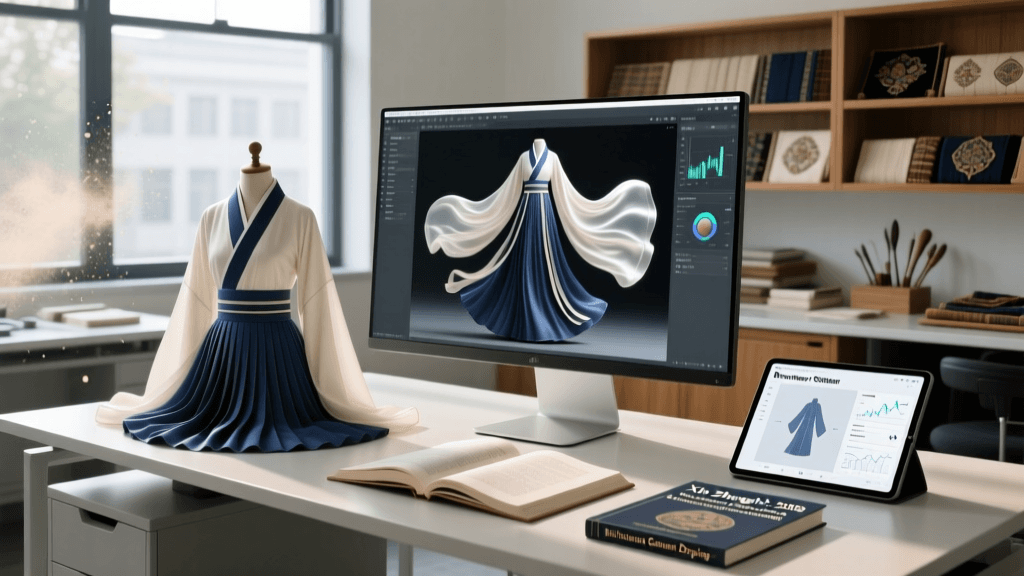
The academic study of Chinese fashion history has undergone a radical transformation by 2026. Gone are the days when university researchers and textile historians relied solely on flat, two-dimensional photography and fragile physical archives to understand the structural nuances of ancient garments. Today, leading institutions across Asia and the globe have integrated advanced 3D fabric drape analysis into their core curricula. This technological leap allows students and researchers to create highly accurate "digital twins" of historical garments, ranging from the flowing robes of the Tang dynasty to the intricately pleated skirts of the Ming era.
By utilizing sophisticated physics engines, academic programs can now simulate how historical fabrics moved, folded, and reacted to the human body in motion. This shift is not merely a visual upgrade; it is a fundamental methodological advancement in textile conservation and historical research. Understanding the kinetic behavior of ancient silks, brocades, and gauzes provides unprecedented insights into the daily lives, social etiquettes, and tailoring genius of historical Chinese societies.
Core Metrics in Historical Fabric Drape Analysis
Before diving into the software used by modern university labs, it is essential to understand the specific textile metrics that researchers analyze when digitizing historical Chinese garments. Academic drape analysis relies on quantifiable physical properties to ensure digital simulations behave exactly like their physical counterparts.
- Bending Length: This metric is crucial when studying the Mamianqun (horse-face skirt) of the Ming and Qing dynasties. The bending length determines how the stiff, heavy brocades hold their sharp, structured pleats versus how lighter silks collapse into softer folds.
- Shear Stiffness: Highly relevant for Kesi (silk tapestry) weaving. Unlike fluid silks, Kesi features a slit-tapestry technique that results in a fabric with high shear stiffness, behaving almost like a lightweight canvas. Accurate shear mapping prevents digital Kesi garments from draping like liquid, which would be historically inaccurate.
- Flexural Rigidity: This measures the fabric's resistance to bending. It is heavily analyzed when researching the Beizi (a traditional jacket from the Song dynasty) to understand how the garment's straight, unstructured silhouette maintained its elegant, columnar drop over the wearer's shoulders without clinging.
Leading Software for Academic Drape Simulation
In 2026, two primary software platforms dominate university textile labs and fashion history departments: CLO 3D and Browzwear VStitcher. While both are heavily utilized in the modern commercial fashion industry, their academic applications for historical research are distinct. According to educational resources provided by CLO Virtual Fashion, their particle-based simulation engine is particularly favored for its ability to render the hyper-fluid drape of lightweight historical silks, such as Luo (gauze) and Sha (crepe).
Conversely, enterprise solutions such as Browzwear are frequently utilized in advanced university labs focusing on structured garments. VStitcher's true-to-life fabric tension mapping is unparalleled when researchers need to simulate the complex internal layering and rigid collars of formal Hanfu or the heavy, multi-layered winter robes of the Qing court. Below is a comparison of how these tools serve academic researchers in 2026.
| Feature | CLO 3D (2026 Academic Edition) | Browzwear VStitcher (2026) |
|---|---|---|
| Physics Engine | Particle-based; excels in fluid, lightweight silk simulation | Tension-mapped; excels in structured, heavy brocade layering |
| Historical Pattern Drafting | Flexible 2D CAD workspace; ideal for experimental flat-cutting | Parametric block libraries; excellent for adapting standard historical blocks |
| Weave Micro-Simulation | High-fidelity surface rendering with displacement maps | Integrated material physics based on real-world yarn twist data |
| Primary Academic Use | Tang/Song dynasty fluid robes and sheer gauze overlays | Ming/Qing dynasty structured skirts, formal jackets, and armor |
Case Study: Digitizing the Ming Dynasty Mamianqun
To understand the practical application of these tools, we can look at a standard 2026 academic workflow used by graduate students digitizing a Ming dynasty Mamianqun. The process bridges physical artifact analysis with digital reconstruction, adhering to strict conservation guidelines similar to those outlined by the Victoria and Albert Museum's conservation department for handling fragile historical textiles.
Step 1: Archival Photogrammetry and Micro-Scanning
Researchers begin by using non-contact 3D scanners, such as the Artec Leo, to capture the macro-structure of the physical skirt. Simultaneously, digital macro-lenses capture the micro-structure of the Zhuanghua (brocade) weave. This data is used to create a custom digital material in the software, inputting the exact weight (often around 30 momme for historical winter brocades) and thickness.
Step 2: Pattern Extraction and Digital Stitching
Unlike Western tailoring, which relies on complex curved darts to fit the body, traditional Chinese tailoring is predominantly flat-cut. Students draft the 2D patterns based on the physical artifact's measurements, noting the precise width of the flat front panels (the "horse faces") and the depth of the side pleats. In the 3D environment, digital stitching lines are applied, paying special attention to the waistband casing and the internal ties that secure the wrap skirt.
Step 3: Physics Simulation and Drape Validation
Once the digital avatar is dressed, the physics engine is activated. Researchers analyze the drape, checking if the side pleats fan out correctly during a simulated walking cycle. If the digital pleats collapse unnaturally, students must adjust the digital fabric's flexural rigidity or re-evaluate the historical pattern's pleat ratio, leading to profound discoveries about how ancient tailors manipulated fabric grain to achieve structural stability without modern interfacing.
Bridging Ancient Weaving with the Xin Zhongshi Movement
The academic rigor applied to 3D drape analysis in 2026 is not confined to the ivory tower; it directly fuels the booming Xin Zhongshi (New Chinese Style) commercial market. Modern consumers of Xin Zhongshi are highly educated regarding traditional garment structures. They can easily spot an inaccurate collar curve, an improper sleeve root attachment, or a historically inaccurate pleat ratio on a modernized Mamianqun.
University textile labs frequently partner with contemporary Xin Zhongshi brands to share their drape analysis data. By providing commercial designers with the exact physics parameters of historical fabrics, brands can engineer modern, washable textiles that mimic the exact drape and movement of ancient silks. This synergy ensures that the modern revival of Chinese fashion remains deeply rooted in historical authenticity, rather than devolving into mere costume or superficial aesthetic appropriation.
Essential Hardware for University Textile Labs
Software is only half of the equation. A fully equipped 2026 academic textile lab requires specialized hardware to capture the physical data necessary for accurate 3D drape analysis.
- Non-Contact 3D Scanners: Essential for capturing the geometry of fragile garments without risking physical damage from measuring tapes or pins.
- Digital Fabric Analyzers: Devices like the FAST (Fabric Assurance by Simple Testing) system are used to physically measure the compression, bending, and stretch of modern reproduction fabrics, providing the raw data needed to program the software's physics engines.
- Haptic Feedback Gloves: An emerging technology in 2026 that allows researchers to "feel" the digital fabric's resistance and weight in a virtual reality environment, adding a tactile dimension to visual drape analysis.
Conclusion
The integration of 3D drape analysis into Chinese fashion history education represents a monumental shift in how we preserve, understand, and revive ancient textile traditions. By combining the meticulousness of academic historical research with the cutting-edge physics engines of modern software, the scholars of 2026 are ensuring that the kinetic beauty of traditional Chinese garments is preserved not just as static images, but as living, moving digital artifacts for generations to come.