Mastering Cheongsam Xiangbian Piping and Pankou Buttons in 2026
The Architecture of the Cheongsam: Beyond the Silhouette
The cheongsam, also widely known as the qipao, is globally recognized for its form-fitting silhouette, high mandarin collar, and dramatic side slits. However, the true mastery of this iconic Asian garment lies not in the two-dimensional pattern, but in its intricate, three-dimensional construction techniques. As we navigate the bespoke fashion landscape of 2026, the structural elements of the cheongsam—specifically the xiangbian (edge piping) and pankou (knotted frog buttons)—have evolved significantly. Modern artisans are now marrying mid-century Shanghai tailoring secrets with cutting-edge, sustainable material science.
According to Britannica's comprehensive guide to the qipao, the garment's evolution from a loose Manchu robe to a tailored masterpiece was defined by these very structural reinforcements. Today, understanding how to construct these elements is essential for any serious student of Asian dress traditions, conservationist, or bespoke tailor operating in the current market.
Xiangbian (Piping): The Structural Lifeline of the Qipao
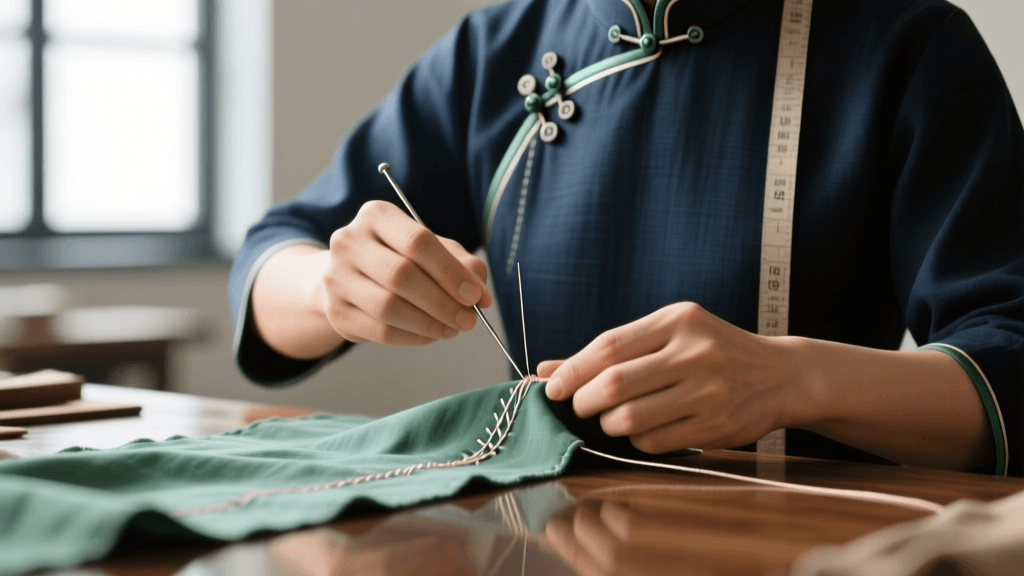
The xiangbian, or edge piping, is far more than a decorative trim. In traditional construction, it serves as the structural lifeline of the garment, preventing the bias-cut silk from stretching out of shape at high-stress areas like the collar, the sweeping diagonal front closure (the dajin), and the hem. In 2026, the standard for haute couture cheongsam requires hand-rolled piping using the exact same silk crepe de chine as the garment body, ensuring uniform shrinkage, identical light refraction, and dye-lot consistency.
The 2026 Bias-Cut Tension Mapping Technique
Historically, master tailors relied on tactile intuition to manage the tension of the silk strips while ironing and rolling the piping. In 2026, leading Shanghai and Parisian ateliers utilize AI-assisted tension mapping. By scanning the specific weave density of vintage or newly milled silk, digital looms calculate the exact bias angle required to yield a piping strip that curves flawlessly around the mandarin collar without buckling. While a standard 45-degree bias cut was the historical norm, modern algorithmic cutting frequently adjusts this to 42 or 48 degrees depending on the fabric's specific warp-to-weft ratio, a breakthrough that has virtually eliminated collar warping in contemporary bespoke pieces.
Hand-Rolled Silk Crepe De Chine Piping Standard
Creating the perfect xiangbian requires a meticulous folding process. The silk strip is first lightly misted with a pH-neutral conditioning spray—a 2026 innovation that replaces the harsh chemical starches of the past. The artisan then uses a heated, temperature-controlled jade rolling tool to fold the raw edges inward, creating a perfectly rounded cord that is subsequently blind-stitched to the garment's edge. This blind stitch, known as the qianfeng (hidden peak) stitch, ensures that no thread is visible on the exterior of the garment, maintaining the unbroken visual flow of the silk.
The Geometry of the Dajin (Diagonal Closure)
Navigating the dajin, or the sweeping diagonal front closure, is widely considered the ultimate test of a cheongsam tailor. The piping must make a sharp, elegant pivot at the collarbone and sweep down toward the underarm. To achieve this in 2026 without puckering, tailors employ a technique called guishu (shaping with heat and moisture). By applying targeted steam and using a curved wooden tailor's ham, the bias-cut piping is physically shrunk on the inner curve and stretched on the outer curve, allowing it to lay perfectly flat against the complex topography of the human chest.
Pankou (Knotted Buttons): Functional Sculpture
The pankou are the intricate knotted buttons that secure the diagonal closure. They are functional sculptures that dictate the drape and tension of the entire upper bodice. A standard floral or geometric knot, such as the classic plum blossom or the intertwined longevity knot, requires a continuous cord, meticulously stuffed and stitched. The complexity of a single pankou can require up to three hours of hand-knotting by a master artisan.
Traditional Wire-Core vs. 2026 Biodegradable Cores
Traditionally, the core of the pankou cord was made of copper wire or tightly twisted cotton thread, which allowed the button to hold its sculptural shape over decades of wear. However, copper wire makes the garment difficult to dry-clean, restricts the flexibility of the knot, and is prone to rusting if exposed to moisture or improper storage. In 2026, the industry standard for luxury, sustainable cheongsam construction has shifted to high-density, biodegradable PLA (polylactic acid) filament cores. These modern cores offer the exact malleability of copper wire during the knotting process but are entirely rust-proof, machine-washable, and eco-friendly, aligning with the strict 2026 global textile sustainability mandates.
Construction Comparison: Mid-Century vs. 2026 Hybrid Methods
To fully appreciate the evolution of cheongsam construction, it is vital to compare the historical methods with the hybrid techniques utilized by top-tier ateliers today. The following table outlines the material and technical shifts that define the modern era of Asian traditional dressmaking.
| Construction Feature | Mid-20th Century Traditional | 2026 Hybrid Bespoke Standard |
|---|---|---|
| Piping Core Material | Cotton thread / Horsehair | Biodegradable PLA filament / Memory-silk |
| Bias Angle Calculation | Strict 45-degree manual cut | Algorithmic 42-48 degree variable cut |
| Pankou Structural Core | Copper wire / Brass | Rust-proof PLA / Recycled titanium micro-wire |
| Collar Stiffening | Rice paste / Heavy buckram | 3D-knitted biodegradable cellulose mesh |
| Edge Finishing Stitch | Standard blind hem stitch | Micro-tension qianfeng (hidden peak) stitch |
Essential 2026 Tools for the Cheongsam Artisan
For those looking to replicate these construction techniques, the modern tailor's toolkit has expanded beyond traditional needles and thimbles. The following tools are currently considered essential for executing flawless xiangbian and pankou in 2026:
- Digital Bias Calculator: A handheld spectrometer that reads the weave tension of silk and outputs the exact degree angle for the bias cut.
- Temperature-Controlled Jade Roller: Replaces traditional irons for folding piping, providing consistent, gentle heat that prevents scorching delicate mulberry silk.
- PLA Filament Extruder Pen: Used for creating custom-thickness cores for pankou knots, allowing for micro-adjustments in button stiffness.
- pH-Neutral Silk Mist: A conditioning spray that relaxes the silk fibers for easing around the dajin curve without leaving water spots or altering the dye.
- Curved Wooden Tailor's Ham (Asymmetric): Specifically carved to mimic the exact topography of the human collarbone and chest, essential for the guishu shaping technique.
Sourcing Materials for Authentic Construction
The integrity of the xiangbian and pankou relies entirely on the quality of the raw materials. In 2026, the most sought-after silk for cheongsam construction is the 30-momme heavy silk crepe de chine sourced from the sustainable mulberry farms of Zhejiang province. This specific weight provides the necessary drape while offering enough structural body to support the intricate piping without collapsing. For the pankou cores, artisans are increasingly turning to specialized bio-labs in Shenzhen that produce textile-grade PLA filaments, which are dyed to match the silk perfectly before the knotting process begins. The conservation of these garments is also a major focus for institutions; as noted by the Victoria and Albert Museum's Asian collections, understanding the precise material composition of historical and contemporary trims is vital for long-term archival preservation and accurate restoration.
"The true soul of the cheongsam is not found in the fabric's print, but in the tension of its piping and the geometry of its knots. To master the xiangbian is to master the garment itself." — Master Tailor Lin, Shanghai Bespoke Guild, 2026.
Conclusion
The construction of the cheongsam is a masterclass in structural engineering disguised as high fashion. The xiangbian piping and pankou buttons are not mere afterthoughts; they are the architectural pillars that allow a flat piece of woven silk to contour perfectly to the human form. As we move through 2026, the integration of algorithmic bias mapping, biodegradable core materials, and advanced thermal shaping techniques has elevated this traditional Asian garment to new heights of sustainability and precision. By respecting the historical foundations of Shanghai tailoring while embracing modern material science, today's artisans ensure that the cheongsam remains a living, evolving masterpiece of global fashion heritage.