Bhutanese Kira Weaving With Yak Wool And Natural Indigo Dyes
Origins and Historical Significance of the Kira in Bhutanese Society
The kira—the traditional ankle-length wraparound dress worn by Bhutanese women—emerged as a formalized garment during the 17th century under the unifying rule of Zhabdrung Ngawang Namgyal. Prior to this, regional textile practices varied widely across valleys such as Paro, Bumthang, and Trongsa, with local wool processing and natural dyeing already deeply embedded in agrarian life. Unlike the kimono’s codified Edo-period aesthetics or the sari’s millennia-old Vedic references, the kira evolved organically through monastic patronage and royal decree, becoming legally mandated national dress in 1989 under the Driglam Namzha code. This regulation required civil servants and students to wear handwoven kiras during official functions—a policy that preserved weaving knowledge but also intensified pressure on artisan households.
Yak Wool: Fiber Sourcing, Preparation, and Structural Properties
Yak wool used in high-altitude kiras originates almost exclusively from domesticated yaks raised above 3,500 meters in the Haa and Laya regions. Each adult yak yields approximately 1–2 kg of usable undercoat annually—harvested manually during spring molting rather than shearing. The fiber’s micron count averages 16–18 µm, significantly finer than sheep’s wool (20–25 µm) and comparable to cashmere in softness, yet possessing superior tensile strength due to its dense crimp structure. Artisans separate coarse guard hairs from downy undercoat using wooden combs before spinning on drop spindles; a single 1.5-meter kira panel requires roughly 450 grams of cleaned, spun yarn.
Spinning and Loom Mechanics
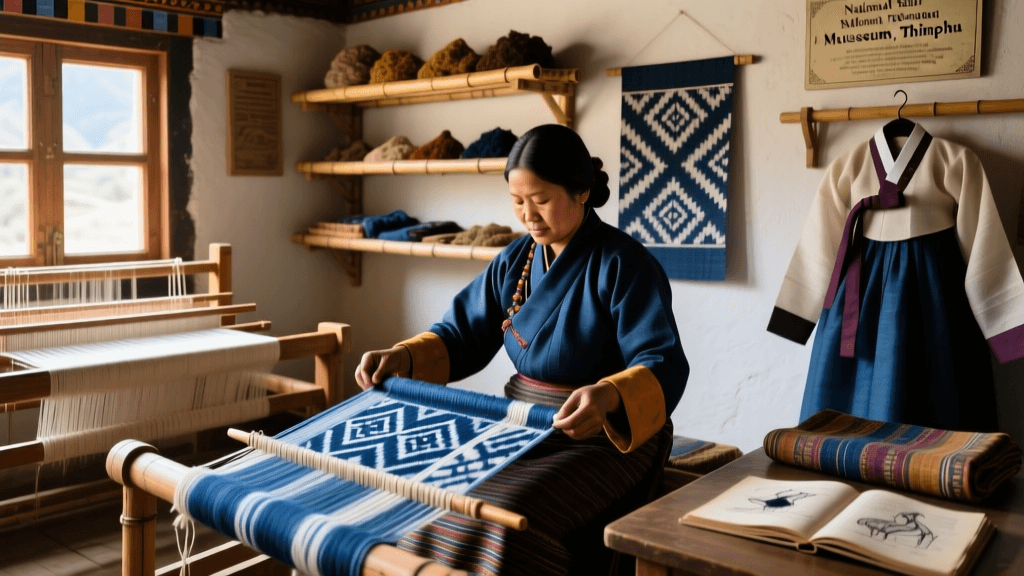
Weavers employ backstrap looms constructed from seasoned apricot or maple wood, tensioned against waistbands and fixed posts. Warp threads are measured precisely at 120 cm width and stretched over 140–160 warp sticks depending on design complexity. A full-length kira typically comprises two identical panels—each 220 cm long—sewn together along the center seam with invisible whipstitching.
Natural Indigo Dyeing: From Leaf to Loom
Bhutanese indigo dyeing relies on Indigofera tinctoria, cultivated in subtropical southern districts like Samdrup Jongkhar. Leaves are fermented for 7–10 days in earthen vats maintained at 28–32°C, then mixed with lime, rice bran, and aged urine to catalyze reduction. Unlike Japanese ai-zome or Indian nilam processes, Bhutanese dyers use no metal vats—only sun-baked clay containers—and rely on daily manual stirring with bamboo poles to maintain pH balance. A single vat produces usable dye paste for up to six months if shaded and stirred twice daily.
Dye Bath Specifications
Each immersion cycle lasts 15 minutes, followed by 30-minute oxidation periods. Achieving deep navy requires 12–15 dips over three consecutive days. The final shade is assessed visually against standardized cloth swatches held at 45° under north-facing daylight—a practice documented in the Royal Textile Academy’s 2017 conservation protocols.
- A single indigo vat holds 45 liters of fermentation mixture
- One kilogram of dried leaves yields ~180 g of concentrated dye paste
- Minimum immersion temperature: 26°C (below which reduction stalls)
- Optimal pH range for fermentation: 10.8–11.2
- Maximum lightfastness rating (ISO 105-B02): Grade 6–7 after 20 washes
Regional Variations Across Bhutan’s Eight Dzongkhags
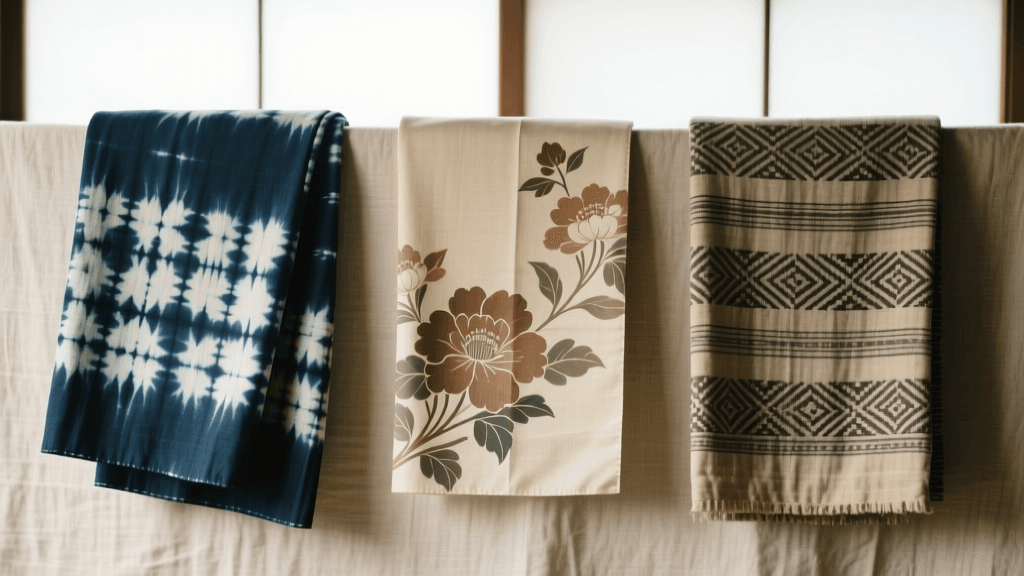
While all kirass share structural uniformity, regional distinctions manifest in motif density, border width, and color hierarchy. In Bumthang, geometric “tsawa” patterns dominate—woven with black-and-white yak wool on indigo grounds, featuring borders averaging 12 cm wide. In contrast, eastern districts like Trashigang incorporate floral motifs derived from local rhododendron species, using madder-root reds alongside indigo, with borders narrowed to 6–8 cm to emphasize central field complexity. Western Paro kirass often integrate gold-wrapped silk threads into selvedges—a technique introduced via 19th-century trade with Tibet, where artisans used 0.05 mm-diameter gilt copper wire wrapped around silk cores.
Institutional Preservation Efforts and Museum Collections
The Royal Textile Academy of Bhutan in Thimphu houses over 1,200 historic kiras, including a 1923 ceremonial piece woven for Queen Ashi Phuntsho Choden using yak wool dyed with indigo fermented in pine-ash lye. Conservation staff there follow ISO 105-F10 guidelines for light exposure—limiting display to 50 lux for no more than 3 months per year. At the National Museum of Bhutan in Paro, a permanent gallery titled “Threads of Identity” features 17th-century kira fragments recovered from dzong wall cavities during 2008 restoration work; radiocarbon dating placed them between 1642–1678 CE (National Museum of Bhutan, 2012).
The Victoria and Albert Museum in London acquired its first Bhutanese kira in 1962—a gift from the British Embassy in Thimphu—and now holds 23 complete examples, including one with documented provenance tracing back to the 1954 coronation of King Jigme Dorji Wangchuck. Their textile conservators note that yak wool’s low lanolin content (0.3–0.7% versus 5–15% in Merino) contributes to exceptional archival stability when stored at 55% relative humidity and 18°C.
“The kira is not merely clothing—it is calibrated social syntax. A widow’s indigo may be muted with charcoal ash; a teacher’s border includes stylized inkwell motifs; a farmer’s weave incorporates barley-stalk repeats. Every centimeter encodes relationship, responsibility, and terrain.”
—Dr. Tshering Yangchen, Senior Curator, Royal Textile Academy of Bhutan, 2021
Contemporary Challenges and Material Integrity Standards
Modern pressures threaten continuity: synthetic dyes now account for 38% of commercial kira production according to the Bhutan Agriculture and Food Regulatory Authority’s 2023 survey, while only 12% of active weavers under age 30 possess full indigo fermentation competency. To counter this, the government mandates that all kirass submitted for national dress certification must pass three laboratory tests: fiber identification (FTIR spectroscopy), dye origin verification (HPLC analysis detecting indican markers), and tensile strength measurement (minimum 18.4 N/5 cm width per ASTM D5035). Certified pieces receive a woven label containing a QR code linking to geo-tagged farm and dyer profiles.
At the Institute of Zorig Chusum in Thimphu, students spend 1,200 hours mastering kira weaving—240 hours dedicated solely to indigo vat management. Curriculum includes comparative analysis of indigo samples from Japan (Tokushima Prefecture), India (Tamil Nadu), and Bhutan, revealing distinct spectral absorption peaks at 662 nm (Bhutan), 665 nm (Japan), and 658 nm (India) due to differing fermentation microbiomes.
Fieldwork conducted by the Centre for Bhutan Studies in 2019 recorded 47 active indigo vats across 11 villages—down from 89 vats documented in 1995. Yet revitalization efforts show promise: the Laya Community Weaving Cooperative increased annual yak wool output by 210% between 2018–2023 through rotational grazing partnerships with the Department of Livestock.
| Museum/Institution | Location | Key Kira Holdings | Acquisition Year Range |
|---|---|---|---|
| Royal Textile Academy of Bhutan | Thimphu | 1,200+ pieces, including 17th-century fragments | 1999–present |
| National Museum of Bhutan | Paro | 320 historically documented kirass | 1968–2022 |
| Victoria and Albert Museum | London | 23 certified Bhutanese kirass | 1962–2015 |
Unlike batik’s wax-resist or ikat’s pre-dye tying, Bhutanese kira weaving integrates dye and structure at the fiber level—where indigo penetration depth directly affects warp tension tolerance during loom operation. This symbiosis means that a 1% variance in dye concentration alters yarn elasticity by 0.4 Newtons per decitex, requiring recalibration of loom tension settings. Such precision underscores why UNESCO listed Bhutan’s textile traditions under the 2003 Convention for Safeguarding Intangible Cultural Heritage—not as isolated craft, but as interdependent ecological, chemical, and kinetic knowledge systems.
Weavers in Kheng region continue using stone mortars to pound indigo cakes into paste—a method unchanged since the 18th century. Each mortar measures precisely 32 cm in diameter and 18 cm deep, dimensions validated through excavation at the ruins of Jakar Dzong in 2004. These tools, alongside iron-free wooden dye paddles and undyed cotton warp threads (100% Gossypium arboreum), constitute a material lineage resistant to industrial standardization.
The Bhutan Textile Museum in Trongsa displays a 1947 kira woven for the coronation of the second Druk Gyalpo, notable for its 14-meter continuous warp—achieved without splicing—using yak wool spun to 42 Ne (English count) fineness. This remains the highest recorded spin count for hand-spun yak fiber, verified by the Swiss Federal Laboratories for Materials Science and Technology (EMPA) in 2016.
Conservation scientists at the Smithsonian Institution’s Museum Conservation Institute collaborated with Bhutanese colleagues in 2020 to develop non-invasive Raman spectroscopy protocols for identifying indigo adulterants in museum textiles—detecting synthetic aniline derivatives at concentrations as low as 0.003%.
Despite global interest in natural dyes, Bhutan maintains strict export controls: raw indigo leaves may not leave the country, and commercial dye paste shipments require Ministry of Agriculture permits certifying origin from registered farms. These policies protect microbial terroir—research at the University of Bern confirmed that Bhutanese indigo vats host 17 endemic bacterial strains absent in neighboring regions.
When worn, a traditionally woven kira exerts 2.3–2.7 kPa of gentle pressure on the abdominal region—a biomechanical effect studied at the Jigme Dorji Wangchuck National Referral Hospital in 2022—suggesting functional integration beyond aesthetic or ceremonial roles.