Bavarian vs Tyrolean Tracht 2026: Dirndl Sourcing Guide
The Living Heritage of Alpine Tracht in 2026
When discussing European folk dress, few garments command as much global recognition—and misunderstanding—as the Alpine dirndl and lederhosen. In 2026, the global slow fashion movement has triggered a massive resurgence in authentic, historically accurate traditional garments. However, a critical distinction must be made between Kostüm (commercial, mass-produced costumes sold for tourist festivals) and Tracht (living, regionally specific traditional dress governed by centuries of cultural evolution). For serious collectors, cultural enthusiasts, and those participating in authentic Alpine festivals, understanding the nuanced differences between Bavarian and Tyrolean Tracht is essential.
The Alpine region is not a monolith. The valleys of Bavaria in southern Germany and the Tyrol region of Austria share geographical proximity but possess distinctly different textile histories, color palettes, and tailoring rules. According to the Bayerischer Trachtenverband (Bavarian Tracht Association), the preservation of regional styles requires strict adherence to historical patterns, natural fibers, and local silversmithing traditions. This comprehensive guide will break down the anatomical, regional, and material differences between Bavarian and Tyrolean dirndls, providing you with an actionable sourcing and pricing guide for the 2026 market.
Anatomy of the Authentic Dirndl
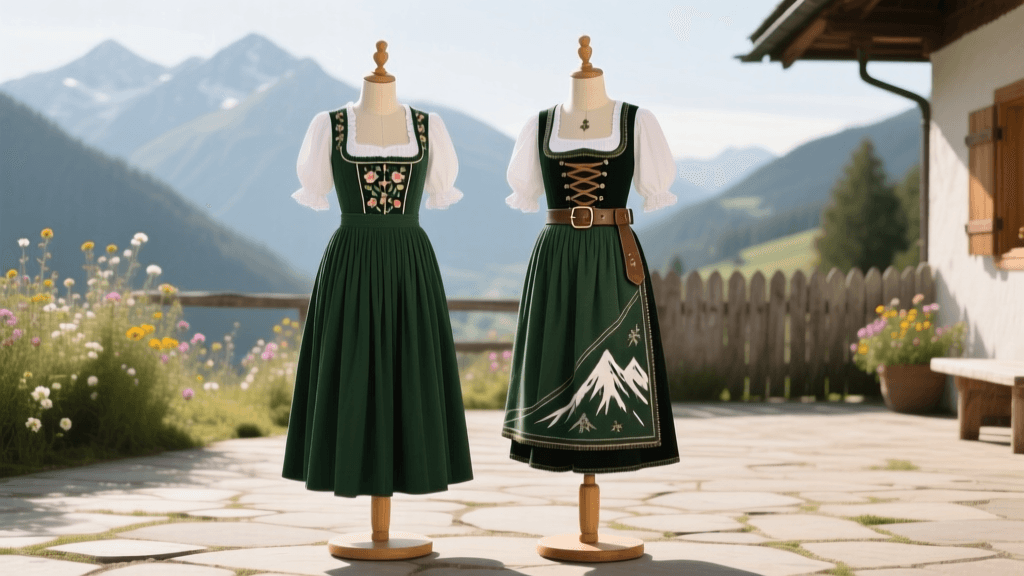
Before diving into regional variations, it is crucial to understand the four mandatory components of a traditional dirndl. A true Tracht dirndl is never a single-piece dress; it is a modular ensemble consisting of:
- Mieder (Bodice): The structured, often heavily decorated corset-like top that provides the garment's silhouette. It is typically boned and lined with sturdy cotton or linen.
- Rock (Skirt): A separate, heavily pleated skirt attached to a waistband. The length and pleat style are strictly dictated by regional village codes.
- Schürze (Apron): A decorative and protective overlay, traditionally made of silk, linen, or fine cotton, featuring specific regional weaving or printing techniques.
- Bluse (Blouse): Worn beneath the Mieder, traditionally featuring a square, round, or heart-shaped neckline, with sleeves ranging from short puffs to long, fitted cuffs for winter.
Bavarian Tracht: Miesbacher and Werdenfelser Styles
Bavarian Tracht is incredibly diverse, but the two most prominent and historically codified styles are the Miesbacher and Werdenfelser Tracht. The Miesbacher Tracht, originating from the Miesbach district, is considered the 'royal' standard of Bavarian dress. It is characterized by its use of luxurious Seidenbrokat (silk brocade) for the Mieder and Rock. The color palette often features deep, rich tones like bordeaux, dark green, and navy blue, contrasted with vibrant, hand-embroidered floral motifs—most notably the stylized Miesbacher rose.
In contrast, the Werdenfelser Tracht from the Garmisch-Partenkirchen region is notably more subdued and practical, reflecting its origins in a harsher, more mountainous climate. The Werdenfelser Mieder is typically made from heavy, dark Wolltuch (wool cloth) rather than silk, and the embroidery relies heavily on intricate silver thread work rather than colorful floral silks. According to historical archives at the Münchner Stadtmuseum, the Werdenfelser style was heavily influenced by the region's historical timber and trade routes, which favored durable, weather-resistant textiles over delicate silks.
The Bavarian Silhouette and Jewelry
The Bavarian dirndl skirt traditionally falls to a length described as 'a handbreadth above the ankle,' though modern formal variations may touch the floor. The apron is typically tied on the left side for unmarried women and the right for married women, though in strict traditional village settings, the knot placement is entirely dependent on local parish rules rather than relationship status. Bavarian jewelry is dominated by the Kropfkette (a multi-row silver or gold chain necklace that fits snugly around the neck) and the Filigrankette, featuring intricate, hollow silver beads crafted by local goldsmiths.
Tyrolean Tracht: Zillertaler and Brixentaler Styles
Crossing the border into the Austrian Tyrol, the textile traditions shift dramatically. The Tyrolean dirndl is generally more vibrant, featuring wider skirts and a distinct approach to headwear and apron weaving. The Zillertaler Tracht is perhaps the most famous Tyrolean style, recognized by its incredibly wide, cartridge-pleated skirts that require up to eight meters of fabric. The Zillertaler Mieder often features a lower, wider neckline compared to the high-necked Bavarian styles, and the silk aprons are frequently hand-blocked with bold, geometric or large-scale floral patterns.
The Brixentaler Tracht offers a striking visual contrast. Originating from the Brixen Valley, this style is heavily defined by its use of black velvet and gold embroidery. The Brixentaler Mieder is often black, adorned with elaborate gold threadwork, and paired with a brightly colored silk skirt and apron. The Tiroler Volkskultur organization notes that the Brixentaler style was historically a display of wealth among valley farmers, as black velvet and gold thread were heavily taxed and difficult to acquire in the 18th and 19th centuries.
The Tyrolean Silhouette and Accessories
Tyrolean skirts are traditionally fuller and shorter than their Bavarian counterparts, often falling to the mid-calf to allow for ease of movement during traditional Tyrolean folk dances like the Schuhplattler. Tyrolean jewelry tends to favor coral beads, garnet chains (Granatketten), and large, ornate silver brooches pinned to the Mieder. Headwear is also a major differentiator; while Bavarian women might wear a simple silk ribbon or a specific regional hat like the Miesbacher Hut, Tyrolean women frequently wear the Zillertaler Hut, a broad-brimmed felt hat adorned with a distinctive cord and feather or floral cluster.
2026 Sourcing Guide: Authentic Makers and Pricing
Sourcing an authentic Tracht dirndl in 2026 requires patience and a significant financial investment. The post-pandemic supply chain shifts have impacted the availability of high-quality European silk brocades and naturally dyed wools, driving up the cost of raw materials. Furthermore, true Trachtenschneidereien (traditional tailors) operate on a bespoke model. As of early 2026, the waitlist for a fully custom, hand-embroidered Mieder from a master tailor in Munich or Innsbruck averages between 7 to 11 months.
Below is a detailed comparison table outlining the material specifications, regional distinctions, and current 2026 market pricing for authentic, bespoke Alpine Tracht.
| Feature | Bavarian (Miesbacher) | Tyrolean (Zillertaler) | 2026 Average Custom Cost (EUR) |
|---|---|---|---|
| Mieder Material | Silk Brocade, Velvet | Heavy Silk, Fine Wool | €800 - €1,800 |
| Skirt (Rock) Fabric | Wool-blend, Silk | Cotton, Lightweight Wool | €400 - €900 |
| Apron (Schürze) | Hand-woven Linen, Silk | Hand-blocked Silk, Damask | €250 - €500 |
| Embroidery Style | Stylized Roses, Silver Thread | Geometric Blocks, Bold Florals | €300 - €700 (add-on) |
| Total Ensemble Cost | Includes Blouse, Mieder, Skirt, Apron | €2,200 - €4,500+ | |
Practical Advice for Assembling Your First Authentic Tracht
If you are commissioning or purchasing your first authentic dirndl in 2026, you must approach the process with an understanding of traditional tailoring metrics. Modern fashion sizing does not apply to Tracht. The Mieder is designed to act as a supportive undergarment and outerwear hybrid. When taking measurements for a bespoke Mieder, the tailor will require your exact underbust, overbust, waist, and torso length. A properly fitted Mieder should provide gentle compression and support without the need for a modern brassiere; historically, the structured boning and heavy linen lining serve this purpose.
Measurements and the 'Rock' Pleating
The skirt (Rock) requires precise waist and hip measurements, but more importantly, it requires a decision on pleat density. Tyrolean cartridge pleating requires the fabric to be tightly gathered and stitched individually to the waistband, creating a bell-like silhouette that stands away from the hips. Bavarian knife pleating lies flatter against the body. Ensure your tailor uses a natural fiber waistband, as synthetic blends will cause discomfort during long festival days. Additionally, the hem of the skirt is traditionally finished with a Besenlitze (a woven cotton braid) on the inside, which protects the delicate wool or silk from fraying against footwear and cobblestone streets.
Footwear: Completing the Regional Look
No authentic Tracht is complete without the correct regional footwear. In 2026, mass-produced costume shoes with plastic buckles are easily spotted and frowned upon in serious Tracht circles. For Bavarian styles, women traditionally wear Spangenschuhe—low-heeled leather shoes with a single strap across the instep, often featuring a decorative silver or horn buckle. For Tyrolean styles, especially in rural or mountainous festival settings, women may wear customized, low-profile Haferlschuhe (traditional alpine shoes with side lacing) or sturdy leather ankle boots. Expect to pay between €180 and €350 for a pair of custom-lasted leather Tracht shoes from a traditional cobbler in Garmisch or Kufstein.
The Apron Knot: Debunking the Modern Myth
It is vital to address a pervasive modern myth regarding the dirndl apron knot. A widespread internet rumor claims that tying the apron knot on the left indicates the wearer is single, on the right means married, in the center means a virgin, and in the back means widowed. This is entirely a modern, commercial invention created by the hospitality industry in the late 20th century to sell more costumes to tourists. In authentic, historically codified Tracht, the apron is tied according to the specific rules of the wearer's home village or regional association. In many strict Bavarian and Tyrolean associations, the knot is always tied on the left side, or always hidden in the back, regardless of the wearer's marital status. When assembling your Tracht in 2026, consult your local Trachtenverein (Tracht association) for the correct regional protocol rather than relying on commercial costume myths.
Preserving the Craft: Why Authentic Sourcing Matters
Investing in authentic Bavarian or Tyrolean Tracht is not merely about acquiring a beautiful garment; it is an act of cultural preservation. The master tailors, silk weavers, and silversmiths who keep these traditions alive rely on the patronage of those who value heritage over fast fashion. By understanding the deep regional differences between the silk brocades of Miesbach and the vibrant cartridge pleats of the Zillertal, you ensure that the rich, complex tapestry of European folk dress continues to thrive in the modern era. Whether you are attending the Leonhardifahrt in Bad Tölz or a traditional Schützenfest in the Tyrolean Alps, wearing a historically accurate, regionally specific Tracht connects you directly to centuries of Alpine history.