Authentic Bavarian Schuhplattler Trachten for 2026 Festivals
The Cultural Resurgence of the Schuhplattler in 2026
As the 2026 European folk festival season approaches, from the springtime Maibaumaufstellen (maypole raising) to the massive summer Gau-Trachtenfeste, the demand for authentic regional garments has reached a decade high. Among the most visually and acoustically striking traditions is the Bavarian Schuhplattler, a folk dance rooted in the Alpine regions of Upper Bavaria, Tyrol, and Salzburg. Unlike the generalized, often commercialized 'Oktoberfest' costumes sold to tourists, the garments worn by active dance clubs—known as Vereinstracht—are bound by strict historical guidelines, regional variations, and functional requirements designed specifically for the choreography of the dance.
The Bayerischer Trachtenverband (Bavarian Tracht Association) continues to lead the 2026 initiative in preserving these sartorial standards, emphasizing that true folk dress is a living, breathing archive of Alpine history. For dancers and cultural enthusiasts attending this year's festivals, understanding the anatomy, sourcing, and mechanics of the Schuhplattler costume is essential. This guide breaks down the exact specifications of the 2026 Vereinstracht, exploring how traditional tailoring meets the rigorous physical demands of Alpine folk dance.
Anatomy of the Male Vereinstracht: Engineered for the Platteln
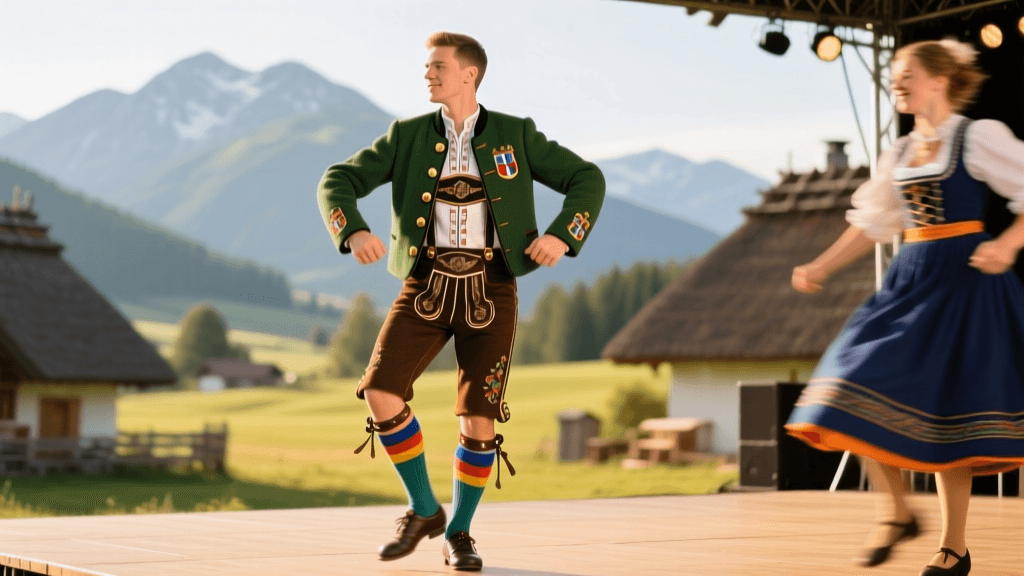
The male Schuhplattler costume is a masterclass in functional folk design. Every element serves either a historical purpose or a direct role in the dance's percussive choreography, which involves the rhythmic slapping of the thighs, knees, and soles of the shoes.
The Kurze Lederhose and Hosenträger
The cornerstone of the male dancer's outfit is the Kurze Lederhose (short leather breeches). While longer Bundhosen are worn for general festival attendance, the Schuhplattler requires the short cut to expose the lower thigh and knee. This exposure is mandatory, as the dancer must strike his bare skin to produce the sharp, cracking sound that defines the Platteln. In 2026, master saddlers and leatherworkers are seeing a massive surge in demand for traditionally brain-tanned Hirschleder (deer leather), prized for its breathability, durability, and soft patina that develops over years of rigorous dancing. The breeches are held up by highly ornate Hosenträger (suspenders), featuring a crosspiece at the chest that is heavily embroidered with regional motifs, such as the Edelweiss, alpine roses, or the specific crest of the dancer's home valley.
The Karo-Hemd and Seidentuch
Beneath the suspenders, dancers wear a Karo-Hemd, a checked linen or cotton shirt, typically in red-white or blue-white. The collar is left unbuttoned to accommodate the Seidentuch (silk scarf). The silk scarf is not merely decorative; it is tied using specific regional knots, such as the Schlappen or the Kreuzknoten. In 2026, hand-rolled silk scarves from specialized Alpine weavers are highly sought after, with vibrant ruby reds and deep forest greens dominating the festival circuit.
Footwear: Haferlschuhe and Loferl
The dance gets its name from the Haferlschuhe (oat-cup shoes), sturdy Alpine footwear characterized by a thick, nailed leather sole and a distinctive side-lacing system. The side lacing prevents the laces from coming undone during the aggressive stomping and leaping of the dance. Over the calves, dancers wear Loferl (calf warmers or calf sleeves), which are essentially knee-high socks with the foot portion cut out. These are usually hand-knitted from coarse grey or green wool, featuring subtle ribbed patterns that stay in place during high kicks.
The Female Miederdirndl: Dynamics of the Drehen
The female counterpart to the Schuhplattler is equally specialized. While the male dance focuses on percussive strikes, the female role centers on the Drehen (spinning) and the elegant, sweeping movements that create a mesmerizing visual contrast to the men's aggressive stomping.
Skirt Engineering and Fabric Choices
The Dirndlgwand worn for folk dance is fundamentally different from the fashion-dirndls sold in modern boutiques. A true dance skirt must be cut from a full circle or heavily gathered rectangle, requiring anywhere from four to six meters of fabric to ensure maximum volume when spinning. In 2026, there is a strong movement away from synthetic poly-blends back toward natural fibers. Heavy cotton damask, raw silk, and fine merino wool blends are the standard, weighted at the hem to ensure the skirt flares perfectly parallel to the ground during rapid pirouettes. The Deutsches Alpenverein Alpine Museum frequently highlights these historical weaving techniques in their textile archives, noting that the weight and drape of the fabric are just as critical as the color.
The Mieder (Bodice) and Schürze (Apron)
The bodice, or Mieder, is structured with internal boning to provide back support during hours of dancing. It is laced at the front using a silver or brass chain (Miederschnur) threaded through ornate hooks (Miederhaken). Over the skirt sits the Schürze (apron). In the context of the Vereinstracht, the apron is often made of fine, semi-sheer linen or silk, featuring intricate hand-embroidered borders. While the popular 'apron bow code' (indicating relationship status) is widely known among tourists, strict traditional dance clubs often dictate that the bow be tied in a specific, uniform manner on the left or right side to maintain visual symmetry across the dance troupe.
2026 Sourcing Guide: Mass-Market vs. Authentic Tailoring
For those looking to invest in a genuine Schuhplattler costume for the 2026 festival season, understanding the pricing and quality tiers is crucial. The market is currently split between mass-produced imports and master-crafted local garments. Below is a comparative breakdown of what to expect when sourcing a complete male and female Vereinstracht in 2026.
| Garment Component | Mass-Market / Department Store (2026) | Master Tailor / Regional Artisan (2026) |
|---|---|---|
| Lederhose (Kurze) | €120 - €180 (Split cowhide, glued seams) | €650 - €1,200 (Brain-tanned Hirschleder, hand-stitched) |
| Haferlschuhe | €80 - €110 (Rubber soles, synthetic uppers) | €250 - €400 (Nailed leather soles, custom-lasted) |
| Dirndl Skirt & Mieder | €150 - €250 (Poly-blend, minimal gathering) | €800 - €1,500 (Natural fibers, 5m+ circumference, boned) |
| Embroidered Hosenträger | €40 - €60 (Machine-embroidered felt) | €180 - €350 (Hand-embroidered velvet/leather, silver clasps) |
| Total Estimated Cost | €390 - €600 | €1,880 - €3,450 |
While the initial investment for a master-tailored outfit is significant, these garments are designed to last a lifetime and are often passed down through generations. Furthermore, active members of recognized Trachtenvereine (folk clubs) often receive subsidies or group-discounts from regional artisans, a practice strongly encouraged by cultural heritage organizations to keep the tradition accessible to local youth.
Dance Mechanics: How the Garment Interacts with Choreography
To truly appreciate the Schuhplattler costume, one must observe it in motion. The German Commission for UNESCO recognizes the deep connection between Alpine folk practices and their material culture, noting that the clothing and the dance are inextricably linked. When the male dancer executes a Weitsprung (leap), the heavy deer leather of the Kurze Lederhose prevents chafing, while the exposed thigh allows for the rapid, stinging slaps that echo across the festival grounds. The nailed soles of the Haferlschuhe act as percussion instruments against the wooden stages of the Bavarian beer tents and alpine meadows.
Simultaneously, the female dancer's heavy, weighted skirt acts as a centrifugal force. As she is spun by her partner, the sheer volume of the natural fabric creates a perfect, bell-shaped canopy. The rustling sound of the heavy cotton or silk skirt, combined with the rhythmic clapping and stomping, creates a multi-sensory experience that defines the Alpine folk festival atmosphere. The structured Mieder ensures that the dancer maintains perfect posture, allowing for seamless transitions between the rapid spins and the elegant, grounded walking steps that frame the performance.
Festival Etiquette and Preservation in 2026
As you attend the 2026 Gau-Trachtenfeste or local Maibaum celebrations, it is important to respect the distinction between 'Mode-Tracht' (fashion tracht) and 'Vereinstracht' (club tracht). Dancers in full Vereinstracht are often participating in highly structured, judged competitions or formal parade marches. When photographing these troupes, always ask for permission, and avoid treating their meticulously crafted garments as mere party costumes. The revival of natural dyes, hand-loomed linens, and traditional leatherworking in 2026 is a testament to the dedication of thousands of Alpine artisans who refuse to let their heritage become a caricature. By understanding the profound functionality and history woven into every stitch of the Schuhplattler costume, festival-goers can engage with European folk dress not just as spectators, but as informed custodians of a vibrant, living tradition.