Schuhplattler Dance Costumes: 2026 Bavarian Festival Guide
The Rhythmic Heart of Bavaria: Understanding Schuhplattler
When preparing for the 2026 European folk festival season, few traditions are as visually striking and acoustically captivating as the Bavarian Schuhplattler. Originating in the alpine regions of Bavaria, Austria, and Tyrol, this traditional folk dance is characterized by its vigorous stomping, clapping, and the rhythmic slapping of the dancer's hands against their thighs, knees, and footwear. Unlike many folk dances where the costume is merely decorative, the Tracht (traditional dress) worn in Schuhplattler is an active, percussive instrument. The garments are engineered to produce specific sounds, facilitate extreme ranges of motion, and withstand the physical toll of the dance.
As we navigate the 2026 festival calendar—from the local Maibaumaufstellen (Maypole celebrations) in spring to the massive Gaufest gatherings and Oktoberfest in autumn—understanding the precise construction of dance-specific Tracht is essential. Whether you are a seasoned member of a Trachtenverein (traditional costume association) or a cultural enthusiast attending your first alpine festival, this guide breaks down the anatomy, sourcing, and material science of authentic Schuhplattler costumes.
Men’s Dance Tracht: Engineered for the Slap and Stomp
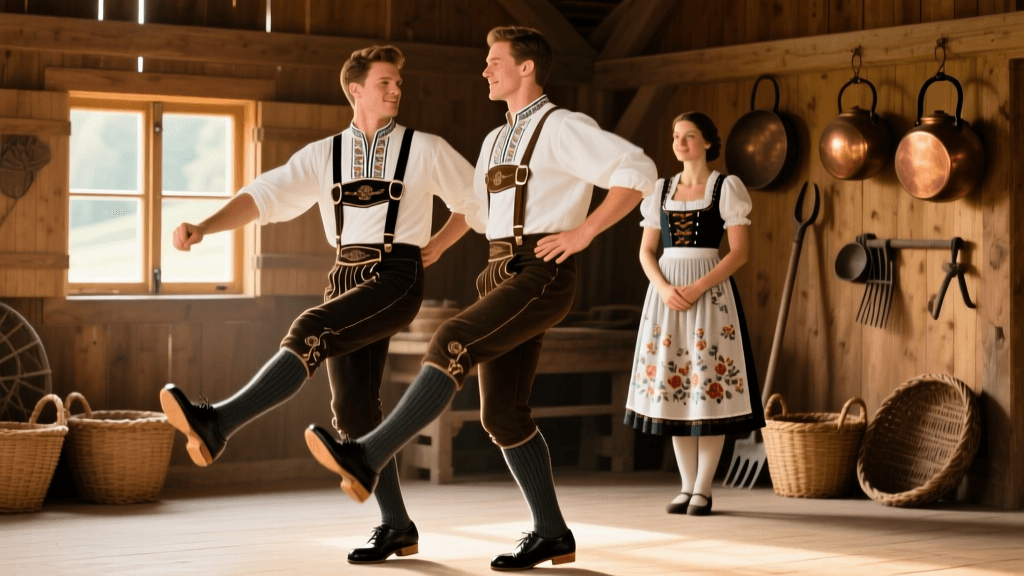
The male Schuhplattler costume is a masterclass in functional alpine workwear adapted for performance. Every element, from the tanning of the leather to the stitching on the suspenders, plays a role in the dance's acoustic profile.
Lederhosen and the Art of Sämischgerbung
For dance, the kurze Lederhosen (short leather breeches) are mandatory. While long trousers are acceptable for certain winter church processions, the Schuhplattler requires the exposed knee and thigh to achieve the signature crisp slapping sound. In 2026, serious dancers continue to reject mass-produced, chrome-tanned leather. Authentic dance Lederhosen are crafted from Hirschleder (deer leather) or Rehleder (roe deer leather) using the traditional Sämischgerbung (smoke and brain tanning) process.
This ancient tanning method yields a leather that is exceptionally soft, breathable, and, most importantly, resonant. When struck by the palm, Sämisch-tanned leather produces a deep, echoing 'crack' that chrome-tanned synthetics simply cannot replicate. The cut must be snug to the thigh to prevent the fabric from absorbing the impact of the slap, yet articulated enough at the hip to allow for the deep squats and high leaps inherent to the choreography.
Loferl: The Calf Warmers
Worn with short Lederhosen are the Loferl, a two-piece sock system consisting of a calf-warmer (a knitted tube) and a separate ankle sock. Typically knitted from heavy, naturally dyed sheep's wool in grey, green, or navy, the Loferl provides a slightly textured surface for the hands to strike during lower-leg slaps. In 2026, hand-knitted Loferl featuring regional cable patterns remain a mark of high status within dance troupes.
Haferlschuhe: The Percussive Footwear
The Haferlschuh is the quintessential Bavarian alpine shoe, featuring a distinctive boat-like toe box and side lacing. For the Schuhplattler, the shoe is the primary percussion instrument for the floor. Authentic dance Haferlschuhe are constructed with a double-leather sole and hobnails or specialized metal taps on the heel and toe. This allows the dancer to generate a sharp, staccato rhythm against the wooden floors of festival tents and alpine halls. Leading alpine shoemakers in 2026, such as those based in Miesbach and Garmisch, continue to hand-welt these shoes to ensure they withstand thousands of high-impact stomps.
Women’s Dance Tracht: The Art of the Drehen (Spin)
While the men provide the percussive rhythm, the women provide the visual melody and the grounding partner-work of the Schuhplattler. The women's dance Tracht is designed to accentuate the Drehen (the spin), requiring precise tailoring and heavy, natural fabrics.
The Glockenrock and Midi Lengths
The centerpiece of the female dancer's outfit is the Dirndlrock (skirt). For dance, the skirt must be cut as a full circle or heavily gathered Glockenrock (bell skirt). When the dancer spins, centrifugal force causes the heavy fabric to flare out perfectly horizontally. In 2026, traditional dance associations strictly enforce midi-lengths (falling just below the knee to mid-calf). This length is historically accurate and practical; it prevents the fabric from tangling during complex partner turns while providing enough weight to create a dramatic visual bell shape.
The fabric of choice is a dense wool-linen blend or heavy cotton poplin. Lightweight synthetics are entirely avoided, as they lack the structural weight required to flare properly and tend to cling to the legs due to static electricity generated during the dance.
Mieder and Bluse
The Mieder (bodice) is heavily boned and structured, providing back support during the rigorous spinning and partnering lifts. It is typically fastened with a silver chain or silk cord. Beneath it, a white linen Bluse (blouse) with a modest neckline and short puff sleeves allows for unrestricted arm movement, which is vital when the female dancer is twirling her partner or executing solo arm flourishes.
Tracht Tanzschuhe
Female dancers wear specialized Tanzschuhe (dance shoes) that resemble traditional Tracht shoes but feature a flexible suede sole. The suede allows for the necessary pivot and slide on wooden floors without gripping too aggressively, which could lead to knee injuries during rapid, multi-revolution spins. Low, blocky heels (no higher than 3 cm) are standard to maintain balance during the stomping sequences.
2026 Sourcing Guide: Cost and Authenticity Matrix
Investing in authentic, dance-ready Tracht is a significant financial commitment, but it is necessary for both performance quality and respect for the tradition. Below is a 2026 market matrix for sourcing high-quality components.
| Garment Component | Material Requirement | 2026 Avg. Cost (EUR) | Dance Function |
|---|---|---|---|
| Kurze Lederhosen | Sämisch-tanned Deer Leather | €850 - €1,400 | Acoustic resonance for thigh slaps |
| Haferlschuhe (Men) | Full-grain leather, double welted sole | €250 - €400 | Floor percussion and ankle support |
| Glockenrock (Skirt) | Heavy Wool-Linen Blend (3m+ hem) | €180 - €300 | Centrifugal flaring during Drehen |
| Tanzschuhe (Women) | Leather upper, flexible suede sole | €120 - €220 | Low-friction pivoting for spins |
| Loferl (Socks) | 100% Virgin Wool, hand-knitted | €60 - €95 | Textured surface for calf slaps |
Material Science: Why Synthetics Fail in Folk Dance
The intersection of textile science and folk tradition is most evident in the rejection of modern synthetic materials in competitive Schuhplattler. According to archival research and ongoing exhibitions at the Bavarian National Museum, historical Tracht was born from the immediate environment—flax, wool, deer, and sheep. Modern polyester blends, often sold as 'costume Tracht' in fast-fashion outlets, fail on three critical fronts in a dance context:
- Acoustic Dampening: Synthetic fibers absorb kinetic energy. A hand striking a polyester-blend thigh will produce a dull thud rather than the sharp, carrying crack required to be heard over a live brass band.
- Moisture Management: Schuhplattler is highly aerobic. Natural fibers like linen and brain-tanned leather wick and evaporate sweat efficiently. Synthetics trap moisture, leading to rapid overheating and skin chafing during multi-hour festival performances.
- Kinetic Drape: The physics of the spinning skirt rely on the specific gravity and drape of natural wool. Polyester lacks the necessary mass, resulting in a skirt that flutters erratically rather than forming a solid, horizontal bell.
2026 Festival Calendar and Etiquette
Attending a Bavarian folk festival in 2026 requires an understanding of regional etiquette. The Bavarian Tourism Board and local cultural committees emphasize the distinction between Tracht (historically accurate, region-specific dress) and Trachtenmode (modern, commercialized fashion).
For major events like the Bayerisches Landestrachtenfest or local Gaufeste, spectators are encouraged to wear respectful, modest Trachtenmode if they do not own authentic regional Tracht. However, for those taking the stage or participating in the open-air dance circles, strict adherence to the historical guidelines of their specific Gau (region) is enforced. For instance, the color of the men's neckerchief (Halstuch) and the specific embroidery pattern on the Lederhosen suspenders can denote the dancer's exact village of origin.
As highlighted by cultural preservationists on Germany's official international portal, the revival and strict maintenance of these regional dress codes in the 2020s is a conscious effort to preserve local identities in a globalized world. The Schuhplattler is not merely a performance; it is a living, breathing archive of alpine history, written in leather, wool, and rhythm.
Conclusion
Preparing your Schuhplattler costume for the 2026 season is an exercise in respecting the past while engaging in a deeply physical, joyous present. By investing in Sämisch-tanned leathers, properly weighted wool skirts, and hand-welted footwear, dancers ensure that the acoustic and visual legacy of the Bavarian folk dance remains uncorrupted. Whether you are perfecting your solo Platteln routine in a Munich rehearsal hall or joining a communal dance under the alpine pines, the right Tracht transforms the body into an instrument of cultural endurance.