Bavarian Dirndl & Norwegian Bunad: 2026 Region Guide
The Resurgence of Authentic Regional Dress in 2026
As we navigate through 2026, the landscape of European folk dress has experienced a profound renaissance. Discerning collectors, cultural preservationists, and fashion enthusiasts are increasingly rejecting the mass-produced, synthetic 'Trachtenmode' that once dominated festival seasons. Instead, there is a powerful return to historically accurate, regionally specific garments crafted by local artisans. This movement is not merely about aesthetics; it is a conscious effort to support sustainable textile practices, preserve ancestral techniques, and honor the deep cultural narratives woven into every stitch. In this comprehensive guide, we explore two of Europe's most iconic and strictly regulated folk dress traditions: the Bavarian and Austrian Tracht (specifically the Dirndl) and the Norwegian Bunad. By understanding their distinct regional variations, material requirements, and 2026 market dynamics, you can make informed decisions when investing in these wearable pieces of history.
Bavarian and Austrian Tracht: Beyond the Festival Tent
When discussing Alpine folk dress, the Dirndl is undoubtedly the most globally recognized garment. However, authentic Tracht is vastly different from the commercialized costumes sold in tourist shops. True Tracht is deeply tied to specific valleys, towns, and even religious denominations. According to the Bayerisches Nationalmuseum, the historical evolution of the Dirndl transitioned from the practical workwear of Alpine maidservants in the 18th century to the high-fashion 'Alpine chic' adopted by the Austrian aristocracy in the late 19th and early 20th centuries. Today, in 2026, the focus has shifted back to regional authenticity and artisanal craftsmanship.
Anatomy of the Authentic Dirndl
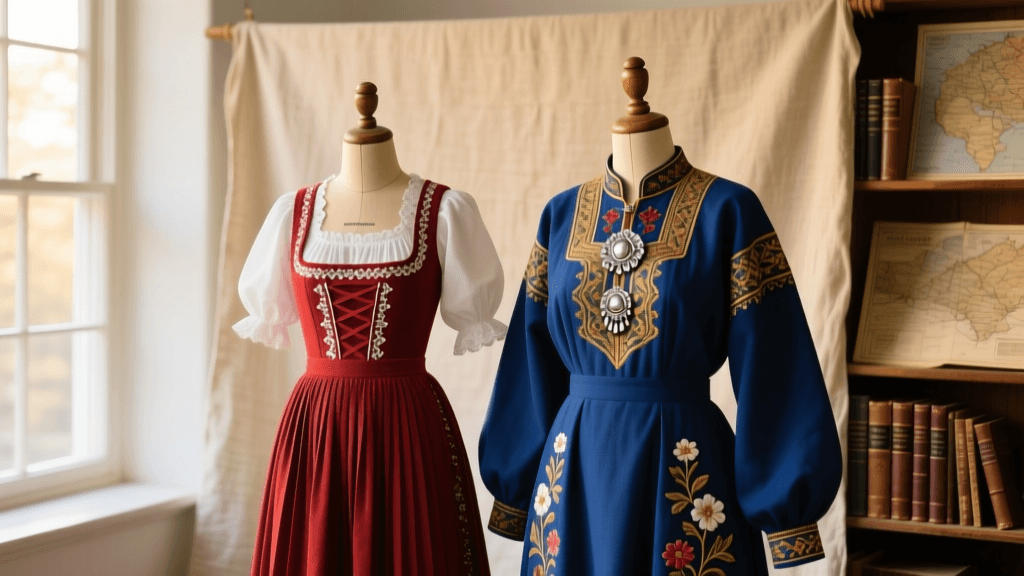
A genuine Dirndl consists of four non-negotiable components, each serving a specific structural and aesthetic purpose:
- Mieder (Bodice): The core of the Dirndl, heavily structured to provide support and silhouette. Authentic bodices are lined with sturdy cotton or linen and feature a front closure using hooks, eyes, or decorative buttons, never a hidden back zipper.
- Rock (Skirt): Traditionally made of high-quality wool, linen, or silk, the skirt is heavily pleated and attached directly to the bodice. The standard length in 2026 for formal regional Tracht falls at the mid-calf (the 'Midi' length), though ankle-length skirts are reserved for specific church occasions.
- Schürze (Apron): Made from silk, fine cotton, or linen, the apron is tied at the front. The placement of the bow historically indicated marital status (left for single, right for married, center for virgins, back for widows), though modern wearers often prioritize aesthetic symmetry.
- Bluse (Blouse): Worn underneath the bodice, the blouse is typically crafted from crisp white cotton, batiste, or linen. In 2026, GOTS-certified organic European linen is the preferred choice among eco-conscious Tracht makers.
Regional Variations: Miesbach vs. Ausseerland
The true beauty of Alpine Tracht lies in its hyper-local variations. The Miesbacher Tracht, originating from Upper Bavaria, is renowned for its dark, rich colors and intricate floral embroidery. A classic Miesbacher Dirndl features a dark blue or black wool skirt, a silk bodice with silver hook closures, and a heavily embroidered silk apron. Conversely, the Ausseerland Dirndl from the Salzkammergut region in Austria is famous for its vibrant, color-blocked design. The traditional Ausseerland combination features a pink (rose) skirt, a green bodice, and a black apron. Sourcing an authentic Ausseerland Dirndl in 2026 requires commissioning a local 'Trachten-schneider' (Tracht tailor), as the specific shade of 'Ausseer Pink' is strictly regulated by local textile guilds.
The Norwegian Bunad: A Woven National Identity
While the Dirndl is a regional dress with flexible stylistic interpretations, the Norwegian Bunad is governed by strict historical parameters. The Bunad is not merely a folk costume; it is a formal garment worn for weddings, confirmations, and National Day (May 17th) celebrations, carrying the same sartorial weight as a tuxedo or an evening gown. The Norwegian Institute of Bunad and Folk Costumes (Bunad- og folkedraktrådet) actively researches, documents, and approves Bunad designs to ensure they remain historically faithful to the specific rural districts they represent.
Strict Regional Rules and Ancestral Ties
Unlike other European folk dresses where one might choose a design based purely on aesthetic preference, Norwegian tradition dictates that you should wear the Bunad from the region where you were born, where your ancestors lived, or where you currently reside. This deep connection to 'bygd' (rural district) makes the Bunad a powerful symbol of personal and familial identity. In 2026, the Institute continues to reconstruct 'lost' Bunads by analyzing 18th and 19th-century garments preserved in local heritage museums, ensuring that newly approved designs are backed by rigorous archaeological textile evidence.
Silver and Embroidery: The Hallmarks of Quality
The value of a Bunad is heavily determined by its hand-embroidery and silver jewelry. The Hardangerbunad, one of the oldest and most popular designs, is characterized by its striking cross-stitch embroidery in red, black, and white, and its elaborate silver belt (beltestøler). The Setesdalsbunad, often referred to as the 'Valdress' style in some older texts but distinct in its own right, features heavy dark wool with intricate white woolen embroidery and an abundance of filigree silver brooches (sølje). The silver used in 2026 Bunads is typically 925 sterling silver, hand-forged by specialized silversmiths in towns like Voss and Bergen. A complete set of Bunad silver can easily weigh over 300 grams and represents a significant financial investment.
Comparative Analysis: Alpine Tracht vs. Nordic Bunad
To understand the distinct characteristics of these regional garments, we have compiled a comparative data table highlighting the core differences in construction, sourcing, and 2026 market pricing.
| Feature | Bavarian Dirndl (Miesbacher) | Norwegian Bunad (Hardanger) | Swiss Appenzeller (Sunday Dress) |
|---|---|---|---|
| Primary Origin | Upper Bavaria, Germany | Hordaland County, Norway | Appenzell Innerrhoden, Switzerland |
| Core Materials (2026) | Merino wool skirt, silk bodice, linen blouse | Heavy black wool, linen underdress | Black silk/wool blend, white cotton lace |
| Key Accessories | Silk apron, Miesbacher hat (Scheibling) | Silver belt, filigree brooches, crown (for brides) | Silver filigree cap (Flügelhaube), embroidered bodice |
| Design Flexibility | High (colors and fabrics adapt to modern trends) | Very Low (strictly regulated by the Bunad Council) | Low (traditional color blocking must be maintained) |
| 2026 Avg. Authentic Cost | €1,500 - €2,800 (excluding jewelry) | €3,500 - €5,500 (including basic silver) | CHF 4,000 - CHF 7,000 (including cap and jewelry) |
| Maintenance | Dry clean wool; hand wash linen blouse | Professional spot cleaning; silver polishing required | Specialist textile conservation cleaning recommended |
2026 Buyer’s Guide: Sourcing and Fitting Your Folk Dress
Investing in authentic European folk dress requires careful planning, precise measurements, and a willingness to engage with specialized artisans. The era of ordering a 'one-size-fits-all' Dirndl online is over for those seeking genuine Tracht.
Taking Measurements for a Custom Dirndl
If you are commissioning a Dirndl from a Bavarian or Austrian tailor in 2026, accurate measurements are critical. The bodice (Mieder) must fit like a second skin to provide the correct posture and support. You will need to provide:
- Underbust Circumference: Measured snugly directly beneath the bust line. This determines the band size and structural foundation of the Mieder.
- Natural Waist: Measured at the narrowest part of the torso, usually just above the navel. The Dirndl skirt sits precisely at this natural waistline, not on the hips.
- Bust Circumference: Measured across the fullest part of the bust while wearing the specific blouse you intend to use, as different sleeve styles alter the bust drape.
- Back Length: Measured from the prominent bone at the base of the neck (C7 vertebra) down to the natural waist. This ensures the bodice does not gap at the back.
Investing in Bunad Silver and Textiles
Purchasing a Norwegian Bunad is a multi-step process that often takes six to twelve months. According to insights from the Tyrolean Folk Art Museum and broader Nordic heritage networks, the preservation of traditional silversmithing is vital to the Bunad ecosystem. When buying Bunad silver, always look for the maker's mark and the 925 sterling stamp. Avoid 'Bunad-style' silver plated in base metals, as these will tarnish irreparably and hold no heirloom value. For the textile components, ensure that the wool is sourced from heritage Nordic sheep breeds, such as the Spælsau, which provides the unique, slightly coarse, and highly durable yarn required for authentic Bunad embroidery and skirt weaving.
Preserving Textile Heritage for the Future
The year 2026 marks a pivotal moment for European folk dress. As global supply chains face scrutiny and the environmental impact of fast fashion becomes undeniable, the slow, deliberate, and localized production of garments like the Dirndl and the Bunad offers a sustainable alternative. These garments are designed to be altered, repaired, and passed down through generations. By choosing to invest in regionally accurate, artisan-crafted folk dress, you are not merely buying a beautiful outfit; you are actively participating in the preservation of European cultural heritage, supporting local rural economies, and ensuring that these magnificent textile traditions endure for centuries to come.