Burgundian Houppelande Recreation Guide: 2026 Fabrics & Patterns
The Resurgence of the Burgundian Houppelande in 2026
As we navigate the historical costuming and European folk dress landscape in 2026, the demand for museum-quality accuracy has never been higher. Among the most iconic and structurally fascinating garments of the late medieval and early Renaissance period is the Burgundian houppelande. Emerging in the late 14th century and dominating 15th-century court fashion, this voluminous, belted gown with its towering collar and dramatic sleeves remains a pinnacle of European textile heritage. Today, major heritage festivals and historical reenactment societies have updated their 2026 authenticity guidelines, requiring makers to move beyond basic costume patterns and embrace historically informed construction methods, natural fibers, and period-accurate tailoring geometry.
Understanding the Silhouette and Historical Context
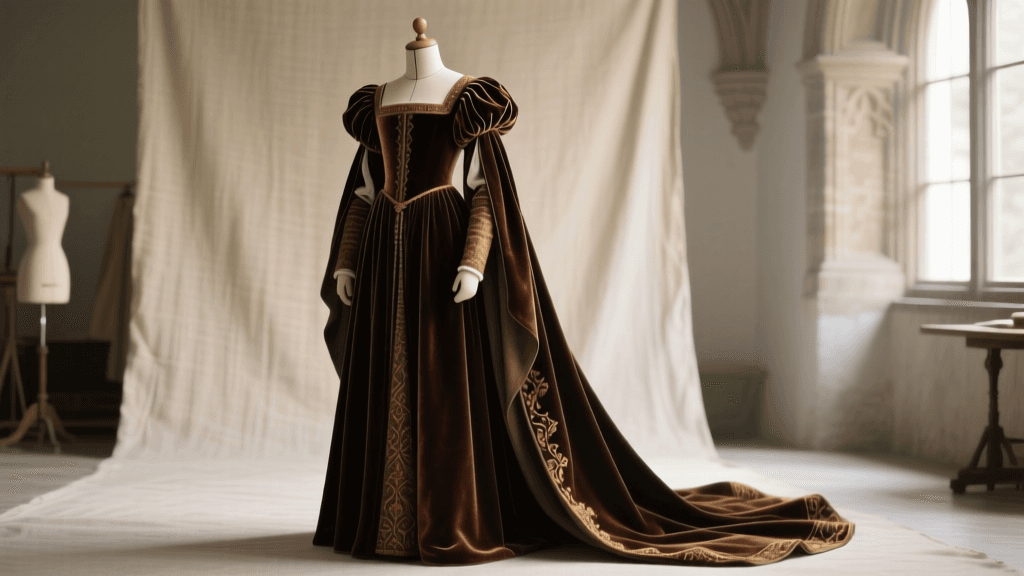
The houppelande was the ultimate status symbol in the Burgundian court, characterized by its immense fabric consumption, which was a direct display of wealth. According to the Victoria and Albert Museum's medieval collections, the structural integrity and heavy drape of these garments were essential to achieving the correct silhouette. Unlike modern clothing, which is tailored to fit the body's contours, the houppelande relies on gravity, heavy textiles, and strategic belting to create its distinctive folds. For men, the garment often fell to the knee or calf, while for women, it was strictly floor-length, sometimes featuring a sweeping train that required specialized walking techniques.
The Metropolitan Museum of Art's Medieval Art department highlights the importance of textile weight and lining in surviving historical records and tapestries. The interplay between a heavy wool outer shell and a smooth linen or silk lining allowed the garment to slide over underlying layers (such as the kirtle or cotehardie) while maintaining the deep, organ-pipe pleats that defined the 15th-century aesthetic.
Sourcing Authentic Textiles: 2026 Market Guide
Sourcing correct yardage is the most critical step in recreating a houppelande. In 2026, heritage textile mills in Yorkshire, England, and Biella, Italy, have released specific 'reenactment-grade' broadcloths that mimic the heavy fulling processes of the 1400s. When shopping for your outer shell, you must avoid modern polyester blends or lightweight suiting wools, which will collapse and fail to hold the iconic tubular pleats.
Fabric Comparison Chart for Houppelande Construction
| Material Type | Weight & Drape | 2026 Est. Cost (USD) | Best Application |
|---|---|---|---|
| Wool Broadcloth | 12-14 oz, structured drape | $45 - $65 / yard | Primary outer shell, all-season wear |
| Wool Melton | 16+ oz, very stiff, minimal drape | $35 - $50 / yard | Heavy winter cloaks, stiffened collars |
| Silk Damask | Fluid, luxurious sheen, heavy | $80 - $120 / yard | Noble class garments, high-end festival wear |
| Medium-Weight Linen | Crisp, breathable, softens over time | $15 - $25 / yard | Inner lining, summer garments, base layers |
Yardage Calculation: For a standard 60-inch wide wool broadcloth, a floor-length women's houppelande requires approximately 7 to 9 yards for the outer shell and an equal amount for the lining. For a knee-length men's version, expect to use 4 to 5 yards. Always purchase an extra 15% to account for fabric shrinkage and pattern matching.
Drafting the Pattern: Geometry and Measurements
Unlike modern commercial patterns that use complex darts and curved seams, the 15th-century houppelande is rooted in geometric cutting. The most historically accurate method utilizes a modified circle or half-circle cut for the skirt, combined with rectangular gussets for the bodice and sleeves. This zero-waste approach minimizes fabric cutting and maximizes the drape.
The Bombard Sleeve
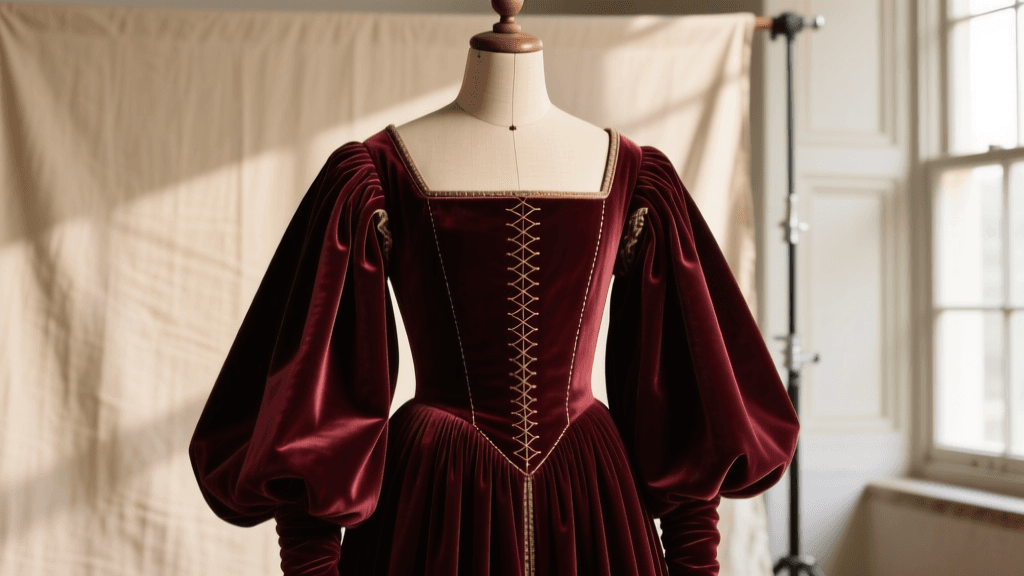
The bombard sleeve is the defining feature of the Burgundian houppelande. It is cut as a massive rectangle or slightly tapered trapezoid, resulting in a sleeve that is relatively fitted at the upper arm but explodes into a vast, floor-sweeping bell at the wrist.
- Upper Arm Circumference: 16 to 20 inches (allowing for movement over the kirtle).
- Sleeve Length: Measure from the shoulder point to the wrist, then add 6 to 10 inches to allow the sleeve to drape past the hand.
- Hem Circumference: For a true bombard effect, the wrist opening should measure between 40 and 60 inches in circumference.
The High Collar
The collar of a houppelande stands rigidly against the neck, sometimes reaching up to the jawline. To achieve this in 2026 without modern fusible interfacings (which are strictly forbidden in high-level reenactment circles), you must use a heavyweight linen canvas or traditional buckram. Cut the collar as a straight rectangle, roughly 5 to 7 inches wide (which yields a 4 to 5-inch standing height when folded and seamed). Pad-stitch the canvas to the wool outer layer using a heavy silk or linen thread to ensure it rolls gracefully rather than buckling.
Historical Sewing Techniques for the Modern Maker
While modern sewing machines can be used for long structural seams, the finishing techniques must remain historically grounded to meet 2026 authenticity standards. The interior of a houppelande should be as beautiful as the exterior, as the heavy skirts and massive sleeves frequently flip open to reveal the lining.
Flat-Felled Seams: For the main body seams, use a flat-felled seam. This encloses all raw edges, providing immense strength to support the heavy wool while eliminating the need for modern sergers or zig-zag stitches. Bag-Lining Method: Construct the outer wool shell and the linen lining as two separate, complete garments. Place them right-sides together, sew around the neckline, center front, and hem, and then turn the garment right-side out. This creates a perfectly clean interior with no visible raw edges. Hand-stitch the armholes and sleeve hems closed using a blind catch-stitch.
Pleating the Skirt: The iconic 'organ pipe' pleats at the waist are achieved through cartridge pleating. Run three parallel rows of heavy gathering stitches along the top edge of the skirt. Pull the threads to gather the fabric tightly, then whip-stitch the top edge of each pleat directly to the bottom edge of the bodice or belt. This technique allows the massive volume of the skirt to flare out dramatically from a relatively small waistband.
Accessorizing: Belts, Hats, and Footwear
A houppelande is never worn unbelted; the belt is what creates the blousing effect over the torso. For women, the belt is worn high, just beneath the bust (an empire waist), creating a long, flowing lower silhouette. For men, the belt sits at the natural waist or slightly lower on the hips. In 2026, custom leatherworkers specializing in medieval reproductions offer belts cast with pewter or brass mounts, featuring the long, dangling tail that was fashionable in the Burgundian court. Expect to invest between $120 and $250 for a historically accurate, custom-fitted leather belt.
Headwear is equally crucial. The houppelande is almost always paired with a chaperon (a complex draped hood) or a towering hennin for women. Footwear should consist of turnshoes made of soft leather with a pointed poulaine toe, which can be sourced from specialized historical cobblers who use period-accurate last shapes and vegetable-tanned leathers.
Final Fitting and 2026 Reenactment Standards
As you finalize your garment, remember that the houppelande is designed to be worn over multiple layers. Always conduct your final fittings while wearing your linen chemise, wool hose, and fitted kirtle. The weight of the garment will change how it sits on your shoulders, and the high collar may require minor adjustments to prevent chafing against the jaw. By adhering to these historical construction methods, utilizing premium natural textiles, and respecting the geometric origins of the pattern, your 2026 recreation of the Burgundian houppelande will not only meet the strictest reenactment standards but will also serve as a wearable tribute to the pinnacle of European medieval sartorial art.