Authentic Banarasi Silk Saree Online Shopping Guide 2026
The 2026 Landscape of Online Banarasi Silk Marketplaces
The global appetite for South Asian traditional garments has reached unprecedented heights in 2026. Driven by a renaissance in heritage fashion, sustainable luxury, and the global visibility of Indian cinema and weddings, the Banarasi silk saree remains one of the most coveted garments in the world. However, this surge in demand has also flooded online marketplaces with power-loom polyester replicas masquerading as handwoven masterpieces. For the discerning buyer, navigating platforms like Etsy, Amazon, Myntra, and direct-to-consumer weaver sites requires a sharp eye and an understanding of textile certifications.
This comprehensive guide will equip you with the knowledge to source authentic Banarasi silk sarees online in 2026, ensuring your investment supports genuine artisans and enriches your wardrobe with a true piece of Asian heritage. In 2026, the most authentic sourcing happens through D2C weaver cooperatives and verified heritage brands. Master weavers in Varanasi now utilize high-resolution digital catalogs and virtual video consultations to sell directly to global clients, bypassing exploitative middlemen.
Understanding 2026 pricing realities is crucial. The cost of raw mulberry silk yarn and pure silver/gold zari (metallic thread) has stabilized but remains premium. A genuine handwoven Katan silk Banarasi saree with pure zari work will typically start at ₹18,000 (approximately $215 USD) and can easily exceed ₹150,000 ($1,800 USD) for intricate bridal Shikargah or Jangla patterns. If an online listing offers a 'pure silk Banarasi' for $45, you are almost certainly looking at a power-loom synthetic blend.
Decoding the GI Tag and Silk Mark Certification
To protect artisans from mass-produced imitations, the Indian government and international bodies have established strict certification protocols. The Banaras Brocades and Sarees hold a prestigious Geographical Indication (GI) tag. According to the World Intellectual Property Organization, a GI tag guarantees that the product possesses qualities, reputation, or characteristics that are essentially attributable to its specific geographic origin. When shopping online, reputable sellers will display a GI hologram or certificate number that can be traced back to the specific weaver or cooperative in the Varanasi district.
Additionally, buyers must look for the Silk Mark. Administered by the Ministry of Textiles, Government of India, the Silk Mark is a proprietary logo that guarantees the fabric is 100% natural silk. Online sellers are required to provide clear, unedited images of the Silk Mark label attached to the saree's pallu. If a seller claims the saree is pure silk but refuses to provide the Silk Mark label or GI documentation, proceed with extreme caution.
Understanding the Four Pillars of Banarasi Weaves
Before adding an item to your digital cart, you must understand the specific terminology used by authentic weavers. Banarasi sarees are broadly categorized into four distinct fabric types:
- Katan: The gold standard for weddings. Katan is a pure silk fabric made by twisting together two or more silk yarns, creating a firm, durable, and incredibly lustrous base that holds heavy zari work beautifully.
- Kora (Organza): A sheer, crisp fabric woven with silk and zari. Kora sarees are lightweight, breathable, and feature a translucent quality that is highly prized for summer weddings and contemporary styling.
- Georgette: A lighter, crepe-textured silk that drapes fluidly. Georgette Banarasis are immensely popular for modern, fusion wear and are easier to maintain than heavy Katan.
- Shattir: A more affordable blend, often mixing silk with cotton or synthetic yarns. While beautiful, Shattir is not considered pure silk and should be priced significantly lower.
Marketplace Comparison: Where to Buy in 2026
Choosing the right platform is just as important as knowing what to look for. Below is a comparison of the primary online avenues for purchasing Banarasi silk in 2026.
| Platform Type | Examples | Authenticity Guarantee | Price Range (USD) | Best For |
|---|---|---|---|---|
| Direct Weaver D2C | Paramparik Karigar, Tilfi, Bhumija | High (GI + Silk Mark verified) | $250 - $2,000+ | Purists, Bridal, Investment pieces |
| Premium Heritage Retailers | Nalli, Angadi Galleria, Tilfi | High (In-house authentication) | $150 - $1,500 | Reliable gifting, Weddings, Easy returns |
| Global Artisan Marketplaces | Etsy (Verified Sellers only) | Medium (Requires buyer vetting) | $180 - $800 | Unique vintage, Contemporary motifs |
| Mega Aggregators | Amazon, Myntra, Ajio | Low (High risk of power-loom fakes) | $30 - $150 | Budget, Casual synthetic blends |
Red Flags: Spotting Power-Loom Fakes on Global Platforms
When browsing global marketplaces like Etsy or Amazon, the sheer volume of listings can be overwhelming. Here is how to spot a synthetic or power-loom fake through digital product photography:
- Visual Perfection vs. Human Touch: Power-loom sarees are mathematically perfect. The motifs on the pallu will be identical down to the millimeter. Handwoven Banarasi silk, crafted on traditional jacquard pit looms, features microscopic irregularities. These slight variations are not flaws; they are the hallmark of human craftsmanship.
- The Reverse Side Test: Always ask the online seller for a high-resolution photograph of the reverse side of the pallu. In authentic handwoven Banarasi, the intricate jala work will show loose threads and a slightly messy reverse side, as the supplementary weft threads are carried across the back. Power-loom fakes often have a neat, interlocked reverse side or use a completely different, flat digital print on the back.
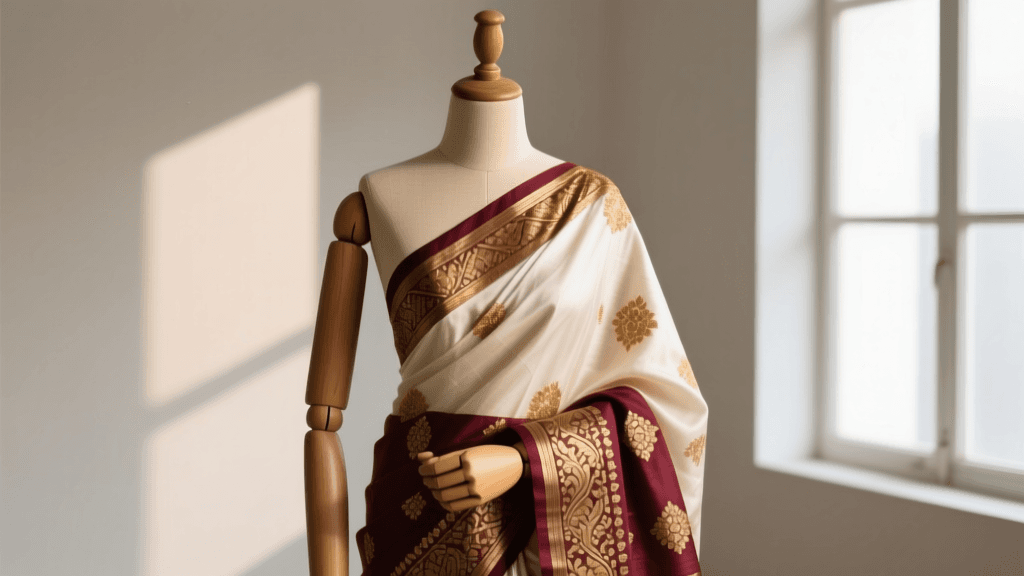
- Stiffness in Photos: Genuine Katan silk is remarkably fluid and heavy, draping elegantly over the shoulder. Synthetic replicas often feature heavy chemical sizing (starch) to mimic the weight of silk. In photos, these fake sarees will look stiff, papery, and will stand away from the mannequin rather than clinging and draping gracefully.
Step-by-Step Verification Before Checkout
Before you enter your payment details on any marketplace, run through this essential verification checklist:
- Request the GI Certificate Number: Message the seller and ask for the specific GI hologram number associated with the saree. Genuine weavers track their inventory and can provide this.
- Demand a Silk Mark Label Photo: Do not accept stock photos of the Silk Mark. Ask for a photo of the actual label attached to the specific saree you are purchasing.
- Check the Seller's Location: Prefer sellers based in Varanasi, Chennai, or Bangalore, or established heritage brands with verifiable physical addresses.
- Read Reviews for 'Burn Test' Mentions: Savvy buyers often perform a burn test on the loose threads provided in the saree's tassel. Authentic silk smells like burnt hair and leaves a crushable black ash; synthetic melts like plastic and forms a hard bead. Look for reviews mentioning this test.
Preserving Your Handwoven Investment
Caring for a handwoven Banarasi silk saree requires specific attention to detail. The UNESCO Intangible Cultural Heritage framework emphasizes that preserving traditional garments is also about preserving the cultural knowledge associated with their care and longevity.
Never wash a pure silk Banarasi at home. Always opt for professional dry cleaning, specifically requesting a petroleum-based solvent rather than harsh perc, which can strip the natural sericin from the silk fibers and dull the zari. Store the saree wrapped in unbleached, breathable mulmul (muslin) cloth. Never store silk in plastic covers, as trapped moisture will cause the metallic zari to tarnish and the silk to develop mildew. Refold the saree every three months to prevent permanent crease lines from weakening the delicate yarn over time.
Conclusion
Shopping for an authentic Banarasi silk saree online in 2026 is a rewarding endeavor that connects you directly to centuries of Asian textile tradition. By understanding the nuances of Katan weaves, demanding GI and Silk Mark certifications, and avoiding the trap of impossibly cheap power-loom replicas, you ensure that your purchase is not just a beautiful garment, but a genuine piece of living history. Support the master weavers, invest in authentic heritage, and wear your Banarasi silk with the pride it deserves.