Banarasi vs Kanchipuram Silk: 2026 Saree Fabric Guide
The Titans of Indian Silk: An Introduction
When it comes to South Asian traditional garments, few textiles command the reverence, heritage, and luxury of pure silk sarees. As we navigate the 2026 bridal and festive shopping seasons, discerning buyers are increasingly looking past superficial embellishments to understand the foundational textiles of their garments. The two undisputed titans of Indian silk weaving are Banarasi silk from the northern city of Varanasi and Kanchipuram silk from the southern town of Kanchipuram. While both are celebrated for their opulence and cultural significance, their fabric structures, weaving techniques, and draping qualities are vastly different. Understanding these textile nuances is essential for making an informed investment in 2026, where authentic handloom prices have shifted due to global silk yarn markets and evolving artisan wages.
According to the Metropolitan Museum of Art's Heilbrunn Timeline of Art History, the evolution of Indian textiles represents a complex synthesis of indigenous techniques and cross-cultural trade influences. Today, choosing between a Banarasi and a Kanchipuram silk saree is not merely a matter of color preference; it is a decision about garment weight, structural drape, climate suitability, and textile longevity. This comprehensive guide breaks down the fabric and textile choices between these two iconic weaves, providing actionable advice for collectors, brides, and textile enthusiasts in 2026.
Banarasi Silk: The Mughal-Inspired Brocade
Weaving Technique and Texture
Banarasi silk is globally renowned for its intricate brocade work, heavily influenced by Mughal-era artistry. The fabric is typically woven on jacquard looms, which allow for the creation of complex, repeating motifs such as kalga (mango/paisley), bel (creeping vines), and intricate jaal (net) patterns. The defining textile characteristic of a traditional Banarasi saree is its zari work—metallic threads woven into the silk base to create a raised, embossed effect. In 2026, authentic premium Banarasi sarees utilize real zari, which consists of a flattened silver wire core electroplated with pure gold, though high-quality tested metallic yarns are also prevalent in mid-tier markets.
The base fabric of a Banarasi saree is usually a fine, tightly twisted silk that provides a smooth, lustrous canvas for the heavy brocade. Because the motifs are woven directly into the fabric using supplementary weft threads, the reverse side of a genuine Banarasi textile will show clear, albeit loose, floating threads where the zari and colored silks have been dropped. This structural element gives the fabric a distinctive stiffness and a rich, heavy drape that holds pleats exceptionally well but requires careful handling to avoid snagging the supplementary wefts.
2026 Trends and Market Pricing
In 2026, the Banarasi textile market has seen a massive surge in demand for lighter-weight variations. While the heavy Satin Silk and Katan (pure silk) variants remain the gold standard for bridal trousseaus, contemporary weavers are increasingly utilizing Kora Silk (organza) and Georgette bases. These lighter textiles retain the iconic Banarasi jacquard motifs but offer a fluid, breathable drape suitable for summer weddings and extended festive wear. As of early 2026, a pure Katan Banarasi silk saree with real zari ranges from $400 to $1,500 USD, while Kora silk variants are priced between $150 and $450 USD, reflecting the reduced silk yarn volume and altered weaving time.
Kanchipuram Silk: The Temple-Weave Marvel
The Korvai and Petni Techniques
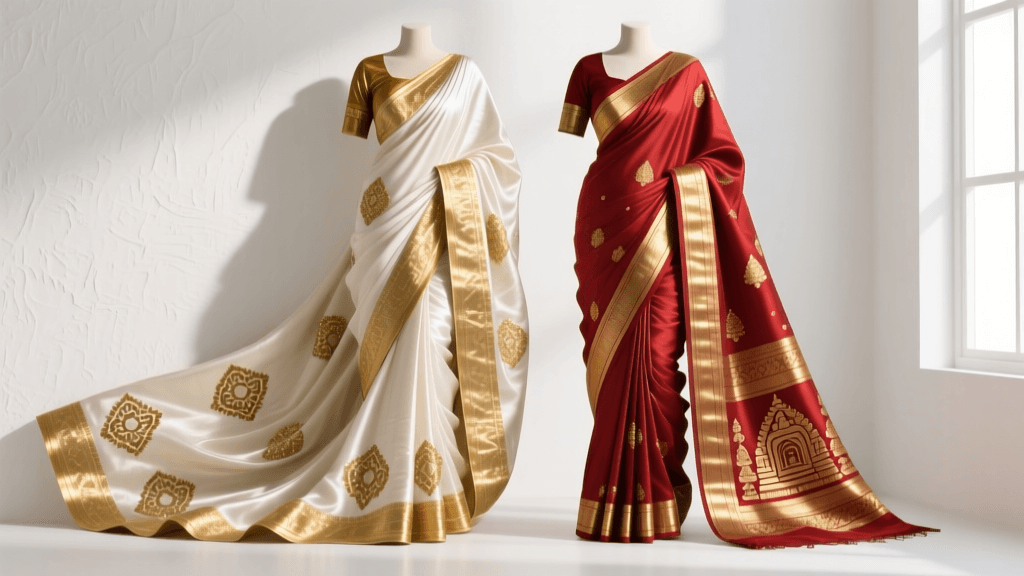
Originating from Tamil Nadu, Kanchipuram silk (often referred to as Kanjeevaram) is the heavyweight champion of South Indian textiles. Woven on traditional pit looms, the fabric is constructed using pure mulberry silk yarn, which is notably thicker and more durable than the silk used in Banarasi weaves. The most remarkable textile engineering feat of the Kanchipuram saree is the Korvai technique. Because the body of the saree and the contrasting borders are often in entirely different colors, they are woven separately and then interlocked together with incredible precision. This interlocking joint is so robust that even if the fabric tears, the border will not detach.
Furthermore, the Petni technique is used to attach the pallu (the decorative end piece draped over the shoulder), which is usually a contrasting color and features dense, elaborate motifs inspired by South Indian temple architecture, such as gopurams (temple towers) and peacocks. The Victoria and Albert Museum's South Asia Collection frequently highlights the structural integrity and vibrant color-blocking inherent in these temple textiles, noting how the heavy mulberry silk creates a sculptural drape that is uniquely suited to the traditional South Indian silhouette.
2026 Trends and Market Pricing
For 2026, Kanchipuram weavers are responding to a younger demographic's preference for minimalist elegance. While traditional stark reds, deep greens, and heavy gold borders remain staples for canonical temple weddings, there is a booming market for pastel mulberry silks—think powder blues, mint greens, and soft lilacs—with delicate, single-line silver or rose-gold zari borders. The structural weight of the fabric remains, but the visual weight has been significantly reduced. In 2026, a genuine pure mulberry Kanchipuram silk saree with tested zari starts around $250 USD, with master-weaver pieces featuring pure gold zari and complex Korvai borders commanding anywhere from $800 to over $2,500 USD.
Head-to-Head Textile Comparison Chart
To help you make an informed textile choice for your 2026 wardrobe, refer to the structural and practical comparison below:
| Feature | Banarasi Silk | Kanchipuram Silk |
|---|---|---|
| Origin Region | Varanasi, Uttar Pradesh (North) | Kanchipuram, Tamil Nadu (South) |
| Silk Type | Fine Katan, Organza, or Georgette | Heavy Pure Mulberry Silk |
| Loom Type | Jacquard Loom | Traditional Pit Loom |
| Motif Inspiration | Mughal florals, paisleys, jaal nets | Temple borders, peacocks, checks |
| Zari Integration | Supplementary weft (brocade) | Interlocked borders and pallu |
| Fabric Weight | Medium to Heavy (depending on base) | Heavy to Very Heavy |
| Drape Quality | Fluid, holds tight pleats well | Sculptural, stiff, grand volume |
| Climate Suitability | Winter/Autumn (Katan), Summer (Kora) | Best for Winter/Cooler climates |
| Avg. 2026 Price (Pure) | $400 - $1,500 USD | $500 - $2,500+ USD |
Actionable Buying Guide: Authenticating Your Silk
The proliferation of power-loom replicas and synthetic blends makes purchasing heritage textiles in 2026 a task that requires vigilance. Here is how to ensure you are investing in genuine handloom fabrics.
The GI Tag and Handloom Mark
Both Banarasi and Kanchipuram silks are protected under Geographical Indication (GI) laws. When shopping, always look for the official GI tag and the Ministry of Textiles, Government of India Handloom Mark. These certifications guarantee that the textile was woven in the specific geographic region using traditional methods. However, be aware that tags can be counterfeited. Use them as a baseline indicator, not the sole proof of authenticity.
The Burn Test and Zari Check
If you are purchasing from a trusted boutique that allows fabric testing, the burn test remains the most definitive way to verify pure silk. Pluck a few loose threads from the fringe or the weaver's waste. Pure silk will burn slowly, smell like burnt hair or feathers, and leave behind a crushable, powdery black ash. Synthetic blends like polyester or art silk will melt, smell like burning plastic, and form a hard, uncrushable bead. Additionally, examine the zari closely. Real zari has a distinct, warm metallic luster and will tarnish slightly over decades, whereas synthetic metallic yarns will remain artificially shiny and may peel or crack when folded sharply.
Garment Care: Preserving Heritage Textiles
The longevity of these exquisite garments depends entirely on post-purchase care. The structural differences between the two fabrics dictate their maintenance routines.
- Dry Cleaning: Both Banarasi and Kanchipuram pure silks must be dry-cleaned for their first three washes to set the dyes and preserve the zari's luster. Afterward, gentle hand-washing in cold water with a pH-neutral protein shampoo (like baby shampoo) is acceptable for Kanchipuram silks, but Banarasi brocades should always be professionally dry-cleaned to prevent the supplementary weft threads from snagging or pulling.
- Storage: Never hang silk sarees on wire or plastic hangers, as the heavy weight of the fabric (especially Kanchipuram) will cause the warp threads to stretch and distort over time. Store them flat in a cool, dark drawer.
- Wrapping: Wrap your garments in unbleached, pure cotton muslin cloth. Avoid plastic covers, which trap moisture and cause the zari to oxidize and turn black prematurely. In 2026, many luxury buyers are investing in cedar-lined storage boxes to naturally repel moths without the use of harsh chemical naphthalene balls, which can degrade silk proteins.
- Refolding: To prevent permanent crease marks that can eventually lead to fabric tearing along the fold lines, refold your sarees every three to four months, changing the position of the pleats and borders.
Pro Tip for 2026 Brides: If you are purchasing a heavy Kanchipuram saree for a multi-hour ceremony, consider having a master tailor stitch a hidden cotton underskirt with pre-pleated silk panels. This modern styling technique reduces the physical weight on your waist while maintaining the flawless, sculptural volume of the traditional drape.
Conclusion
Choosing between Banarasi and Kanchipuram silk is a celebration of India's diverse textile heritage. Banarasi silk offers a fluid, intricately patterned brocade that speaks to Mughal artistry, while Kanchipuram silk provides a robust, structurally magnificent canvas rooted in Dravidian temple culture. By understanding the weave techniques, verifying authenticity through GI tags and burn tests, and adhering to strict preservation protocols, you ensure that your 2026 textile investments will remain pristine heirlooms for generations to come.