Authentic Balkan Embroidery: Shevitsa & Ie Guide 2026
The 2026 Renaissance of Balkan Slavic Textiles
The mid-2020s have witnessed an unprecedented renaissance in traditional European textile arts. As we navigate 2026, the global maker movement has increasingly turned its gaze toward the intricate, deeply symbolic world of Slavic Balkan and Eastern European folk dress. Far from being static museum relics, garments like the Bulgarian Shevitsa and the Romanian Ie are living traditions. Today’s cultural preservationists, sustainable fashion designers, and hobbyist embroiderers are actively reviving these techniques, blending ancestral geometry with modern, ethically sourced materials. This comprehensive guide will walk you through the history, anatomy, and practical execution of Balkan Slavic embroidery in 2026, providing actionable steps to create your own heritage pieces.
Decoding the Bulgarian Shevitsa
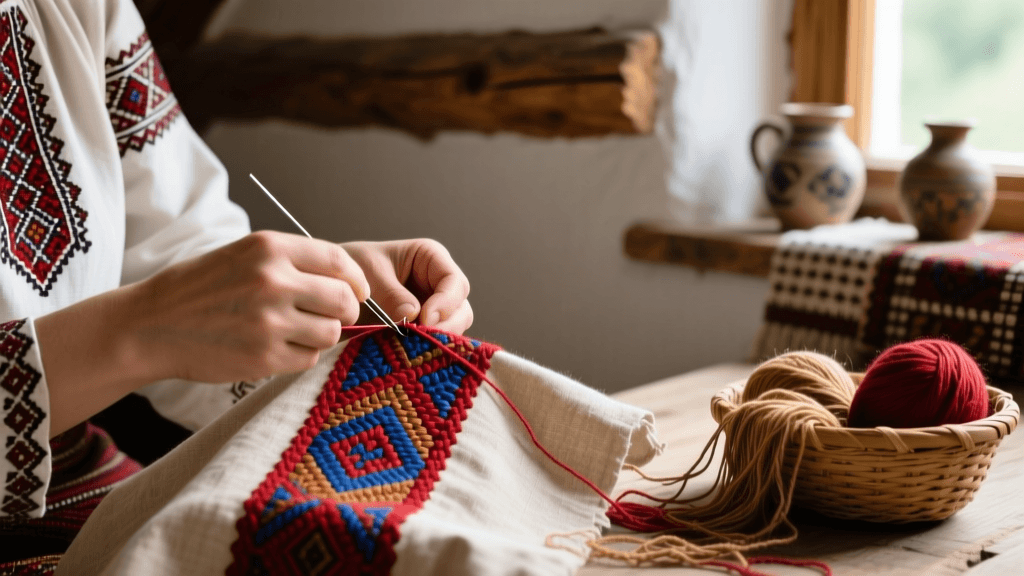
The term Shevitsa refers to the traditional geometric embroidery that adorns Bulgarian folk costumes, particularly on the sleeves, hems, and necklines of women's chemises. Historically, these motifs were not merely decorative; they served as apotropaic (protective) talismans and encoded the wearer's regional identity, marital status, and social standing. In 2026, digital archiving projects have made thousands of high-resolution historical patterns accessible to home embroiderers, allowing for precise replication of village-specific motifs that were once thought lost.
Color Symbolism and Regional Variations
In 2026, natural dyeing workshops across the Balkans have meticulously reconstructed historical color palettes, moving away from the synthetic aniline dyes of the late 20th century. The foundational triad of Bulgarian embroidery consists of red, green, and black:
- Red: Derived historically from madder root or kermes insects, red symbolizes life, blood, and maternal protection. It is the dominant color in almost all Balkan Slavic textiles.
- Green: Sourced from weld or indigo over-dyes, green represents youth, nature, and eternal renewal. It is often used as an accent to balance the visual weight of the red.
- Black: Often created using oak galls or iron mordants, black grounds the design, symbolizing the earth, stability, and the wisdom of ancestors.
Regional variations dictate the geometric complexity. The Thracian plain favors dense, floral-inspired geometry with heavy gold metallic thread accents, reflecting historical agricultural wealth. In contrast, the Shopi region of western Bulgaria is renowned for stark, highly contrasting geometric shapes. According to the Europeana digital cultural archives, these Shopi motifs share striking mathematical similarities with ancient Celtic knotwork and early Slavic runic carvings, utilizing a strict cross-stitch that creates pixelated, almost digital-looking mandalas.
The Anatomy of the Romanian Ie
While Bulgarian embroidery often relies on strict grid-based geometry, the Romanian Ie (the traditional pleated blouse) is celebrated for its fluid, rhythmic compositions and masterful use of negative space. The cultural significance of this garment was cemented globally when it was inscribed on the UNESCO Intangible Cultural Heritage registry, a status that has heavily influenced its 2026 revival among Eastern European diaspora communities and high-fashion sustainable cooperatives.
Structural Components of the Ie
To replicate an authentic Ie, one must understand its tripartite sleeve structure, which dictates the flow and placement of the embroidery:
- The Altița: This is the rectangular or square shoulder piece, historically the most ornate section. It was the primary canvas for a maker to display her skill, featuring complex geometric or floral motifs bounded by a strict frame. In 2026, contemporary makers often use the altița to incorporate personal or modern symbolic motifs while maintaining traditional stitch structures.
- The Încreț: Located just below the altița, this is a gathering band that transitions the rigid shoulder piece into the flowing sleeve. It often features a contrasting color palette, utilizing yellows or pale blues, and smaller, denser stitch work to create a visual "waist" for the sleeve.
- The Râuri: Translating to "rivers," these are the diagonal or vertical bands of embroidery that flow down the length of the sleeve to the cuff. The "rivers" guide the eye and create a sense of kinetic movement when the wearer dances or works in the fields.
Sourcing Authentic Materials in 2026
A major challenge for modern embroiderers is sourcing materials that mimic the texture, drape, and thread count of historical hand-spun hemp and linen. In 2026, the market has shifted decisively away from mass-produced, chemically treated fabrics toward heritage agricultural cooperatives and specialized artisan mills. Below is a comparison of historical materials versus their best 2026 alternatives for serious makers.
| Material | Historical Source | 2026 Artisan Alternative | Est. Cost (2026) |
|---|---|---|---|
| Base Fabric | Hand-loomed hemp | Organic heritage flax linen (18-22 count evenweave) | $45 - $60 / meter |
| Red Thread | Madder root dyed wool | Naturally dyed merino/silk blend floss | $12 / skein |
| Black Thread | Oak gall & iron mordant | Logwood & iron dyed cotton floss | $8 / skein |
| Metallic Accents | Spun gold/silver wire | Tarnish-resistant copper-core bullion thread | $25 / spool |
Step-by-Step: Stitching Your First Shevitsa Motif
To begin your journey into Balkan Slavic embroidery, we recommend starting with a basic Shopi-style geometric rosette using the traditional kanitsa (cross-stitch) method. This technique relies on counting the threads of the base fabric to ensure perfect symmetry.
1. Fabric Preparation and Hooping
Select an 18-count or 22-count evenweave linen. Unlike modern Aida cloth, evenweave linen requires you to stitch over two fabric threads to achieve the correct scale. Wash and iron your fabric before beginning to remove any manufacturing sizing. Secure the fabric in a wooden embroidery hoop or a slate frame to maintain consistent tension, which is critical for preventing the geometric patterns from warping.
2. Thread Management
Cut your embroidery floss into 18-inch lengths to prevent fraying and tangling. For 18-count linen, use two strands of floss for the cross-stitch and one strand for the backstitch outlining. Thread your needle and begin from the back of the fabric, leaving a small tail that will be caught by your subsequent stitches—avoid using knots, as historical Balkan garments were finished without them to ensure the fabric lay flat against the skin.
3. Executing the Kanitsa (Cross-Stitch)
The traditional Balkan cross-stitch is worked in rows. First, create a row of half-stitches (bottom-left to top-right) across the width of your motif. Then, work back in the opposite direction, completing the crosses (bottom-right to top-left). Ensure that the top thread of every cross lies in the same direction; this uniformity catches the light evenly and is the hallmark of a master embroiderer. For the outlining, use a stem stitch or backstitch in black thread to define the edges of the geometric "star" or "rosette" motif.
Conservation and Care for Heritage Textiles
Whether you are working with a genuine 19th-century antique or a piece you have stitched yourself in 2026, proper conservation is vital. The Smithsonian Center for Folklife and Cultural Heritage recommends storing embroidered textiles flat, interleaved with acid-free tissue paper, in a climate-controlled environment away from direct UV light. If washing is necessary, avoid modern enzymatic detergents. Instead, use a pH-neutral conservation wash in lukewarm water, gently pressing the water through the fabric without agitating or wringing, which can distort the linen grid and damage the delicate metallic threads.
Conclusion
The revival of Balkan Slavic embroidery in 2026 is more than a nostalgic craft trend; it is an act of cultural resilience. By understanding the profound symbolism of the Bulgarian Shevitsa and the structural poetry of the Romanian Ie, modern makers do more than recreate beautiful garments. They participate in a continuous, living dialogue with the ancestors, ensuring that the geometric language of Eastern European folk dress continues to be spoken, worn, and cherished for generations to come.