Balkan Folk Shirt Pattern Drafting: Zero-Waste Techniques 2026
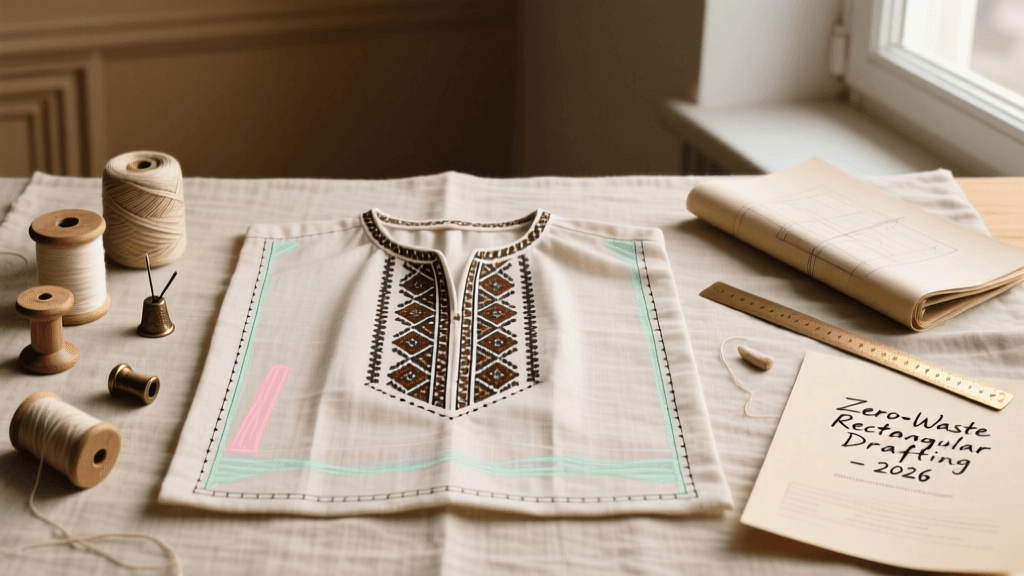
The Renaissance of Rectangular Pattern Cutting in 2026
In the contemporary landscape of 2026, the global shift toward sustainable, zero-waste fashion has sparked a massive revival in historical European garment construction. Modern sewists and bespoke tailors are moving away from the fabric-wasting curved armholes and complex slopers of the 20th century, turning instead to the geometric brilliance of the Balkan and Slavic folk shirt. Known regionally as the košulja, rubakha, or vyshyvanka, this traditional garment is a masterclass in mathematical efficiency. Every single thread woven into the linen is utilized in the final garment, leaving absolutely no scraps on the cutting room floor.
Historically, this zero-waste approach was born of necessity. Flax cultivation, harvesting, retting, spinning, and weaving on narrow handlooms required thousands of hours of labor. To cut away fabric and discard it was unthinkable. Today, with premium Baltic linen prices reaching unprecedented highs in 2026 due to shifting agricultural supply chains, adopting these historical zero-waste pattern drafting techniques is not just an act of cultural preservation—it is an economic and ecological necessity for modern makers.
Anatomy of the Balkan and Slavic Folk Shirt
Unlike modern garments that are draped to follow the contours of the human body, the traditional Balkan folk shirt is entirely geometric. It relies on straight lines, rectangles, squares, and right-angled triangles. The fit and mobility are not achieved through darts or curved seams, but through strategic volume, gathering, and the ingenious placement of gussets.
The Core Geometric Components
- The Body Panels: Two large rectangles (front and back) that fold over the shoulder or are joined by a straight shoulder seam.
- The Sleeves: Two long rectangles that attach directly to the body panels without a curved armscye.
- The Gussets (Lastovitsa): Small squares of fabric placed at the underarm intersection to provide crucial three-dimensional mobility.
- The Side Gores (Kliny): Right-angled triangles inserted into the side seams to create an A-line flare, allowing for ease of movement and layering over heavy wool skirts or trousers.
- The Collar and Cuffs: Narrow rectangular bands used to gather the excess fabric at the neck and wrists.
Adapting Historical Loom Widths to 2026 Textiles
The most significant challenge for modern pattern drafters is adapting historical layouts to modern fabric widths. Traditional Balkan and Eastern European handlooms produced linen that was typically 40cm to 60cm wide. This narrow width dictated the pattern math: the body of the shirt was often constructed from multiple vertical panels sewn together, or the shirt was cut with a distinct front and back panel, with sleeves cut from the remaining length.
In 2026, commercially milled linen is almost exclusively sold in 140cm to 150cm widths. While this wider bolt allows for fewer seams, it can lead to massive fabric waste if you simply lay modern pattern pieces on it. To maintain the zero-waste ethos, makers are utilizing digital marker-making software like Seamly2D and CLO3D to map out nested rectangular layouts that utilize 100% of the 150cm width, often cutting multiple garments or integrating the leftover geometric blocks into matching accessories like aprons or headpieces.
| Component | Traditional 60cm Loom Layout | Modern 150cm Bolt (2026) | Zero-Waste Adaptation Strategy |
|---|---|---|---|
| Body Panels | Front and back cut as one continuous tube, folded at the shoulder. | Cut as two separate wide rectangles side-by-side. | Use the remaining 150cm width to cut the sleeves and gussets horizontally, eliminating off-cuts. |
| Sleeves | Woven to exact length, attached with minimal gathering. | Cut from the wide bolt, resulting in a wider, more voluminous sleeve. | Increase the gathering ratio at the cuff; use the excess width for traditional smocking (carrickmacross or shirring). |
| Gussets | Cut from the narrow selvedge edges. | Cut from the negative space between the body and sleeve rectangles. | Nest the 15x15cm gusset squares directly into the L-shaped corners left by the sleeve cuts. |
Step-by-Step Drafting and Cutting Guide
To draft a traditional zero-waste košulja using a standard 150cm wide medium-weight linen (approx. 180-200 GSM), follow these foundational measurements. This draft assumes a standard adult female frame, but the rectangular nature of the pattern makes it inherently size-inclusive.
1. The Body Panels
Measure the wearer's bust and add 10-15cm of positive ease. Divide this number by two. This is your body panel width. For a 100cm bust, each panel (front and back) will be 55cm wide. Cut two rectangles: 55cm wide by the desired length (typically shoulder to mid-calf, around 110cm). The shoulder seam is a straight horizontal line. The neckline is the only curve in the entire garment—a simple slit or shallow U-shape cut into the front panel, which is then gathered into a narrow collar band.
2. The Sleeves and Gussets (The Mobility Secret)
Without a curved armhole, raising the arms in a rectangular shirt would pull the entire garment upward. The gusset solves this. Cut two sleeve rectangles: width equals the bicep circumference plus 10cm ease; length equals the arm measurement from shoulder to wrist. Next, cut two square gussets, typically 12cm x 12cm. When assembling, the gusset is sewn into the underarm seam, connecting the sleeve to the body panel. This square acts as a pivot point, allowing the arm to lift independently of the torso.
3. The Side Gores
To achieve the iconic sweeping hem of the Balkan folk dress, side gores are inserted. Cut two right-angled triangles. The straight grain should run down the center of the gore to prevent bias stretching. Insert these into the side seams starting from the waist or hip line down to the hem. The hypotenuse of the triangle will be sewn into the side seam, creating a beautiful, flared silhouette that requires no curved hemming techniques.
Structural Seams and Traditional Joinery
In 2026, modern sewists often rely on sergers to finish raw edges. However, historical European folk dress relied on flat-felled seams (run-and-fell) and intricate insertion stitches to enclose raw edges and add structural integrity. Because linen frays easily, the merezhka (drawn-thread work) and faggoting techniques were used not just as decoration, but as functional seam joinery.
When sewing the rectangular panels together, leave a 1.5cm seam allowance. Instead of sewing them directly right-sides-together, traditional makers would hem the edges of each rectangle first, and then join them using a decorative insertion stitch. This creates a flexible, breathable seam that can withstand the rigorous washing and boiling processes that traditional linen undergarments and shirts required. For modern makers replicating this, using a 60-weight heirloom cotton thread and a zigzag or antique lace stitch on a standard sewing machine perfectly mimics the historical merezhka joinery.
Embroidery as Structural Reinforcement
It is a common misconception that the heavy cross-stitch and satin-stitch embroidery found on Slavic and Balkan shirts was purely decorative. As highlighted by cultural historians and documented in extensive archives by BBC Culture, the placement of embroidery on the vyshyvanka and regional variants was deeply tied to the structural vulnerabilities of the garment. The dense stitching at the cuffs, the collar, the chest slit, and the shoulder seams served to reinforce areas subjected to the highest friction and tension, effectively acting as a textile armor that prolonged the life of the linen.
When drafting your pattern in 2026, you must account for the embroidery zones. If you plan to execute traditional counted-thread work, the fabric's warp and weft must be perfectly aligned with the pattern edges. Cutting even slightly off-grain will render counted embroidery impossible. For deeper research into historical textile preservation and the structural role of European embroidery, the Victoria and Albert Museum (V&A) Textile Collections offers invaluable visual references of surviving 18th and 19th-century garments. Furthermore, the Textile Society of America provides extensive academic archives on the intersection of zero-waste weaving traditions and folk costume construction.
Sourcing Materials in 2026
To achieve an authentic drape and structural soundness, the choice of fabric is paramount. Avoid modern linen-cotton blends or rayon-linen lookalikes, which lack the crispness required to hold the geometric gathers of a Balkan sleeve. In 2026, the most sought-after linens for historical reconstruction are sourced from heritage mills in Lithuania and Latvia, which have recently upgraded their water-retting facilities to meet new European environmental standards while maintaining the slubby, irregular texture of hand-loomed cloth. Look for unbleached or naturally water-retted linen in the 180 to 220 GSM range. This weight is heavy enough to support dense embroidery without puckering, yet breathable enough for the voluminous layers of traditional folk dress.
Conclusion
Drafting a Balkan or Slavic folk shirt is an exercise in respecting the geometry of the woven cloth. By embracing the zero-waste rectangular construction techniques of our ancestors, modern makers in 2026 are not only preserving a vital piece of European cultural heritage but are also pioneering a sustainable, mathematically elegant approach to garment creation. Whether you are crafting a historically accurate reenactment piece or adapting the košulja silhouette for contemporary slow-fashion wardrobes, the enduring brilliance of the gusset, the gore, and the rectangular panel remains as relevant today as it was centuries ago.