Awa Odori Festival Costumes: The Ultimate Dance Guide
The Spectacle of Awa Odori and its Sartorial Roots
Every August, the city of Tokushima on the Japanese island of Shikoku transforms into a vibrant sea of music, movement, and traditional textiles. The Awa Odori festival, often cited as Japan's largest dance festival, draws over 1.3 million spectators and tens of thousands of dancers. According to the Tokushima Prefecture Tourism Association, the festival's origins date back over 400 years, evolving from Bon Odori (ancestral dances) into a highly stylized, energetic performance art. For participants, the Awa Odori is not merely a dance; it is an endurance event that demands specialized, highly functional traditional garments. Unlike the restrictive silk kimono worn for tea ceremonies, Awa Odori festival costumes are engineered for breathability, dynamic movement, and the sweltering heat of the Japanese summer.
The Textile of Tokushima: Awa Shijira Cotton
Before diving into the specific garments, one must understand the fabric that defines the region's summer wear: Awa Shijira. Designated as a traditional craft by the Japanese government, Awa Shijira is a unique cotton crepe textile native to Tokushima. The fabric is woven using varying tension on the warp threads, which, when washed and dried, creates a distinct, bumpy texture known as shibo. This textured surface prevents the fabric from clinging to sweaty skin, allowing for superior air circulation. For serious Awa Odori dancers, an authentic Awa Shijira yukata (summer cotton robe) is the gold standard, offering unparalleled comfort during hours of continuous choreography under the August sun.
Anatomy of the Awa Odori Costume
The Awa Odori is divided into two primary styles: Onna-odori (women's dance) and Otoko-odori (men's dance). The costumes for each are distinctly different in silhouette, accessories, and function.
Onna-Odori (Women's Dance) Attire
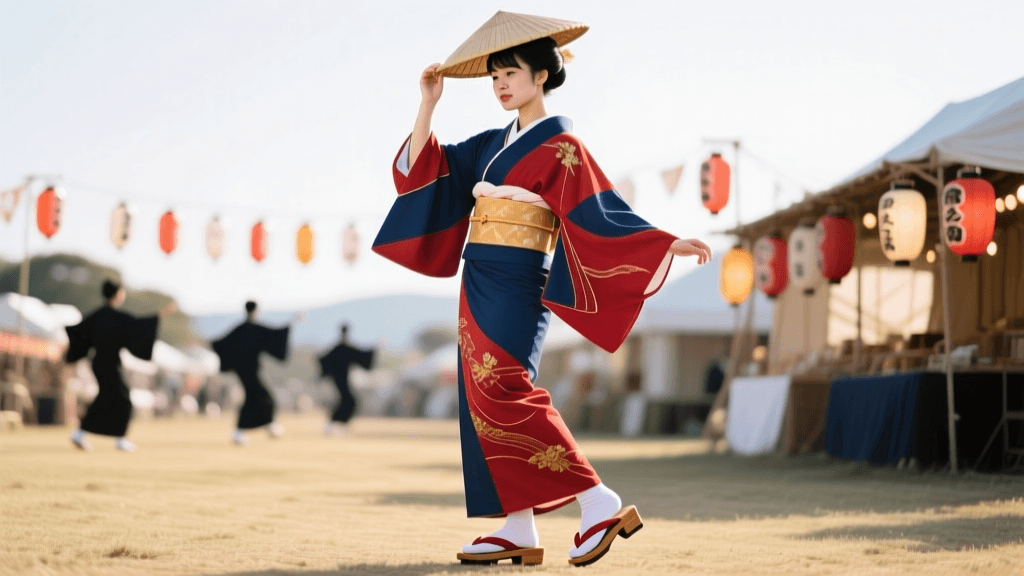
The women's dance is characterized by graceful, refined movements, punctuated by the striking of small brass cymbals (narimono) and the balancing of traditional headwear. The core components include:
- Odori Yukata: A lightweight cotton yukata, often featuring vibrant, auspicious patterns like cranes, flowers, or geometric shapes. The hem is tied higher than a standard yukata to allow for deep, lunging steps.
- Hanagasa or Amigasa: While some wear floral hair ornaments, many female dancers don the amigasa (woven sedge hat). In the women's style, the hat is often held delicately in one hand or balanced on the head, tilted to obscure the face and add an air of mystery.
- Zori and Tabi: Women typically wear white split-toe tabi socks paired with flat, woven straw zori sandals, allowing for a gliding, rhythmic footwork.
Otoko-Odori (Men's Dance) Attire
The men's dance is famously boisterous, acrobatic, and low to the ground. The costume is designed for maximum mobility and a somewhat disheveled, festive aesthetic.
- Yukata Worn Low: Men wear their yukata tied very low on the waist, often letting the top half peel back to expose the chest and shoulders. This not only keeps the dancer cool but emphasizes the dynamic, grounded movements of the dance.
- Tenugui: A long, thin cotton towel wrapped tightly around the head in the suzume (sparrow) or hachimaki style to absorb sweat and keep hair out of the eyes.
- Geta and Tabi: Men wear tabi with wooden geta clogs. The loud, percussive clacking of the wooden geta against the asphalt acts as a secondary instrument, keeping time with the shamisen and taiko drums. The Japan National Tourism Organization (JNTO) frequently highlights this rhythmic footwork as a defining sensory experience of the Tokushima festival.
Practical Sizing and Measurement Guide
Purchasing or renting a dance yukata requires specific measurements that differ from standard Western clothing sizing. The critical metric is the mi-take (garment length).
For Women: The standard mi-take is calculated by subtracting roughly 30 cm from your total height. For example, a woman who is 160 cm tall requires a yukata length of about 130 cm. This excess length is folded at the waist to create the ohashori (waist fold), which acts as a shock absorber during the deep squats of the dance. If the ohashori is too short, the dancer risks tripping; if too long, it restricts hip movement.
For Men: Men do not wear an ohashori. The yukata must match the wearer's height almost exactly, from the base of the neck to the ankle. Because the men's dance involves extreme lunges, a garment that is even 3 cm too long will result in stepping on the hem and falling.
Cost, Rental, and Purchasing Data
Whether you are a tourist joining a niwaka-ren (impromptu dance group) or a dedicated practitioner, budgeting for your costume is essential. Below is a comparison chart detailing the costs and logistics of acquiring Awa Odori attire.
| Acquisition Method | Estimated Cost (JPY) | Lead Time Required | Customization & Fit | Best Suited For |
|---|---|---|---|---|
| Standard Rental (Tourist) | 3,500 - 5,500 | Book 1-2 months prior | Limited to standard S/M/L sizing | First-timers, casual participants |
| Premium Rental (Dancer) | 6,000 - 9,000 | Book 3 months prior | Includes authentic Awa Shijira & geta | Enthusiasts, photographers |
| Off-the-Rack Purchase | 12,000 - 25,000 | Buy 1 month prior | Requires self-tailoring of hem/obi | Frequent festival attendees |
| Custom Awa Shijira Bespoke | 40,000 - 80,000+ | Order 4-6 months prior | Full bespoke fit, custom dye patterns | Ren (dance troupe) members, collectors |
Note: Prices are approximate and exclude shipping. Festival rentals in Tokushima city sell out rapidly by late June. As noted in cultural reports by Nippon.com, planning ahead is mandatory for August matsuri (festivals).
Dressing for Movement: Tying the Odori Yukata
A standard kimono belt (obi) is far too rigid for Awa Odori. Dancers utilize a hanhaba obi (half-width obi) or a specialized stretch-fabric dance obi. The tying process must secure the garment without restricting the diaphragm, as the dance requires deep, continuous breathing and vocalizations (kakegoe).
- The Base Layer: Wear a thin, moisture-wicking compression shirt underneath. Traditionalists may use a koshimaki (waist wrap) for modesty during high kicks.
- Securing the Waist: Use two koshi-himo (long, thin cotton ties). The first is tied tightly just above the hip bones. The second is tied slightly higher to create the structural foundation for the obi.
- The Obi Knot: For women, the bunko musubi (butterfly knot) is tied at the back, but positioned slightly higher than usual to prevent it from dragging during backward steps. For men, the obi is tied in a simple kai-no-kuchi (clam shell) knot at the front or side, allowing the back to remain open for ventilation.
- The Amigasa Chin Strap: If wearing a sedge hat, the woven chin strap (himo) must be adjusted so the hat rests securely at a 30-degree angle without requiring the dancer's hands to hold it in place during complex arm choreography.
Preserving the Tradition: Care and Maintenance
Awa Odori costumes endure immense physical stress, sweat, and friction. Proper post-festival care ensures the longevity of the textiles, particularly the delicate Awa Shijira cotton.
- Airing Out: Never fold a sweat-dampened yukata immediately. Hang it in a shaded, well-ventilated area for 24 hours to allow the moisture to evaporate and the cotton fibers to relax.
- Washing: Authentic Awa Shijira can be hand-washed in cold water using a neutral pH detergent. Do not wring the fabric; instead, roll it in a clean towel to press out excess water. The natural crepe texture (shibo) will actually rejuvenate and tighten as it air-dries.
- Tabi and Geta Care: White tabi socks will stain easily from street dust and sweat. Pre-treat the soles with a specialized enzymatic stain remover before machine washing. Wipe down wooden geta with a damp cloth and check the hanao (thongs) for fraying, replacing them before the next dance season to prevent mid-performance breakage.
Mastering the Awa Odori costume is an integral part of mastering the dance itself. The garments are not mere decorations; they are functional tools that connect the dancer to the history of Tokushima, transforming human movement into a living, breathing tapestry of Japanese summer tradition.