Authenticating Shibori, Yuzen, and Kasuri Kimono Textiles
The Collector's Guide to Japanese Resist and Pattern Dyeing
For vintage kimono collectors and enthusiasts of Asian traditional garments, understanding the nuances of Japanese dyeing techniques is paramount. The market is flooded with modern, mass-produced prints masquerading as traditional craftsmanship. To build an authentic and valuable collection, one must learn to distinguish between the "Big Three" traditional textile arts: Shibori, Yuzen, and Kasuri. This guide provides actionable advice, identification markers, and preservation techniques for these exquisite fabrics.
Decoding Shibori: The Art of Shaped Resist
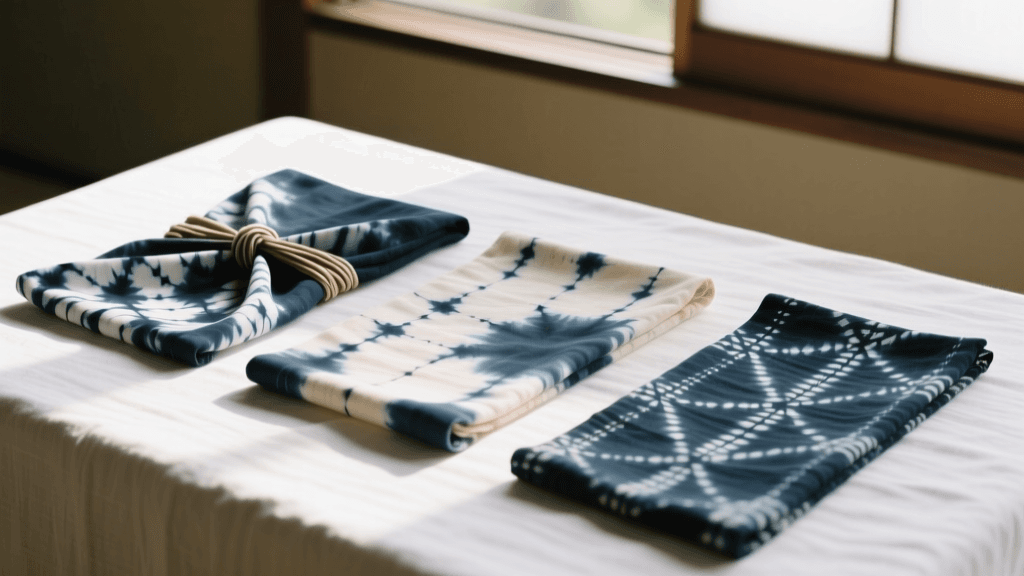
Shibori is a manual resist-dyeing technique that involves folding, twisting, binding, or compressing fabric before immersing it in dye. The most prized form in vintage kimono collecting is Kanoko Shibori (fawn-spot tie-dye), which requires tying thousands of tiny individual knots by hand.
Identifying Authentic Kanoko and Arimatsu Shibori
Authentic hand-tied Shibori possesses a distinct three-dimensional texture. When you run your fingers over the fabric, you should feel the tiny puckers (known as shibo). Modern machine-printed imitations are completely flat. Furthermore, genuine Shibori will retain its textured puckers even after decades of wear, provided it has not been aggressively steam-pressed.
True Kanoko Shibori is a testament to human patience; a single high-quality kimono bolt can require over 100,000 individual hand-tied knots, taking an artisan up to a year to complete.
Collector's Tip: Use a 10x jeweler's loupe (costing around $15-$25) to examine the edges of the dyed circles. Hand-tied Shibori will show slight irregularities and soft, blurred edges where the dye bled under the binding thread. Machine prints will have uniform, pixelated, or perfectly sharp edges.
Yuzen Dyeing: Stencil and Freehand Painting
Yuzen revolutionized Japanese fashion during the Edo period by allowing for intricate, multi-colored pictorial designs on silk. According to The Metropolitan Museum of Art, the evolution of these resist-dyeing techniques allowed commoners to bypass strict sumptuary laws by hiding luxurious designs on the inside of garments or using subtle, highly regulated patterns.
Kyo-Yuzen vs. Kaga-Yuzen
The technique is named after Miyazaki Yuzensai, a 17th-century fan painter from Kyoto who revolutionized textile decoration. By applying a waterproof rice paste (itome nori) through delicate brass stencils or freehand with a fine brush, artisans could separate colors and prevent them from bleeding into one another. This allowed for the creation of the Uroko (scale) and Seigaiha (blue ocean waves) patterns with unprecedented crispness.
Kyo-Yuzen (from Kyoto) is characterized by vibrant, stylized, and often auspicious motifs like cranes, pine trees, and flowing water. Kaga-Yuzen (from Kanazawa) leans towards realistic, naturalistic depictions of flora and fauna, utilizing a strict five-color palette (Kaga Gosai) and featuring a distinctive "insect-bitten" leaf effect.
The hallmark of authentic hand-painted Yuzen is the itome—a fine, white, thread-like line that outlines the design. This line is created by applying a rice-paste resist before dyeing. In modern stencil Yuzen (Kata-Yuzen), the itome is often printed on afterward and lacks the slight raised texture of genuine rice paste. As highlighted in the Victoria and Albert Museum's comprehensive kimono exhibitions, Yuzen allowed for unprecedented artistic expression, turning the kimono into a walking canvas. When inspecting a piece, look for the subtle gradations of color (bokashi) which are incredibly difficult to replicate with modern digital printing.
Kasuri: The Beauty of Blurred Threads
Kasuri (the Japanese equivalent of Ikat) involves dyeing the threads before they are woven. Bundles of yarn are tightly bound to resist the dye, creating a pattern that only emerges once the threads are woven together on a loom. The Smithsonian National Museum of Asian Art notes that Kasuri textiles represent a profound intersection of mathematics, agriculture, and art, particularly in rural Japanese communities.
Kurume and Oshima Kasuri Identification
The creation of authentic Kasuri is a mathematical marvel. Artisans must calculate the exact shrinkage of the cotton or silk threads during the dyeing and weaving processes. A single misalignment of a millimeter can distort the entire geometric pattern. In Kurume, the threads are bound with hemp or cotton string, dipped in fermented indigo vats (sukumo) multiple times to achieve the deep kame-nozoki (bottle-peek) or kon (navy) shades, and then meticulously aligned on the loom.
Kurume Kasuri is traditionally a cotton textile from Fukuoka, known for its deep indigo blue and intricate, often geometric or folk-art patterns. Oshima Tsumugi is a highly prestigious silk Kasuri from Amami Oshima, famous for its incredibly fine, mud-dyed threads that create subtle, dark brown and black patterns.
The Reverse-Side Test: Because Kasuri is dyed at the yarn stage, the pattern must be visible on both the front and the back of the fabric. If you flip the hem or sleeve over and the pattern disappears or looks like a faded shadow, you are looking at a surface-printed fake. Authentic Oshima Tsumugi will show crisp, albeit slightly blurred, patterns on the reverse side.
Comparison Chart: Shibori vs. Yuzen vs. Kasuri
| Feature | Shibori | Yuzen | Kasuri |
|---|---|---|---|
| Primary Technique | Shaped resist (binding/folding) | Rice-paste resist & painting | Pre-dyed warp/weft threads (Ikat) |
| Base Fabric | Silk (Chirimen, Rinzu), Cotton | Silk (mostly) | Cotton (Kurume), Silk (Oshima) |
| Visual Hallmark | 3D puckers, soft blurred edges | White itome outlines, pictorial | Blurred thread intersections |
| Reverse Side | Dye penetrates, but texture differs | Often white or lightly tinted | Pattern clearly visible |
| Avg. Vintage Cost | $150 - $800+ | $200 - $1,500+ | $100 - $2,000+ (Oshima) |
Practical Care and Preservation Guide
Preserving these delicate, historically significant textiles requires specific environmental controls and handling protocols. Improper care can lead to irreversible dye bleeding, silk shattering, or mold.
Washing and Spot Cleaning
- Product: Use a pH-neutral, conservation-grade detergent like Orvus WA Paste or Quilt Soap. Avoid standard laundry detergents containing enzymes or optical brighteners.
- Measurements: Dissolve exactly 1 teaspoon of Orvus paste per 1 gallon of cool distilled water (below 70°F / 21°C).
- Timing: Submerge the garment for no longer than 5 to 10 minutes. Agitate gently by hand. Never wring or twist Shibori, as this will permanently crush the 3D puckers.
- Rinsing: Rinse three times in cool distilled water until no suds remain. Roll the garment in a clean, white cotton towel to press out excess water, then lay flat on a drying rack away from direct sunlight.
Storage and Pest Management
Silk and cotton are highly susceptible to acid degradation and protein-eating pests (like clothes moths and carpet beetles).
- Wrapping: Wrap each kimono in unbleached, washed cotton muslin or acid-free tissue paper (such as Lineco brand). Never use plastic dry-cleaning bags, which trap moisture and emit acidic gases that yellow silk.
- Containers: Store in archival-quality, acid-free cardboard boxes or cedar chests. If using cedar, ensure the wood does not directly touch the fabric, as cedar oils can stain.
- Pest Control: Place natural Aromatic Eastern Red Cedar blocks in the storage area. Sand the blocks lightly every 3 months to refresh the oils, and replace them entirely every 12 to 18 months.
- Humidity Control: Maintain a relative humidity (RH) of 45% to 55% in your storage room. Use a digital hygrometer (approx. $12) to monitor levels. If humidity drops below 40%, silk can become brittle; if it rises above 60%, mold spores will activate. Use renewable silica gel desiccant canisters to absorb excess moisture during humid summer months.
- Airing Out: Every 3 to 4 months, remove the garments from storage on a dry, low-humidity day. Unfold them and let them rest in a shaded, well-ventilated room for 2 hours to prevent permanent crease lines and allow trapped moisture to escape.
Conclusion
Mastering the identification of Shibori, Yuzen, and Kasuri transforms kimono collecting from a simple hobby into a practice of cultural preservation. By understanding the meticulous handiwork behind each knot, brushstroke, and woven thread, collectors can make informed acquisitions and ensure these masterpieces of Asian tradition survive for generations to come.