Authentic Vyshyvanka & Romanian Ie: 2026 Buyer Guide
The Enduring Legacy of Slavic and Balkan Embroidery
The landscape of Eastern European folk dress has experienced a profound renaissance over the last decade, culminating in a highly sophisticated market for traditional garments in 2026. At the forefront of this movement are the Ukrainian vyshyvanka and the Romanian and Moldovan ie (traditional embroidered blouses). Once reserved strictly for village festivals and national holidays, these masterfully crafted textiles are now recognized globally as premier examples of wearable art and intangible cultural heritage. According to UNESCO's framework on Intangible Cultural Heritage, traditional craftsmanship is not merely about the physical object, but the transmission of knowledge, community identity, and ancestral techniques passed down through generations.
For collectors, cultural enthusiasts, and ethical fashion consumers in 2026, navigating the market requires a discerning eye. The surge in global demand has inevitably led to an influx of mass-produced, machine-embroidered replicas that mimic regional patterns without honoring their structural or cultural integrity. This comprehensive guide will equip you with the knowledge to decode regional motifs, authenticate hand-stitched techniques, and ethically source genuine Eastern European folk blouses in today's market.
Decoding Regional Motifs: A Semiotic Map
Before purchasing a vyshyvanka or an ie, it is crucial to understand that traditional Eastern European embroidery is a visual language. Every geometric shape, floral vine, and color combination serves a specific apotropaic (protective) or symbolic function. In 2026, master artisans continue to strictly adhere to these historical codes, whereas commercial manufacturers often mix and match motifs purely for aesthetic appeal, stripping the garment of its cultural context.
Ukrainian Vyshyvanka Regional Variations
Ukraine boasts over 100 distinct regional embroidery techniques. Identifying the origin of a blouse is the first step in authentication:
- Poltava Region: Famous for the bil po bilomu (white-on-white) technique and intricate cutwork (lyshva). Authentic Poltava blouses rely on the texture of the thread and the shadow of the drawn-thread work rather than vibrant colors. In 2026, genuine Poltava cutwork is exceptionally rare and commands premium prices due to the hundreds of hours required to weave the openwork lattice.
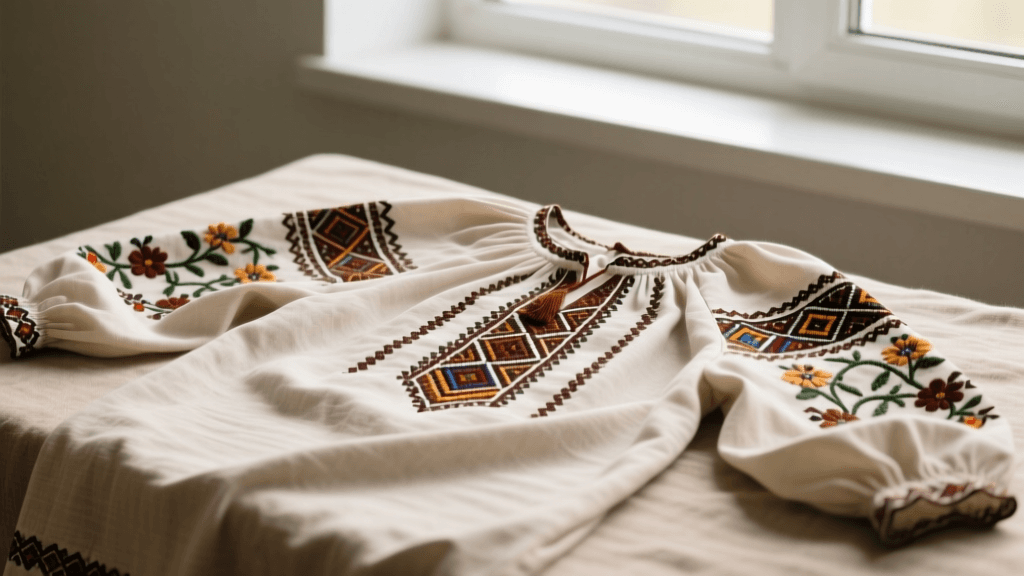
- Hutsul Region (Carpathian Mountains):strong> Characterized by dense, vibrant geometric patterns utilizing bright orange, green, black, and yellow threads. Hutsul embroidery often incorporates curly stitches (kurivka) and is frequently adorned with brass sequins, glass beads, and sometimes metallic threads. The motifs heavily feature the tree of life, rhombuses (symbolizing sown fields and fertility), and solar signs.
- Bukovyna Region: Known for heavy, elaborate floral motifs and the extensive use of beadwork and metallic threads. The sleeves are often entirely covered in dense embroidery, creating a stiff, armor-like protective barrier for the wearer.
Romanian and Moldovan Ie Traditions
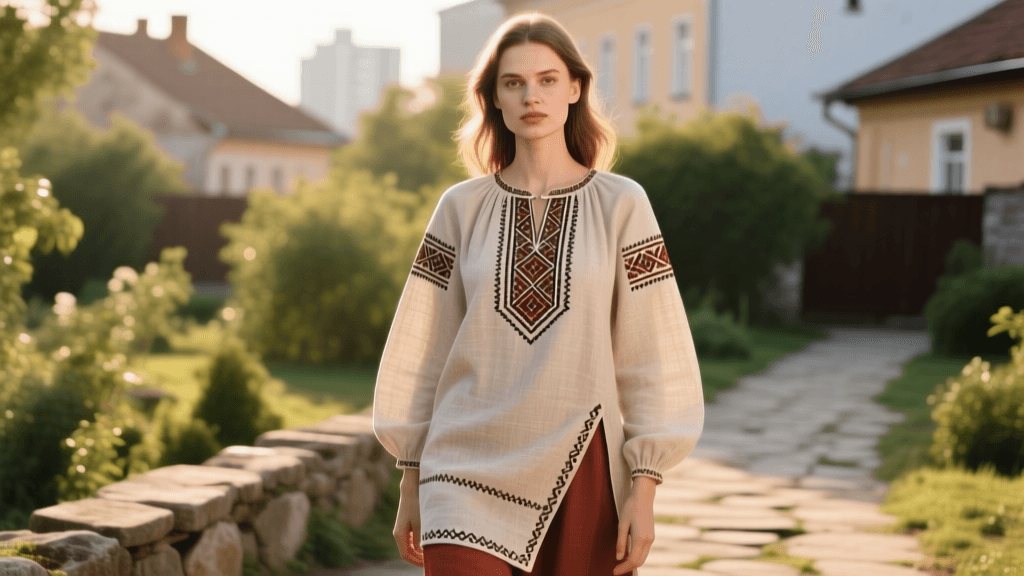
The Romanian ie is defined by its specific structural layout, most notably the altiniță (a wide, dense band of embroidery on the shoulder) and the râuri (vertical rivers of embroidery flowing down the sleeve).
- Maramureș: Blouses from this northern region are typically monochrome, featuring tight, microscopic geometric patterns stitched in black or dark brown thread on white hemp or linen. The precision required for Maramureș cross-stitch is staggering, with some authentic pieces featuring over 40 stitches per inch.
- Argeș and Vâlcea: These regions favor intricate floral and vegetal motifs, often utilizing red and black threads. The altiniță is highly pronounced, and the spaces between the vertical râuri are often filled with delicate lace-like insertions (cheițe) crocheted by hand.
2026 Market Guide: Sourcing Authentic Handmade Pieces
Sourcing an authentic, hand-embroidered blouse in 2026 requires looking beyond standard retail channels. The most reliable method is to purchase directly from artisan cooperatives, verified cultural foundations, or specialized heritage boutiques located in Kyiv, Lviv, Bucharest, and Cluj-Napoca, as well as established diaspora hubs in North America and Western Europe.
Pricing for authentic folk dress has stabilized in 2026, reflecting the true cost of artisanal labor and sustainable materials. Expect to pay between $280 and $450 for an entry-level handmade blouse stitched on mill-spun linen. Masterwork pieces, featuring hand-spun hemp, natural botanical dyes, and antique techniques like Poltava cutwork or Hutsul beadwork, typically range from $800 to well over $1,500. If a vendor is offering a 'handmade' vyshyvanka with complex, dense regional patterns for under $100, it is almost certainly machine-made or produced in a fast-fashion sweatshop.
Fabric and Thread: How to Spot Machine-Made Fakes
Understanding the physical construction of the garment is your best defense against counterfeits. As detailed in Encyclopedia Britannica's comprehensive guide to embroidery techniques, the mechanics of hand-stitching differ fundamentally from computerized multi-head embroidery machines. Here is how to conduct the 'reverse side test' and inspect the materials:
- The Reverse Side Test: Turn the garment inside out. Hand-embroidered cross-stitch and satin stitch should look nearly as neat on the back as on the front, with threads following logical, continuous paths. Machine embroidery will reveal a messy underside with erratic bobbin threads, jump stitches, and synthetic stabilizer backing (a papery or plastic-like mesh used to keep the fabric taut in the machine hoop).
- Thread Composition: Authentic artisans in 2026 predominantly use high-mercerized cotton, silk, or wool threads. Mass-produced replicas often use polyester or rayon threads, which possess an unnatural, plastic-like sheen and feel slightly slippery to the touch.
- Fabric Weave: Traditional blouses are stitched on even-weave linen, hemp, or cotton blends. Artisans count the threads of the fabric to ensure perfect geometric symmetry. Machine-made fakes are often stitched on standard, uneven-weave commercial cotton, resulting in slightly distorted geometric patterns.
Comparison: Handmade vs. Machine-Made Embroidery (2026)
| Feature | Authentic Handmade | Mass-Produced Machine |
|---|---|---|
| Reverse Side | Neat, logical thread paths; no stabilizer backing. | Messy bobbin threads, jump stitches, synthetic mesh backing. |
| Thread Material | Mercerized cotton, silk, wool; matte or soft luster. | Polyester or rayon; high synthetic shine, slippery feel. |
| Production Time | 40 to 200+ hours per blouse. | 1 to 3 hours per blouse. |
| Cultural Accuracy | Strict adherence to regional semiotics and layouts. | Randomized motifs mixed for purely visual aesthetics. |
| 2026 Price Range | $280 - $1,500+ | $35 - $95 |
Ethical Sourcing and Supporting Artisan Cooperatives
The revival of Eastern European folk dress is deeply tied to economic empowerment for rural women and the preservation of endangered crafts. When purchasing in 2026, prioritize vendors who provide transparency regarding their supply chain. Organizations and digital platforms that partner directly with village cooperatives ensure that the artisans receive fair, living wages for their painstaking labor. Look for certifications or partnerships with recognized cultural heritage NGOs. Avoid platforms that drop-ship unbranded 'peasant blouses' from overseas manufacturing hubs, as these purchases actively undercut the livelihoods of the very custodians keeping these ancient traditions alive.
Natural Dyes vs. Synthetic Colors
A growing trend among master artisans in 2026 is the return to botanical and natural dyeing. While high-quality synthetic aniline dyes have been used in Eastern Europe since the late 19th century, contemporary heritage brands are reviving the use of madder root (for deep reds), woad and indigo (for blues), onion skins (for vibrant yellows and oranges), and walnut husks (for rich browns and blacks). Naturally dyed threads possess a complex, variegated depth of color that synthetic threads cannot replicate. Furthermore, natural dyes age gracefully, developing a soft, cherished patina over decades, whereas cheap synthetic dyes tend to fade unevenly or bleed when exposed to moisture.
Care and Preservation of Heirloom Textiles
An authentic vyshyvanka or ie is an investment and a potential family heirloom. Proper conservation is essential to maintain the structural integrity of the linen and the vibrancy of the threads. Drawing upon best practices from institutions like the Victoria and Albert Museum's fashion and textile archives, follow these preservation guidelines:
- Washing: Never machine wash or dry clean a handmade folk blouse. Hand wash gently in cold water using a pH-neutral, conservation-grade textile soap. Do not wring or twist the fabric; instead, press the water out gently between clean, dry towels.
- Drying and Ironing: Lay the garment flat to dry away from direct sunlight, which can degrade both natural and synthetic dyes. Iron the blouse while it is still slightly damp, always pressing on the reverse side over a clean cotton cloth to prevent crushing the three-dimensional texture of the embroidery.
- Storage: For long-term storage, do not use wire hangers, as they will distort the shoulder seams and the delicate altiniță. Fold the blouse gently, padding the folds with acid-free tissue paper to prevent hard creases that can eventually snap the linen fibers. Store in a breathable cotton garment bag or a cedar chest to protect against moths and humidity.
By understanding the profound history, regional nuances, and structural markers of Eastern European folk dress, you can confidently navigate the 2026 market. Choosing authentic, ethically sourced garments not only elevates your personal wardrobe but actively participates in the safeguarding of Europe's most exquisite textile traditions.