Authentic Viking Smokkr and Kyrtil Sewing Guide 2026
The 2026 Shift Toward Archaeological Accuracy
As the 2026 historical reenactment and living history season approaches, the standard for Viking Age garments has reached unprecedented levels of archaeological accuracy. The days of Hollywood-inspired leather armor, furry cloaks, and generic peasant tunics are entirely behind us. Today’s dedicated historians, textile artists, and reenactors demand garments that reflect the true material culture of Scandinavia and the broader Norse diaspora between the 8th and 11th centuries. According to the National Museum of Denmark, recent textile analyses from burial sites have completely reshaped our understanding of Viking tailoring, dyeing, and weaving techniques.
This comprehensive guide will walk you through the authentic reconstruction of the two most iconic garments in the Norse wardrobe: the Smokkr (the apron dress) and the Kyrtil (the tunic or underdress). We will cover historically accurate zero-waste cutting layouts, period-correct seam finishes, and where to source the best materials for your 2026 projects.
Deconstructing the Smokkr (Apron Dress)
The Smokkr, often referred to as the apron dress, is the defining garment of the Viking Age woman’s wardrobe. Suspended from the shoulders by a pair of oval brooches (often called tortoise brooches), this garment was both highly functional and a primary canvas for displaying wealth through fabric quality and elaborate trims.
The Tube vs. Wrapped Dress Debate
For decades, reenactors debated whether the Smokkr was a wrapped garment or a closed tube. Based on textile fragments found in Birka, Hedeby, and Køstrup, the modern 2026 consensus heavily favors the closed tube or multi-panel construction for most regions, though wrapped variations likely existed in specific locales or earlier periods. For a universally accepted, highly accurate reconstruction, the four-panel tube dress with integrated side gores is the gold standard. This design minimizes fabric waste and provides the necessary flare at the hem for walking and working.
Fabric Selection and Zero-Waste Cutting
Authentic Smokkrs were almost exclusively made from wool. For a high-status reconstruction, look for a diamond twill or herringbone twill weave. The fabric weight should ideally fall between 250 and 350 grams per square meter (GSM). When cutting your fabric, utilize a zero-waste historical layout: the main body panels are cut as rectangles, while the side gores are cut as right-angled triangles that perfectly interlock on the woven cloth. This respects the immense time and labor required to produce hand-woven cloth in the Viking Age.
The Kyrtil (Tunic) and Underdress Construction
Worn beneath the Smokkr by women, or as the primary outer garment by men, the Kyrtil is the foundational layer of Norse dress. While women’s underdresses were often made of fine, bleached linen or lightweight tabby-woven wool, men’s tunics were typically constructed from heavier, dyed wool.
Necklines and Gore Placement
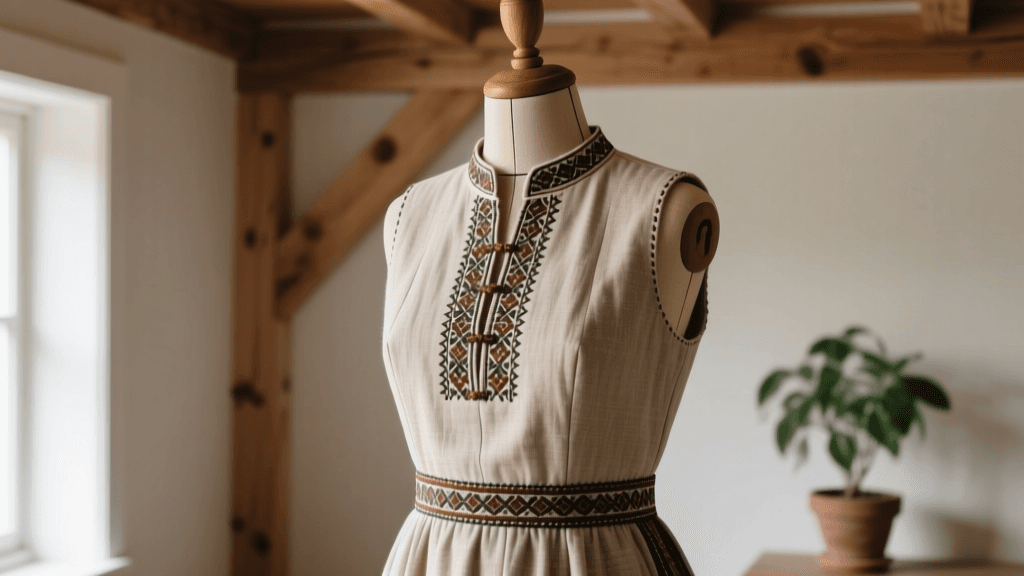
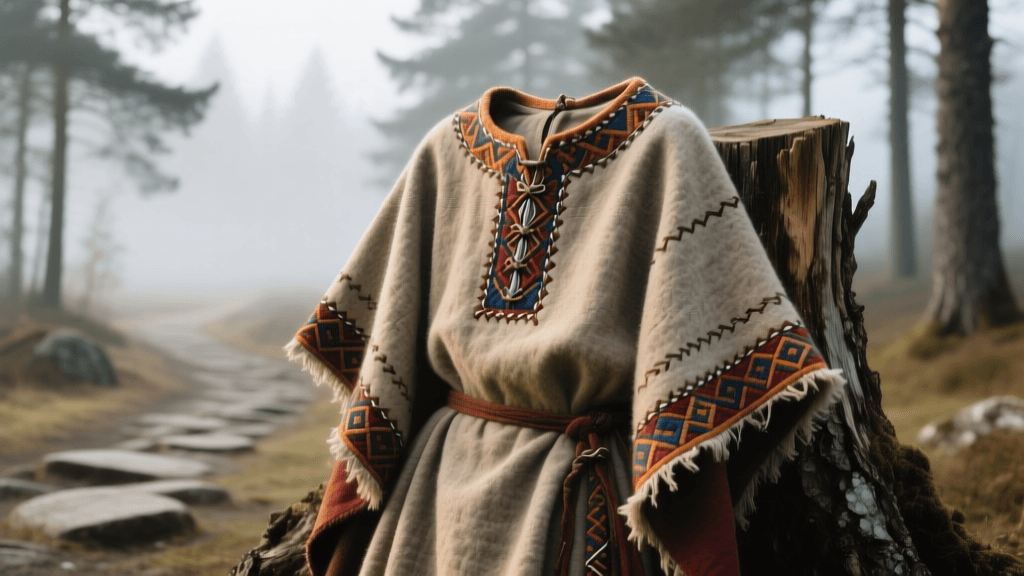
The most critical error modern sewers make with the Kyrtil is the neckline. Avoid modern boat necks or deep V-necks. The historically accurate neckline is a simple round opening with a vertical slit (the keyhole neckline), secured by a woven drawstring or a small bone, wood, or bronze toggle. The slit should be finished with a narrow, rolled hem or a tablet-woven edge.
To achieve the dramatic flare seen in historical depictions, the Kyrtil relies on gores—triangular fabric inserts. Place two gores at the side seams and, for a more advanced and historically supported silhouette, insert a center-front and center-back gore. This creates a skirt with beautiful, flowing drape that moves naturally with the body.
Seam Finishes: The Hedeby Hem and Mammen Stitch
In 2026, the mark of a master Viking tailor is not just the cut of the garment, but the finishing of the seams. Raw edges were never left exposed in high-quality Norse garments. Two techniques are essential for your reconstruction:
- The Hedeby Hem: Used primarily on hems and necklines, this technique involves rolling the raw edge inward, whipping it down, and then covering the raw edge with a narrow strip of silk or fine wool, stitched down with a blind hem stitch.
- The Mammen Stitch: A decorative and functional embroidery stitch used to cover seams, particularly on cuffs and hems. It creates a raised, braided appearance that is both beautiful and structurally reinforcing.
Tablet Weaving for Authentic Trims
No Viking garment is complete without tablet-woven trims. The Viking Ship Museum in Roskilde highlights that tablet weaving was not merely decorative; it provided crucial structural reinforcement to high-stress areas like necklines, cuffs, and the top edges of the Smokkr. For your 2026 projects, utilize a 3/1 twill tablet weave using fine wool or silk yarn. The continuous warp method, where the weft thread is passed through the shed and then sewn directly into the garment edge as you weave, is the most historically accurate way to attach trims.
2026 Material and Dye Sourcing Chart
Sourcing historically accurate materials can be challenging. Below is a comparison chart of recommended fabrics and natural dyes for the 2026 reenactment season, balancing historical accuracy with modern availability and cost.
| Material / Dye | Historical Application | 2026 Estimated Cost (per yard) | Authenticity Rating |
|---|---|---|---|
| Diamond Twill Wool (12/12) | High-status Smokkr, Winter Kyrtil | $65 - $85 | Excellent |
| Tabby Woven Linen (Bleached) | Women's Underdress, Men's Summer Tunic | $25 - $40 | Very Good |
| Madder Root Dye (Red/Orange) | High-status garments, tablet weaving yarn | $30 - $45 (dyed) | Excellent |
| Woad / Indigo Dye (Blue) | Men's tunics, cloaks, trim | $35 - $50 (dyed) | Good (Woad preferred) |
| Walnut Hull Dye (Brown) | Everyday work garments, lower status | $20 - $30 (dyed) | Excellent |
Essential Hardware: Oval Brooches and Belts
The Smokkr relies entirely on its hardware for suspension. You will need a pair of oval brooches. For an accurate 9th or 10th-century impression, avoid cheap, pot-metal castings from mass-market costume shops. Invest in sand-cast bronze or brass replicas based on specific archaeological finds, such as the P37 or P51 brooch types. These should feature a double-pin mechanism and be attached to the dress using linen or wool loops, never leather.
Belts were another vital accessory. While men often wore leather belts with bronze buckles, women’s belts were frequently tablet-woven bands made of wool or linen, tied or secured with simple woven knots or small bone rings. If you choose a leather belt, ensure it is vegetable-tanned and dyed with natural tannins, avoiding modern chrome-tanned leathers which have an artificial, plastic-like sheen.
Nålbindning: The Forgotten Textile Art
To complete your Viking wardrobe for the harsh winters of the 2026 festival circuit, you must look beyond woven textiles to Nålbindning (needle binding). This ancient technique, which predates knitting and crocheting, uses a single flat bone or wooden needle to create dense, highly insulating, and stretchy fabrics. Nålbindning was used exclusively for socks, mittens, and sometimes hats. The Mammen stitch and the Dalby stitch are the most well-documented patterns from the Viking Age. Learning this technique will elevate your living history impression from merely accurate to truly exceptional.
Conclusion
Creating an authentic Viking Smokkr and Kyrtil in 2026 is a deeply rewarding journey into experimental archaeology. By prioritizing zero-waste cutting patterns, period-correct seam finishes like the Hedeby hem, and historically accurate natural dyes, you honor the incredible skill of the original Norse textile workers. Whether you are preparing for a major historical festival or simply expanding your traditional garment collection, the dedication to archaeological truth ensures that the legacy of Viking craftsmanship continues to thrive in the modern era.