Authentic Viking Smokkr Apron Dress Reconstruction Guide 2026
The Shift Toward Archaeological Accuracy in 2026
The landscape of historical European martial arts (HEMA) and Viking reenactment has undergone a massive transformation by the 2026 festival season. Gone are the days of fantasy-inspired leather armor, synthetic fabrics, and inaccurate "biker" aesthetics. Today, the focus is entirely on archaeological authenticity, particularly regarding the traditional garments of the Norse people. At the center of this revival is the Smokkr, commonly known as the Viking apron dress. This comprehensive guide explores how modern historical tailors and enthusiasts are reconstructing the Smokkr in 2026, utilizing historically accurate wool weaves, natural botanical dyes, and traditional tablet-weaving techniques to honor true European folk dress.
Deconstructing the Smokkr: The Archaeological Evidence
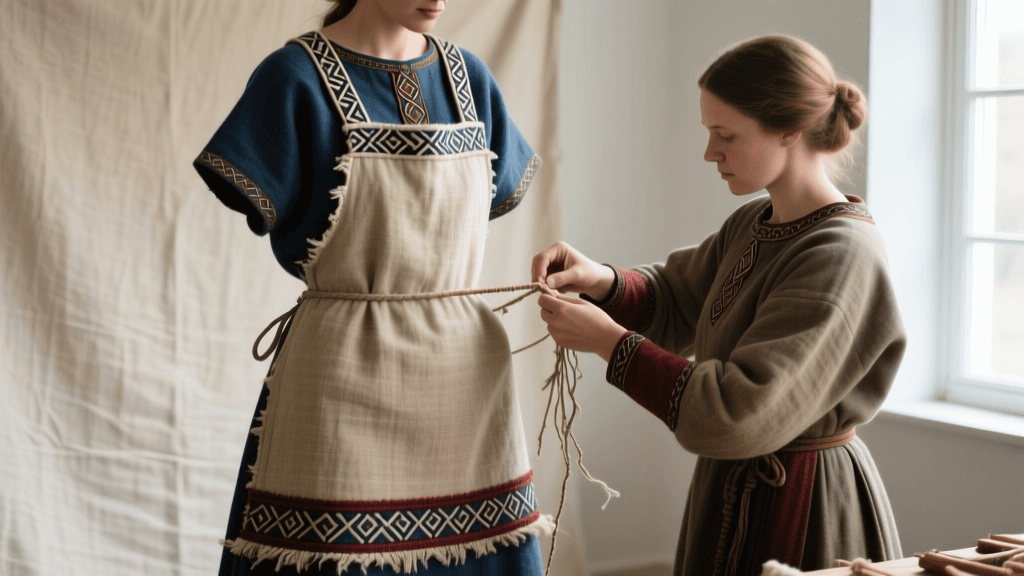
The term Smokkr is derived from Old Norse, referring to a tubular or open-sided overdress suspended by shoulder straps. The most crucial archaeological evidence for the Smokkr comes from the Køstrup find in Funen, Denmark, which famously preserved a small, pleated panel of diamond twill wool attached to a pair of oval brooches. Another vital piece of evidence is the Hedeby harbor fragment, which showcases tailored shaping and intricate stitching. When drafting a pattern in 2026, historical tailors no longer rely on the simplistic "two-rectangle" fantasy patterns popularized by early television shows. Instead, they use multi-panel constructions featuring side gores and front/back gussets to allow for movement while maintaining the elegant drape of the heavy wool.
According to the National Museum of Denmark, the preservation of textile fragments from sites like Hedeby and Mammen reveals a society that valued complex weaving patterns and vibrant, color-fast dyes as primary indicators of wealth and social status. The 2026 consensus among textile archaeologists is that the Smokkr was a highly tailored garment, not a simple wrapped blanket.
Sourcing Historically Accurate Textiles
Finding the right fabric is the most critical step in a 2026 Smokkr reconstruction. The Norse favored diamond twill (also known as broken diamond twill) and herringbone weaves for their high-status garments. In 2026, specialized heritage weavers in the UK, Sweden, and Estonia produce hand-woven or shuttle-loom diamond twill wool that closely mimics the thread count of archaeological finds (typically 10-14 threads per cm in the warp and 12-16 in the weft). Expect to pay between €45 and €75 per meter for authentic, undyed diamond twill wool from heritage mills this year.
| Textile Weave | Historical Use & Status | Thread Count (Warp/Weft) | 2026 Market Price (per meter) |
|---|---|---|---|
| Diamond Twill | High-status overdresses (Smokkr), cloaks | 12-16 / 14-18 per cm | €55 - €85 |
| Herringbone Twill | Everyday tunics, winter mantles | 10-14 / 12-15 per cm | €40 - €60 |
| Tabby (Plain) Weave | Underdresses (Serk), linings, thrall clothing | 8-12 / 8-12 per cm | €25 - €40 |
Natural Dyeing: Achieving Authentic Viking Colors
The popular media depiction of Vikings wearing drab browns and grays is a myth reserved only for the poorest thralls or undyed everyday workwear. High-status Norse women wore brilliant reds, deep blues, and vibrant yellows. In 2026, authentic reconstruction requires the use of natural botanical dyes. Madder root (Rubia tinctorum) is used to achieve rich reds and oranges, requiring an alum mordant to bind the color to the wool. Woad (Isatis tinctoria) provides the iconic Norse blue, while weld or dyer's broom yields bright yellows.
Modern dyers are increasingly using fermentation vats for woad, a technique validated by recent archaeological chemistry papers, to achieve the deep, color-fast blues seen in the Oseberg ship burial textiles. Sourcing organic, historically accurate mordants like clubmoss (for alum extraction) has become a major trend in the 2026 historical dyeing community, ensuring that the chemical footprint of the garment matches the 9th-century originals.
Construction Techniques and the Serk
Viking Age sewing was executed entirely by hand, using fine bone or iron needles. To achieve an authentic 2026 reconstruction, machine sewing must be avoided, or at the very least, hidden entirely within the seam allowances. The primary seams were often constructed using a running stitch, but the raw edges were meticulously finished to prevent fraying. The most common edge finish was the overcast stitch or a folded hem secured with a whipstitch. For high-status garments, seams were sometimes covered with narrow strips of silk or fine wool, or embellished with stem stitching using contrasting wool yarn.
Drafting the Serk (Underdress)
The foundation of the Viking wardrobe is the Serk, or underdress. While the Smokkr is made of heavy wool, the Serk was typically crafted from fine, tightly woven linen or lightweight wool. In 2026, historical tailors favor unbleached or naturally pale linen, avoiding the harsh chemical bleaches of modern fabrics. The Serk is cut with underarm gussets and side gores to provide a wide hemline for walking and working, while keeping the shoulders and neckline relatively fitted. A keyhole neckline, closed with a simple woven tie or a small bronze ring pin, is the most archaeologically supported design.
Tablet Weaving and High-Status Trims
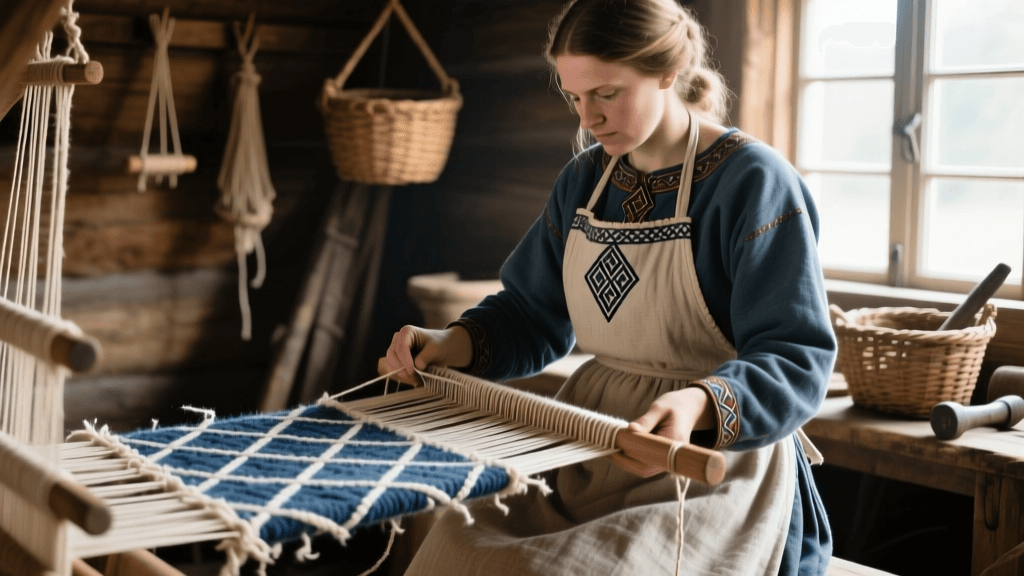
No high-status Smokkr is complete without tablet-woven trims. The Viking Ship Museum in Roskilde highlights that tablet weaving was not merely decorative but served to reinforce the structural edges of the garment, particularly around the neckline and the top hem of the apron dress. Using small square cards with holes in the corners, weavers twist the warp threads to create intricate, geometric patterns.
The Oseberg ship burial yielded some of the most complex tablet-woven bands in history, featuring motifs of animals and interlacing knotwork. In 2026, reenactors use historically carved bone, antler, or wood tablets, spinning their own wool yarn to match the exact Z-spun/S-plied twist directions found in archaeological textile reports. The integration of imported Byzantine silk threads into tablet-woven bands is also a highly accurate way to denote extreme wealth and far-reaching trade connections in a modern reconstruction.
Accessorizing the Smokkr: Oval Brooches and Beads
The Smokkr is held together by a pair of oval brooches, often colloquially called "tortoise brooches" due to their domed, textured shape. These bronze, silver, or gold-alloy brooches are not just jewelry; they are the structural suspension system of the dress. The linen or wool straps of the Smokkr are looped through the pins of these brooches, securing the garment over the shoulders.
In 2026, master casters use lost-wax casting methods based directly on 3D scans of original museum artifacts to produce flawless replicas of the P51 or P37 brooch types. Between the brooches, women strung beads of glass, amber, and carnelian. The number, size, and quality of beads directly correlated to the wearer's wealth and regional trade access. Modern glassblowers in Scandinavia are currently producing historically accurate mosaic and millefiori beads using traditional pontil techniques, perfectly matching the palettes of the 9th and 10th centuries.
Conclusion
Reconstructing the Viking Smokkr in 2026 is a labor of love that bridges the gap between modern craftsmanship and ancient Norse ingenuity. By prioritizing archaeological evidence over fantasy tropes, today's historical tailors are keeping the true textile heritage of the Viking Age alive. Whether you are preparing for the upcoming summer reenactment festivals, participating in living history demonstrations, or simply studying historical European folk dress, the dedication to authentic weaves, natural dyes, and traditional stitching offers a profound connection to the women who originally spun, wove, and wore these magnificent garments.