Bavarian Tracht for Schuhplattler Dance: 2026 Festival Guide
The Resurgence of Authentic Tracht in 2026 Festival Culture
As the 2026 European folk festival season approaches, from the alpine Maifest celebrations to the massive Oktoberfest gatherings in Munich, there is a definitive shift away from mass-produced "costume shop" apparel. Enthusiasts, cultural preservationists, and folk dance troupes are returning to the roots of authentic Tracht (traditional regional dress). For those participating in or attending traditional folk dance performances, particularly the vigorous and acrobatic Schuhplattler, wearing historically accurate and structurally sound garments is not just a matter of aesthetics—it is a requirement for mobility, safety, and cultural respect.
The Bavarian National Museum, which houses one of the world's most extensive collections of historical European folk dress, notes that regional Tracht is deeply tied to local identity. In 2026, master tailors and leatherworkers in Upper Bavaria and the Tyrol are experiencing record backlogs for bespoke dance garments, driven by a younger generation's desire to preserve intangible cultural heritage through active participation in folk dance guilds (Trachtenvereine).
The Mechanics of Schuhplattler: Demands on Traditional Garments
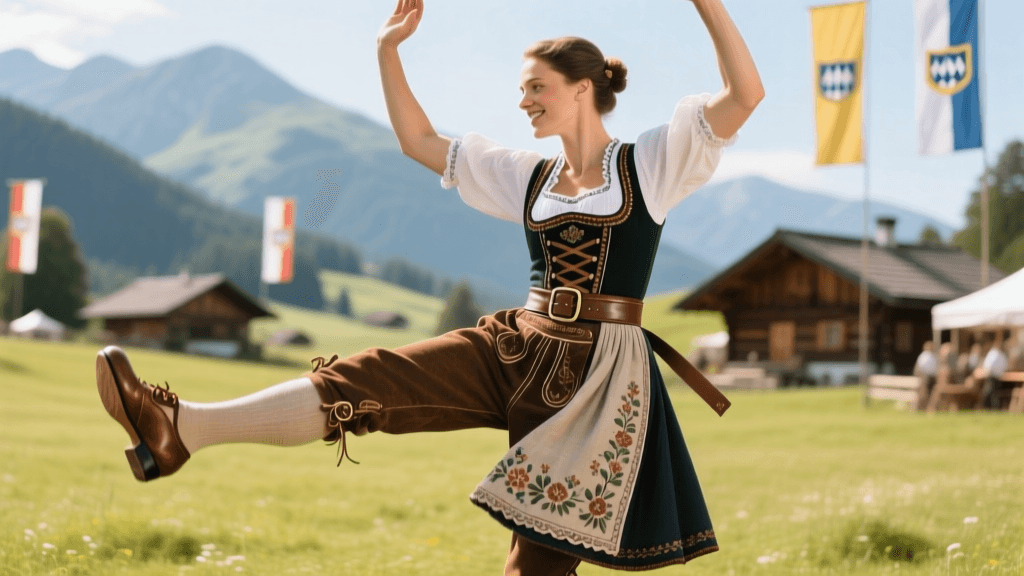
The Schuhplattler is a highly physical folk dance originating from the Alpine regions of Bavaria, Tyrol, and Salzburg. It involves leaping, stomping, and rhythmically slapping the thighs, knees, and shoes. The physical demands placed on the garments are immense. A standard fashion-lederhosen will tear at the seams during a Weitsprung (long leap), while a poorly constructed Dirndl bodice will fail to provide the necessary support during rapid, centrifugal spins.
Key Stress Points for Dancers
- The Thigh and Knee Impact: Male dancers strike their leather breeches repeatedly. The leather must be thick enough to absorb shock but supple enough to allow deep squats.
- The Spin and Flare: Female dancers execute rapid turns. The skirt must have a precise circumference and weighted hem to flare beautifully without tangling in the dancer's legs.
- Thermal Regulation: Festival tents and outdoor alpine stages in 2026 can swing from sweltering heat to chilly mountain evenings. Natural fibers like linen, wool, and genuine leather are mandatory for breathability.
Sourcing Authentic Lederhosen for Male Dancers
For male Schuhplattler dancers, the Bundlederhosen (knee-breeches) are the centerpiece of the ensemble. In 2026, the gold standard for dance-specific Lederhosen relies on specific tanning processes and regional embroidery patterns.
Leather Selection and Tanning
Authentic dance Lederhosen are never made from cowhide, which is too stiff and heavy. Instead, dancers seek out Hirschleder (deer leather) or Wildbockleder (chamois/ibex leather). The tanning process is equally critical. Look for Samtgerbung (a traditional suede-like brain-tanning or oil-tanning method) which leaves the leather incredibly soft, breathable, and durable. For dance, the leather weight should be between 1.0mm and 1.2mm. Anything thinner will not withstand the slapping; anything thicker will restrict the high kicks required in the dance choreography.
Construction and Embroidery
The cut of the breeches must include a hidden gusset in the crotch and reinforced double-stitching along the inner thigh. The front flap (Latz) is traditionally fastened with horn buttons. Embroidery (Stickerei) is not merely decorative; it historically denoted the wearer's specific valley or village. For the 2026 festival season, the Miesbach and Werdenfels regional patterns remain the most popular among dance troupes, featuring intricate floral motifs stitched in silk or heavy cotton thread. According to cultural guidelines highlighted by the German National Tourist Board, wearing the correct regional Tracht fosters a deeper connection to the specific local folk dances being performed.
Dirndl Construction: Balancing Silhouette and Spin
The female equivalent for folk dance is the authentic Dirndl, which consists of three distinct pieces: the bodice (Mieder), the skirt (Rock), and the apron (Schürze). Modern "Dirndl" dresses sold in fast-fashion outlets are single-piece garments that are entirely unsuitable for the rigors of folk dance.
The Bodice (Mieder)
For a dancer, the bodice must provide corset-like support without restricting diaphragmatic breathing. Authentic 2026 dance bodices are constructed with internal boning (often synthetic whalebone or flexible steel) and are lined with sturdy cotton or linen. They are fastened with a chain laced through silver or horn hooks, or with traditional frog closures. A properly fitted Mieder supports the bust during jumps and maintains the dancer's posture during the demanding arm movements of the Schuhplattler.
The Skirt (Rock) and Cartridge Pleating
The skirt is where the magic of the dance happens. An authentic dance skirt is cut from a full circle or double-circle of lightweight wool, linen, or high-quality cotton. The waist is gathered using cartridge pleating (Falten), which allows the skirt to sit flat against the waistband but explode outward during a spin. For dance troupes, the hemline is strictly regulated—typically falling to mid-calf (Midi length) to ensure the slapping dancers can see their partners' footwork. A subtle lead-weight tape is often sewn into the hem in 2026 to ensure the skirt drops perfectly the moment the spin ends.
"A true Trachtenskirt is engineered like a parachute. It must catch the air during the Dreher (spin) and collapse instantly upon stopping, revealing the intricate footwork beneath." — Master Tailor, Chiemgau Trachten Guild.
Footwear: Haferlschuhe and Dirndlschuhe
Footwear can make or break a folk dancer. The traditional Bavarian Haferlschuh for men features a distinctive side-lacing system and a robust, hobnailed or heavily treaded leather sole. For wooden festival stages in 2026, dancers are opting for custom-fitted Haferlschuhe with a slight rubberized heel tap to prevent slipping during stomping routines while maintaining the traditional aesthetic.
Women wear Dirndlschuhe, which resemble a sturdy Mary Jane or a low-boot. For dance, stilettos or thin heels are strictly forbidden. Dancers require a solid, low block heel (no higher than 3cm) with a flexible leather sole that allows for the articulation of the foot during rapid stepping sequences.
2026 Tracht Sourcing and Investment Guide
Investing in authentic dance Tracht is a significant financial commitment, but it ensures longevity and cultural accuracy. Below is a comparative guide to pricing and sourcing for the 2026 season, reflecting current artisan rates in Southern Germany and Austria.
| Garment Tier | Material & Construction | Estimated Cost (EUR, 2026) | Suitability for Schuhplattler |
|---|---|---|---|
| Tourist / Fast Fashion | Polyester blends, glued seams, cowhide faux-leather. | €80 - €150 | Unsuitable. Will tear or cause chafing. |
| High-End Off-the-Rack | Genuine deer leather, wool skirts, cotton lining. Standard sizing. | €450 - €900 | Good for casual festival wear; acceptable for beginner dancers. |
| Bespoke Artisan Tracht | Custom-tailored Wildbock leather, hand-embroidered, cartridge-pleated wool skirts. | €1,800 - €3,500+ | Professional standard. Required for competitive Trachtenvereine. |
Maintenance for the 2026 Festival Season
Authentic Tracht requires specialized care to survive a rigorous festival season. Lederhosen should never be machine washed. The natural oils from the skin actually condition the deer leather over time, creating a beautiful patina. Spot cleaning with a damp cloth and specialized leather soap is sufficient. For the Dirndl skirt and apron, dry cleaning is recommended for heavy wools, while linen blouses (Dirndlbluse) can be gently hand-washed and ironed on a high setting to maintain crispness.
As you prepare for the vibrant folk festivals of 2026, remember that traditional European dress is a living, breathing art form. By investing in garments built for the demands of the Schuhplattler, you are not just buying clothes; you are stepping into a centuries-old lineage of alpine culture, movement, and community.