2026 Schuhplattler Dance: Authentic Bavarian Tracht Guide
The Heartbeat of Bavaria: Schuhplattler Dance in 2026
As we navigate the vibrant European festival calendar of 2026, few cultural expressions are as visually arresting and acoustically thunderous as the Bavarian Schuhplattler. This traditional folk dance, deeply rooted in the Alpine regions of Germany and Austria, is a mesmerizing display of athleticism, courtship, and regional pride. Unlike static museum exhibits, the Schuhplattler is a living tradition, performed at Maibaumfest (Maypole) celebrations in May and culminating at the world-famous Oktoberfest, which runs from September 19 to October 4 in 2026. To truly understand this dance, one must examine the garments that make it possible: the authentic Bavarian Tracht. At The Garment Atlas, we delve into the textile engineering, historical accuracy, and modern sourcing of these iconic costumes, separating genuine heritage wear from commercial tourist novelties.
The Mechanics of the Dance and Textile Requirements
The Schuhplattler is historically a courtship dance, designed to mimic the mating ritual of the Auerhuhn (capercaillie). The male dancers (Buam) execute a series of rhythmic, acrobatic leaps, forcefully slapping their thighs, knees, and the soles of their shoes in rapid succession. This high-impact choreography demands extraordinary durability and flexibility from the lower garments. Conversely, the female dancers (Diandln) perform continuous, rapid spins (Drehen), requiring skirts engineered with precise pleating and weighted hems to create a perfect, gravity-defying bell shape. According to the Bayerischer Trachtenverband (Bavarian Tracht Association), authentic dance costumes must adhere to strict regional guidelines, ensuring that the textiles move harmoniously with the dancer's body without restricting breath or mobility.
Deconstructing the Men's Tracht: Beyond the Tourist Shops
The Lederhosen: Sämisch Tanning and Hirschleder
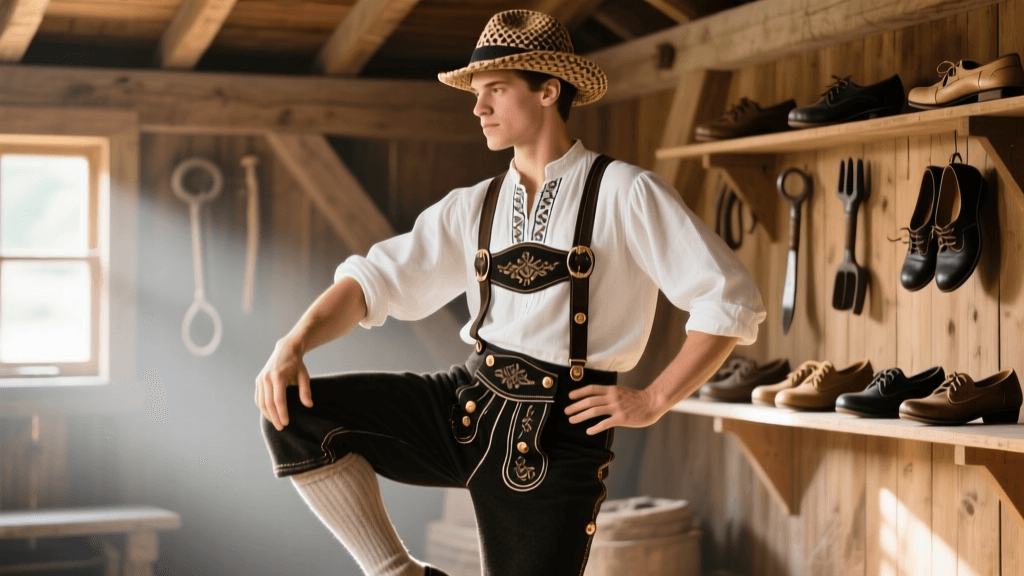
Authentic Lederhosen are not merely leather shorts; they are masterpieces of Alpine tanning. For the 2026 festival season, serious collectors and dance guild members insist on Hirschleder (deer leather) processed via Sämischgerbung (brain and cod-liver oil tanning). This ancient method yields a suede-like finish that is exceptionally soft, breathable, and, remarkably, washable. When a dancer performs the Schuhplattler, the leather must absorb the impact of the slaps without stiffening or cracking over time. The embroidery, often featuring motifs of edelweiss, oak leaves, or hunting scenes, is traditionally executed using Federkielstickerei (peacock feather quill embroidery) or heavy silk floss. A genuine pair of bespoke Miesbacher or Werdenfelser Lederhosen in 2026 will cost between €1,200 and €2,500, reflecting the hundreds of hours of hand-stitching required.
The Trachtenhut, Gamsbart, and Haferlschuhe
The headwear and footwear are equally critical for the folk dancer. The traditional Trachtenhut is made of water-resistant loden wool or rabbit felt, adorned with a Gamsbart—a tuft of hair from the chamois antelope. The size and quality of the Gamsbart denote the wearer's status and regional origin. For footwear, the Haferlschuh is mandatory. Originating from Alpine workwear, this shoe features a distinctive side-lacing system and a heavily studded, rubberized sole. For the 2026 dance season, dancers are advised to purchase Haferlschuhe a half-size larger than their standard fit to accommodate the thick, hand-knitted wool socks (Loferer Stutzen) that provide essential calf support and friction protection during the vigorous leg-slapping routines.
The Women's Dirndl: Engineering the Perfect Spin
Bodice Structure and Skirt Dynamics
The modern commercial Dirndl is often reduced to a tight, zippered bodice and a flimsy skirt. However, the authentic Dirndlgwand worn by folk dance troupes is a marvel of structural tailoring. The bodice (Mieder) is heavily structured with internal linen lining and cording, providing torso support without the use of rigid boning that would impede the deep breathing required for aerobic dancing. It is fastened with a chain or silk ribbon laced through silver or horn hooks. The skirt (Rock) is the true star of the Schuhplattler. Cut from a heavy wool blend or densely woven cotton, the skirt is either knife-pleated or gathered at the waist. The hem is often weighted with a subtle cotton tape to ensure that when the dancer spins, the skirt flares out horizontally, maintaining a modest and traditional silhouette.
The Apron Bow Code (Schleife)
The silk or fine linen apron (Schürze) is tied in a specific manner that communicates the wearer's marital status—a vital piece of non-verbal communication at village festivals. The 2026 etiquette remains strictly observed in traditional guilds:
- Bow on the Left: Single and available for courtship.
- Bow on the Right: Married, engaged, or in a committed relationship.
- Bow in the Center: Traditionally denotes virginity, though in modern festival settings, it is often worn by waitresses to prevent patrons from untying it.
- Bow in the Back Center: Widowed.
2026 Buyer’s Guide: Authentic vs. Commercial Tracht
When preparing for the 2026 festival circuit, it is crucial to distinguish between heritage garments and mass-produced costumes. The following table outlines the primary differences to look for when investing in dance-ready attire.
| Feature | Authentic Trachtenvereine Standard (2026) | Commercial Tourist Costume |
|---|---|---|
| Primary Material | Brain-tanned Hirschleder / Silk-Linen blends | Polyurethane faux-leather / Polyester |
| Embroidery | Hand-stitched Federkiel or Silk Floss | Machine-embroidered synthetic thread |
| Skirt Length | 65cm - 75cm (Below knee / Mid-calf) | 40cm - 50cm (Mini / Above knee) |
| Bodice Structure | Linen-lined, cord-structured, front-lacing | Unlined, flimsy elastic, back-zipper |
| 2026 Avg. Cost | €1,200 - €2,500 (Full Authentic Set) | €60 - €150 (Full Commercial Set) |
Sizing and Tailoring for Folk Dance Mobility
Proper fit is non-negotiable for the Schuhplattler. For men, the Lederhosen should sit high on the natural waist, secured by wide, embroidered suspenders (Hosenträger). The inseam of the traditional Kurze Lederhose ends just above the knee, allowing unrestricted movement for the leaping Sprung steps. Tailors recommend leaving a 2cm allowance in the waistband, as the brain-tanned leather will stretch and mold to the dancer's body over the first few weeks of wear. For women, the Dirndl bodice must be snug enough to provide posture support during spins but loose enough to allow a full expansion of the ribcage. The shoulder straps should be adjusted so the bodice sits flush against the collarbone without gaping. As highlighted by the Bavarian Tourism Board, investing in a local Alpine tailor for final adjustments ensures the garment respects both historical accuracy and biomechanical necessity.
Where to Experience and Source Authentic Tracht in 2026
To witness the Schuhplattler performed in its most authentic context, travelers in 2026 should look beyond the main tents of Munich. Regional festivals such as the Gaufest (the annual gathering of the Trachtenvereine) and the village-level Maibaumfest in towns like Rottach-Egern or Mittenwald offer unparalleled views of regional variations in both dance and dress. For sourcing genuine garments, heritage houses such as Lodenfrey and Angermaier in Munich offer high-end, authentic lines, while smaller, specialized ateliers in the Chiemgau region provide fully bespoke, hand-embroidered commissions. According to the Official Munich Oktoberfest Portal, visitors arriving in authentic, guild-approved Tracht are often granted access to exclusive traditional society tents, offering a deeply immersive cultural experience that commercial costumes simply cannot unlock.
"The Tracht is not a costume we put on to play a part; it is the skin of our heritage. When we dance the Schuhplattler, the leather and the linen move with us, telling the story of our ancestors through every strike and every spin." — Master Dance Instructor, Gauverband I, 2026.
Whether you are a textile historian, a folk dance enthusiast, or a traveler seeking genuine cultural immersion in 2026, understanding the intricate construction of the Bavarian Tracht elevates the festival experience from mere spectacle to a profound appreciation of European sartorial engineering.