Authentic Oaxacan Huipiles 2026: Natural Dyes & Backstrap Weaves
The Enduring Legacy of the Oaxacan Huipil in 2026
The Oaxacan huipil is far more than a traditional garment; it is a woven codex of Zapotec and Mixtec identity, history, and cosmology. As we navigate the global textile market in 2026, the demand for sustainable, slow-fashion indigenous garments has reached an all-time high. However, this surge in popularity has also brought an influx of machine-made, culturally appropriated knockoffs into the market. For collectors, ethical fashion enthusiasts, and cultural preservationists, understanding the intricate mechanics of the backstrap loom and the chemistry of natural dyes is no longer optional—it is essential.
In recent years, the Mexican government has strengthened the Ley General de Salvaguardia (General Law for the Safeguarding of Indigenous Cultural Heritage), providing communities with stronger legal frameworks to protect their textile designs from fast-fashion plagiarism. Despite these 2026 protections, the burden of verification often falls on the consumer. This comprehensive guide will equip you with the actionable knowledge needed to identify, price, and care for authentic handwoven Oaxacan huipiles.
The Mechanics of the Backstrap Loom (Telar de Cintura)
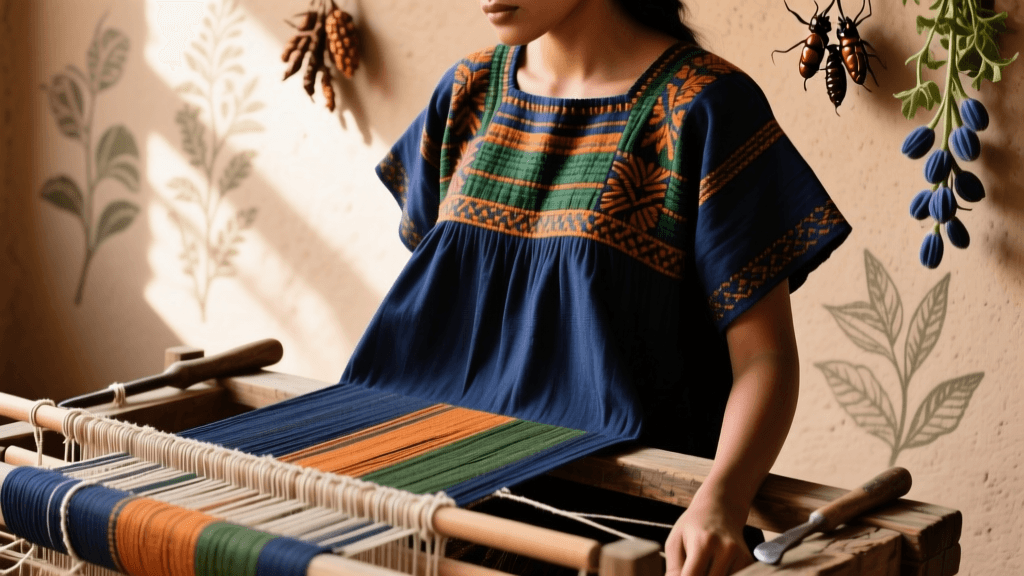
The authentic Oaxacan huipil is woven on a telar de cintura, or backstrap loom. This pre-Columbian technology relies entirely on the weaver's body weight to maintain the tension of the warp threads. One end of the loom is tied to a sturdy post or tree, while the other is secured around the weaver's lower back via a belt.
Because the width of the fabric is limited by the reach of the weaver's arms and the tension their body can sustain, backstrap-woven textiles are typically produced in narrow panels, usually measuring between 18 to 24 inches (45 to 60 cm) in width. A traditional huipil is constructed by stitching two or three of these panels together side-by-side.
Actionable Inspection: Checking the Selvedge and Seams
When examining a huipil in a market in Oaxaca City, Teotitlán del Valle, or San Juan Colorado, look closely at the side seams and the selvedge (the tightly woven edge of the fabric).
- The Panel Join: Authentic garments will feature a visible, often decorative, hand-stitched seam (called a randa) joining two or three distinct panels. If the fabric is wider than 30 inches and has no center or side seams, it was woven on a pedal loom or a modern industrial machine.
- The Selvedge: Run your thumb along the unsewn edges. A backstrap-woven selvedge will have a distinct, slightly raised cord-like texture. It will never be perfectly uniform; minor variations in tension are the hallmark of a human weaver.
- The Brocade: Traditional Zapotec and Mixtec huipils feature brocade patterns woven directly into the fabric, not embroidered on top. Turn the garment inside out. If the pattern is woven in, the reverse side will show the floating threads of the supplementary weft. If it is embroidered, the back will show a mirror image of the stitches.
Decoding Natural Dyes: Cochineal, Añil, and Pericón
The 2026 market has seen a massive renaissance in natural dyeing, driven by both ecological awareness and a desire for historical accuracy. However, synthetic dyes are frequently passed off as natural to tourists. Here is how to understand and test for the 'holy trinity' of Oaxacan natural dyes.
Cochineal (Grana Cochinilla)
Derived from the Dactylopius coccus insect that parasitizes the native Opuntia cactus, cochineal produces a stunning spectrum of reds, pinks, and purples. Climate fluctuations in the Valles Centrales over the past few years have impacted cactus yields, making high-quality cochineal 15% more expensive in 2026 than it was in 2024.
The pH Shift Test: Cochineal is highly reactive to pH levels. If you are permitted by the vendor, take a single loose thread from the garment's fringe. Apply a drop of lemon juice (acidic); the red thread should shift toward a vibrant orange or coral. Next, apply a paste of baking soda and water (alkaline); the thread should shift toward a deep purple or plum. Synthetic red dyes will not react to these mild pH changes.
Añil (Indigo)
Sourced from the Indigofera suffruticosa plant native to the Americas, natural indigo requires a complex fermentation vat. Authentic Oaxacan indigo yields deep, rich navy blues that often have a slight reddish or purplish undertone in direct sunlight. Unlike synthetic indigo, which penetrates the fiber entirely, natural indigo coats the outside of the cotton or wool fiber. If you scratch a deeply blue thread with your fingernail and reveal a white or pale core, you are likely looking at authentic natural indigo.
Pericón (Mexican Tarragon)
Used to achieve brilliant, warm yellows and golds, Tagetes lucida (pericón) is a staple in the dyer's garden. Natural yellow dyes are notoriously fugitive (prone to fading). If a yellow garment in a sunlit market stall looks neon or unnaturally bright, it is almost certainly dyed with synthetic acid yellow. Authentic pericón yields a soft, earthy marigold hue that smells faintly of anise when rubbed.
2026 Pricing, Tiers, and Sourcing Guide
Pricing a handwoven huipil requires an understanding of the labor involved. A master weaver in the Mixteca region may spend up to six hours a day for four months to complete a single ceremonial garment. Below is the 2026 pricing matrix for authentic, naturally dyed, backstrap-woven huipiles purchased directly from artisan cooperatives or reputable galleries.
| Tier / Category | Weaving Time | Materials & Dyes | 2026 Price Range (USD) | Best Use Case |
|---|---|---|---|---|
| Daily / Blusa | 3 - 5 Weeks | Commercial cotton, synthetic or mixed dyes, simple brocade | $80 - $150 | Everyday wear, casual styling |
| Festive / Medio | 2 - 3 Months | Hand-spun cotton, natural cochineal/pericón, complex geometric brocade | $250 - $450 | Special events, cultural exhibitions |
| Ceremonial / Novia | 4 - 6 Months | Native coyuche cotton, full natural dye palette, dense full-body brocade | $600 - $1,200+ | Weddings, museum collections, heirlooms |
Note: Prices listed reflect direct-to-artisan or cooperative pricing. Purchasing through international boutiques or high-end galleries in 2026 will typically add a 40% to 100% markup to support curation and import logistics.
Ethical Sourcing: Where to Buy in 2026
The most critical step in acquiring a huipil is ensuring the funds reach the indigenous women who preserve these ancient techniques. Avoid purchasing from middlemen in resort towns who cannot name the specific village or weaver. Instead, seek out established institutions and cooperatives.
The Museo Textil de Oaxaca remains the premier authority on textile preservation in the region. Their on-site boutique and annual artisan directories are invaluable resources for connecting with verified master weavers and learning about their 2026 exhibition schedules. Furthermore, networks like Colectivo 1050° have revolutionized direct-trade models, ensuring that Zapotec and Mixtec artisans receive fair, transparent compensation while maintaining complete creative control over their cultural patrimony.
Garment Care: Preserving Natural Pigments
Owning a naturally dyed, handwoven huipil requires a departure from modern laundry habits. The pH sensitivity that makes cochineal so magical also makes it highly vulnerable to alkaline detergents and harsh agitation.
Step-by-Step Washing Protocol
- Preparation: Fill a clean basin with cold water. Never use warm or hot water, as heat will cause the natural fibers to shrink and the dyes to bleed.
- Detergent Selection: Use a pH-neutral, no-rinse wool wash (such as Eucalan or Soak). Standard laundry detergents are highly alkaline and will strip the mordant from the fibers, turning cochineal red into a dull, muddy brown.
- Soaking: Submerge the huipil gently. Do not agitate, scrub, or wring the fabric. Let it soak for exactly 15 minutes.
- Rinsing and Drying: Lift the garment from the water, supporting its weight so the wet fibers do not stretch. Roll it in a clean, colorfast cotton towel to press out excess moisture. Lay it flat on a drying rack in a shaded, well-ventilated area. Never hang a wet huipil, and never expose natural indigo or cochineal to direct, harsh sunlight while drying, as UV radiation will rapidly degrade the organic pigments.
Conclusion
The Oaxacan huipil is a testament to indigenous resilience and mathematical brilliance. By learning to read the tension of the backstrap loom, testing the chemistry of natural dyes, and committing to ethical sourcing, you do more than acquire a beautiful garment. In 2026, every conscious purchase acts as a vital vote for the survival of ancestral knowledge, ensuring that the rhythmic clatter of the wooden batten continues to echo through the valleys of Oaxaca for generations to come.