Ancient Greek Chiton & Roman Toga Guide 2026: Fabrics & Draping
The Revival of Classical Antiquity Fashion in 2026
As we navigate the cultural landscape of 2026, the intersection of historical reenactment, theatrical costuming, and Mediterranean heritage festivals has sparked a massive resurgence in the accurate reconstruction of ancient European folk dress. Enthusiasts and scholars alike are moving away from the cheap, synthetic costumes of the past, demanding rigorous historical accuracy in their garments. At the forefront of this movement are the foundational garments of classical antiquity: the Greek chiton and peplos, and the Roman toga and stola. Understanding these garments requires more than just wrapping a bedsheet; it demands an intimate knowledge of ancient textile weights, precise mathematical draping techniques, and an understanding of the social hierarchies embedded in every fold.
According to the World History Encyclopedia's guide on Greek Clothing, ancient garments were rarely cut or sewn. Instead, they were masterfully draped from rectangular or semi-circular pieces of woven cloth, held in place by pins, brooches, and belts. This uncut approach to fashion was not merely a stylistic choice but a reflection of the immense value of hand-woven textiles in the ancient economy. In 2026, modern weavers and reenactors are utilizing advanced loom technologies to replicate the exact grams-per-square-meter (GSM) weights of ancient linen and wool, allowing for historically accurate silhouettes that were previously impossible to achieve with modern commercial fabrics.
Understanding the Greek Chiton and Peplos
The backbone of the ancient Greek wardrobe was the chiton, a versatile tunic worn by both men and women, though with distinct variations in length and draping. The chiton was fundamentally a large rectangle of fabric, but its styling dictated the wearer's region, era, and social standing.
The Doric Chiton
The Doric chiton was the older, more austere style, traditionally made from heavy wool. It was folded over at the top to create an overhang known as the apoptygma, which gave the illusion of a layered garment. The sides were left open and pinned at the shoulders with large, decorative fibulae. For modern reenactors in 2026, sourcing a lightweight, high-twist merino wool is essential to replicate the heavy, structured drape of the Doric style without causing the wearer to overheat during summer Hellenic festivals.
The Ionic Chiton
Originating from the eastern Mediterranean, the Ionic chiton was characterized by its use of lightweight, finely woven linen. Unlike the Doric version, it featured sleeves created by pinning the fabric at multiple points along the arms. The sheer volume of fabric used in the Ionic chiton allowed for intricate, cascading folds that were highly prized in classical Greek sculpture. To achieve this in 2026, costumers recommend using Belgian linen with a GSM of around 120-140, which provides the necessary fluidity while maintaining enough body to hold the pleats.
The Peplos
Worn exclusively by women, the peplos was a heavy woolen garment that served as a symbol of traditional Dorian femininity. It was constructed from a single large rectangle of cloth, folded down at the top, wrapped around the body, and pinned at the shoulders. The side was typically left open, revealing the leg when walking—a feature that was both practical for movement and frequently highlighted in ancient vase paintings.
The Roman Toga and Stola: Symbols of Citizenship
While Greek dress focused on the elegant drape of rectangular cloth, Roman dress was deeply codified, serving as a visual indicator of citizenship, political rank, and moral standing. The World History Encyclopedia's overview of Roman Clothing emphasizes that the toga was not merely a garment, but a legal uniform.
The Toga Virilis and Praetexta
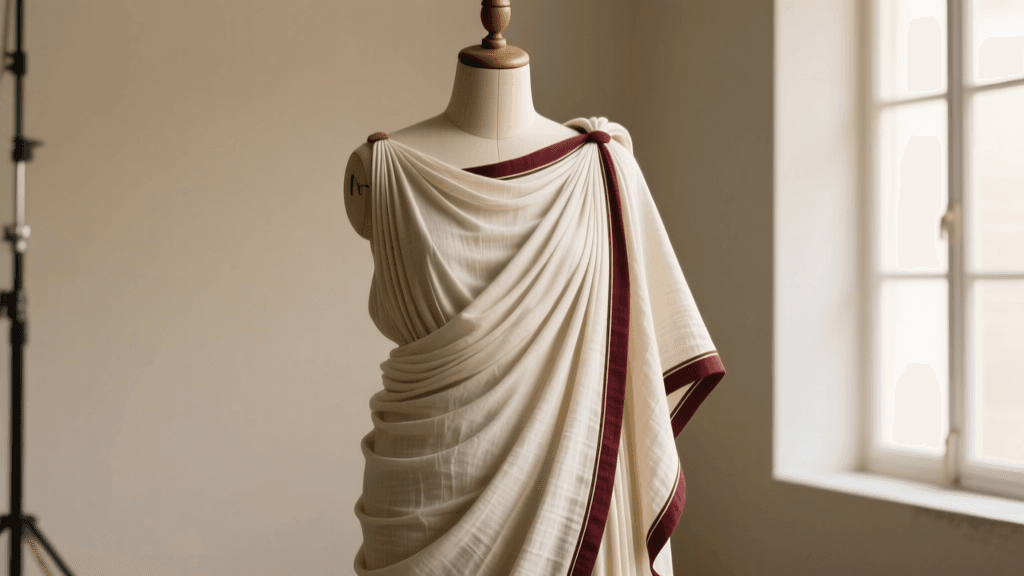
The toga was a massive, semi-circular piece of white wool, often measuring up to 18 feet in length and 7 feet in width. The toga virilis (the toga of manhood) was plain white, worn by adult male citizens. The toga praetexta, featuring a woven purple border, was reserved for magistrates and freeborn youths. Draping a toga was a highly complex art form, requiring the assistance of a slave or servant to arrange the sinus (the deep, sweeping curve across the chest) and the umbo (the decorative, pouch-like fold resting over the left shoulder). In 2026, historical societies have developed specialized toga-draping workshops, utilizing custom-woven wool flannel that mimics the fulled, slightly felted texture of ancient Roman broadcloth.
The Stola and Palla
Roman citizen women did not wear the toga; instead, they wore the stola, a long, sleeveless overdress worn over a base tunic (the tunica intima). The stola was characterized by its instita—a wide, decorative border at the hem that signaled the wearer's modesty and high social status. When venturing outdoors, women draped a palla (a large rectangular mantle) over their heads and shoulders, functioning as both a cloak and a veil.
2026 Fabric Sourcing Guide for Authentic Replicas
The success of any ancient garment relies entirely on the textile. Modern cotton is historically inaccurate and drapes too stiffly. Below is a curated comparison chart for 2026 textile sourcing, tailored for serious reenactors and theater departments seeking historical accuracy.
| Fabric Type | Weight (GSM) | Drape Quality | Historical Equivalent | 2026 Est. Cost/Yard |
|---|---|---|---|---|
| Belgian Pure Linen | 130 - 150 | Fluid, crisp pleats | Ionic Chiton, Tunica | $38.00 |
| Lightweight Merino Wool | 110 - 130 | Superb, clings elegantly | Doric Chiton, Peplos | $45.00 |
| Fulled Wool Flannel | 250 - 300 | Structured, heavy folds | Roman Toga, Palla | $52.00 |
| Silk-Linen Blend | 100 - 120 | Luxurious, sheer | Hellenistic Elite Dress | $65.00 |
| Cotton Muslin (Budget) | 90 - 110 | Stiff, lacks historical body | None (Modern Substitute) | $12.00 |
Step-by-Step Draping Techniques
Mastering the drape is where the true artistry of ancient European folk dress comes to life. Here are the precise measurements and techniques for the two most iconic garments.
Draping the Doric Chiton
- Measure the Fabric: Cut a rectangle of lightweight wool. The width should be 1.5 times your shoulder span (roughly 60-72 inches), and the height should be your height from shoulder to ankle, plus 12 inches for the apoptygma.
- Create the Overhang: Fold the top 12 inches of the fabric down towards the outside, creating a visible cuff across the chest and back.
- Wrap and Pin: Wrap the fabric around your body with the open edge on the left side. Bring the front and back panels together at your right shoulder and secure them with a historically accurate bronze or iron fibula.
- Belt and Blouse: Tie a woven wool belt around your waist. Pull the fabric up and over the belt to create a kolpos (a bloused overhang), which adjusts the hemline and adds volume to the torso.
Arranging the Roman Toga
- Prepare the Toga: Lay the semi-circular toga flat. Fold the straight edge down by about 12 inches to create a reinforced border.
- The Initial Drape: Drape the left end over your left shoulder, letting it fall down to your calves in the front.
- Wrap the Back: Pull the bulk of the fabric across your back, under your right arm (leaving the right arm entirely free), and across your chest.
- Create the Sinus: Allow a generous, sweeping loop of fabric to hang down across your thighs—this is the sinus. It should be deep enough to act as a pocket or a resting place for the right hand.
- Form the Umbo: Take the remaining fabric and toss it over your left shoulder. Grab a handful of the fabric hanging in the front and pull it up through the waist belt to form the umbo, a decorative, weighted pouch that helps anchor the entire garment and prevents it from slipping during movement.
Essential Accessories and Footwear
No classical garment is complete without its accompanying accessories. In 2026, artisan metalworkers are producing museum-quality replicas of ancient hardware that elevate a costume from amateur to professional.
- Fibulae (Brooches): Essential for the Greek chiton. Look for 'bow' or 'crossbow' style fibulae made from cast bronze. Ensure the pin mechanism is functional and secure enough to hold heavy wool.
- Zone and Cingulum (Belts): Greek women wore the zone high under the bust or low on the hips, while Roman men wore the cingulum tightly at the natural waist. Leather belts with bronze buckles or woven wool sashes are the most accurate choices.
- Footwear: The Greek krepis (a sturdy leather sandal with a thick sole) and the Roman calceus (an enclosed leather shoe for citizens) or solea (a simple indoor sandal) are vital. Avoid modern strappy sandals; seek out bespoke historical shoemakers who use vegetable-tanned leather and hand-stitching.
- Jewelry: Gold and electrum were favored by the elite. Snake bracelets, intricate gold hoop earrings with granulation, and signet rings are excellent additions that reflect the wealth and status of the wearer.
Dyes and Colors in Antiquity vs. Modern Reproductions
While we often picture the ancient world in stark, pristine white marble and unbleached linen, the reality of ancient European folk dress was vibrantly colorful. The Greeks and Romans utilized complex botanical and mineral dyes. Saffron was used to produce brilliant yellows for bridal veils, while madder root and kermes insects yielded deep reds. The most famous, and expensive, was Tyrian purple, extracted from the murex sea snail, reserved almost exclusively for Roman imperial and high-magisterial use.
For 2026 reenactors, sourcing authentic botanical dyes is easier than ever, with several heritage textile farms offering madder, weld, and indigo dye kits. However, for those on a budget or requiring colorfastness for frequent theatrical washing, modern fiber-reactive dyes mixed to match historical Pantone equivalents are widely accepted in the reenactment community, provided the underlying textile remains a natural fiber like wool or linen.
Conclusion
The chiton, peplos, toga, and stola are far more than archaic relics; they are masterclasses in sustainable, zero-waste fashion and textile engineering. By understanding the precise mathematics of the drape, sourcing the correct natural fibers, and utilizing historically accurate accessories, modern enthusiasts can breathe vibrant, authentic life into the garments of classical antiquity. Whether you are preparing for a major 2026 Hellenic heritage festival, a university classics production, or simply exploring the rich tapestry of European folk dress, mastering these ancient techniques connects you directly to the daily lives and artistic triumphs of the ancient world.