Authentic Chiton and Peplos Draping Guide for Reenactors 2026
The Renaissance of Classical Antiquity in 2026
The landscape of historical reenactment and classical theater costuming has evolved significantly as we navigate the 2026 season. Today's enthusiasts, scholars, and living historians demand far more than the simplistic, costume-shop approximations of the past. Modern reconstructions of ancient Greek and Roman garments require a deep understanding of textile physics, historical draping techniques, and accurate material sourcing. Whether you are preparing for a major Hellenic festival, a Roman military and civilian immersion event, or simply studying the evolution of European folk dress, mastering the chiton, peplos, and stola is essential.
This comprehensive guide will walk you through the precise mathematics, fabric selection, and step-by-step draping techniques required to recreate authentic classical garments. By moving away from tailored seams and embracing the elegant, uncut geometry of ancient weaving, you can achieve a historically accurate silhouette that honors the textile traditions of antiquity.
Deconstructing the Core Garments
Ancient Mediterranean clothing was fundamentally based on the loom's output. Unlike modern fashion, which relies on complex pattern cutting and sewing, classical garments were primarily rectangular pieces of woven cloth draped directly onto the body. According to the World History Encyclopedia, the beauty of these garments lay not in their tailoring, but in the quality of the weave, the drape of the fabric, and the skill of the wearer in arranging the folds.
The Doric Peplos
The peplos is the quintessential garment of the Dorian Greeks, predominantly worn by women from the Archaic period through the early Classical era. It is constructed from a single, large rectangular piece of heavy woolen cloth. The defining feature of the peplos is the apotygma—an overfold created by folding down the top edge of the fabric before it is pinned at the shoulders. This overfold provides structure, warmth, and a distinct visual weight to the upper body. The sides are typically left open or loosely stitched, allowing for freedom of movement and a striking, columnar silhouette.
The Ionic Chiton
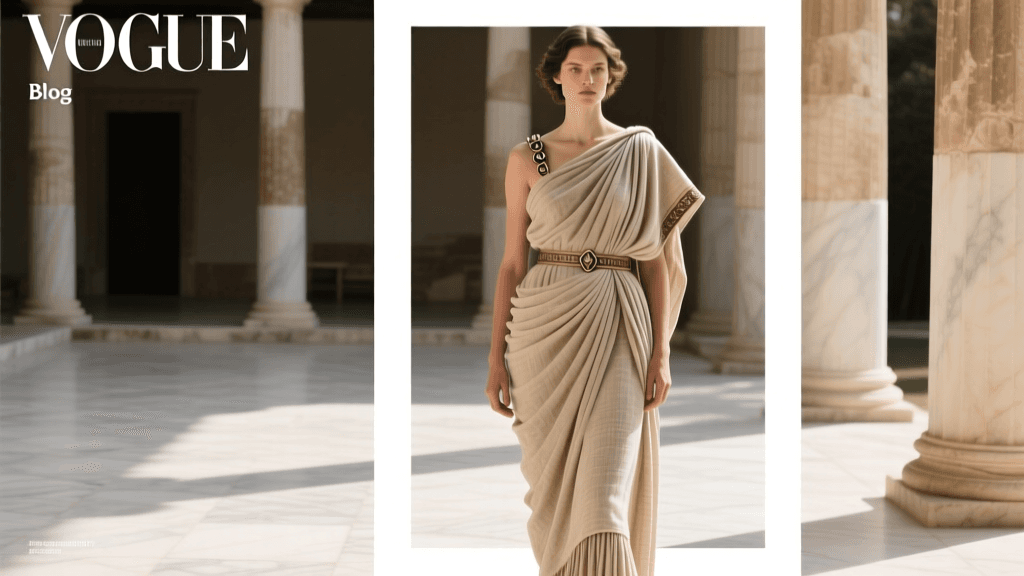
In contrast to the heavy woolen peplos, the Ionic chiton is characterized by its lighter, more fluid fabrics, typically linen or fine, lightweight wool. It features no overfold but instead utilizes a much wider piece of fabric that is gathered and pinned multiple times along the arms to create the illusion of sleeves. The Ionic chiton relies on complex pleating and belting (using a kolpos or bloused overhang) to achieve its intricate, cascading folds. It was worn by both men and women, though women's versions were generally ankle-length while men's often fell to the knee.
The Roman Stola and Toga
As Greek influence permeated Roman culture, the chiton evolved into the Roman tunica. However, the Roman stola became the defining garment of the respectable Roman matron. The stola was a long, sleeveless or short-sleeved tunic worn over the tunica interior, characterized by its instita (a decorative flounce or border at the hem) and shoulder straps. For men, and for women in very specific ceremonial contexts, the toga remained the ultimate symbol of Roman citizenship—a massive, semi-circular expanse of white wool that required immense skill and sometimes the aid of a slave to drape correctly.
Sourcing Historically Accurate Textiles in 2026
The success of any classical reconstruction hinges entirely on the fabric. The modern textile market in 2026 offers incredible variety, but finding historically accurate weaves requires careful selection. You must avoid synthetic blends, modern chemical dyes, and machine-knitted fabrics.
Wool for the Peplos and Toga
For a Doric peplos or a Roman toga, you need a woven wool with a high drape factor but enough body to hold structured folds. Look for a 'tropical weight' or 'medium weight' worsted wool, ideally between 200 and 250 GSM (grams per square meter). A 2/2 twill weave was incredibly common in antiquity and provides a beautiful diagonal drape. Avoid modern melton or boiled wools, as they are too stiff and resemble felt rather than ancient woven textiles.
Linen for the Ionic Chiton
The Ionic chiton demands a lightweight, semi-sheer linen to achieve the famous 'crinkled' effect. In 2026, sourcing handkerchief-weight linen (around 100-120 GSM) is easier than ever through specialized European heritage mills. For maximum historical accuracy, seek out linen that has been naturally retted and woven on shuttle looms, which provides a slightly slubby, organic texture that modern projectile looms cannot replicate.
Natural Dyes and Bleaching
While the pristine white toga was a status symbol (the toga candida, bleached with sulfur and chalk), everyday garments were frequently dyed. For 2026 reenactors, utilizing naturally dyed fabrics elevates the authenticity of your kit. Madder root produces authentic reds and terracottas; weld and woad yield historical yellows and blues. If you are purchasing undyed fabric, ensure it is 'loomstate' and wash it thoroughly in hot water to remove modern sizing before attempting to dye or drape it.
The Mathematics of the Ancient Drape
Ancient weavers designed their fabric dimensions to match the human body without the need for cutting. The primary unit of measurement for width was the orgyia (the fathom, or wingspan, roughly 1.8 meters or 72 inches for an average adult).
- Peplos Width: Typically 1.5 to 2 times the wearer's hip circumference.
- Peplos Height: The distance from the shoulder to the floor, plus 12 to 18 inches for the apotygma (overfold).
- Ionic Chiton Width: A minimum of 1.5 times the wearer's wingspan (often exceeding 3 meters or 118 inches) to allow for the sleeve pins and deep pleats.
- Ionic Chiton Height: Shoulder to floor, plus 8 to 10 inches to allow for the kolpos (the bloused overhang created by the belt).
Step-by-Step Guide: Draping the Ionic Chiton
Draping an Ionic chiton requires patience and a few essential tools: a series of small bronze or iron fibulae (brooches) and a woven wool or leather belt. Here is how to achieve the classical silhouette.
- Prepare the Fabric: Lay your massive rectangle of lightweight linen flat on the ground. If you desire the historically debated 'crinkled' look, the fabric should have been tightly twisted and tied while wet, then left to dry completely before this step.
- Pin the Shoulders: Fold the top edge down by about 3 inches to create a clean hem. Starting at one edge, pinch the fabric and secure it with a fibula. Continue pinning across the top edge at intervals of 4 to 6 inches. The number of pins dictates the 'sleeve' length and fullness.
- Drape the Arms: Slip your arms through the gaps created between the pins. The first gap is for your head, the subsequent gaps form the open, draped sleeves.
- Belt and Blouse: Tie your belt securely around your natural waist. Reach inside the fabric from the bottom hem and pull the excess length up and over the belt until the hem falls exactly where you want it (ankle or knee). This creates the kolpos, hiding the belt and providing a beautiful, voluminous drape over the hips.
- Adjust the Folds: Arrange the vertical pleats evenly across the front and back. The weight of the linen and the tension of the shoulder pins will naturally train the fabric into elegant, fluted columns.
Comparative Analysis: Classical Garments
Understanding the distinct differences between these garments is crucial for accurate portrayal. The table below outlines the primary characteristics to help you choose the right garment for your specific historical impression.
| Garment | Primary Material | Key Structural Feature | Fastening Method | Historical Era / Culture |
|---|---|---|---|---|
| Doric Peplos | Heavy Wool | Apotygma (Overfold) | Large Shoulder Pins (Fibulae) | Archaic / Early Classical Greece |
| Ionic Chiton | Lightweight Linen | Multiple Sleeve Pins & Kolpos | Small Pins, Belt | Classical Greece, Hellenistic |
| Roman Stola | Wool or Linen | Instita (Hem border), V-strap | Shoulder straps, Belt | Roman Republic & Empire (Matrons) |
| Roman Toga | Heavy White Wool | Semi-circular cut, Sinus fold | Friction and Tension (No pins) | Roman Republic & Empire (Citizens) |
Essential Accessories: Fibulae, Belts, and the Himation
No classical garment is complete without its accompanying accessories. The fibula is not merely a decorative brooch; it is a vital structural component. For a peplos, you need large, heavy-duty bronze or iron bow fibulae capable of supporting the weight of thick wool without tearing it. For the Ionic chiton, smaller, disc-shaped or simple wire fibulae are appropriate to avoid damaging delicate linen.
Belts in antiquity were often simple woven wool cords or thin leather strips. In 2026, many reenactors opt for tablet-woven wool belts, which offer incredible tensile strength and historical accuracy. Finally, the himation—a heavy, rectangular woolen mantle—was draped over the chiton or peplos when venturing outdoors. Draping the himation involves wrapping the fabric around the lower body, throwing the excess over the left shoulder, and sometimes pulling it over the head for modesty or warmth.
Maintaining Your Historical Wardrobe
Caring for un-tailored, naturally dyed historical textiles requires a departure from modern laundry habits. Never machine wash or machine dry your woolen peplos or toga. Wool should be spot-cleaned or gently hand-washed in cool water with a pH-neutral detergent designed for protein fibers. Linen chitons can tolerate warmer water but should be line-dried while still slightly damp to make ironing or re-pleating easier.
When storing your garments for the off-season, do not hang them on modern wire hangers, as this will distort the woven fibers and stretch the shoulder points. Instead, fold them loosely along their natural drape lines and store them in breathable cotton bags with cedar blocks to deter moths. By respecting the materials and the ancient engineering of these garments, your classical wardrobe will remain authentic, beautiful, and functional for many reenactment seasons to come.