The Ultimate Chiton & Toga Reconstruction Guide 2026
Introduction to Classical Garment Reconstruction in 2026
The study and reconstruction of ancient Mediterranean textiles have evolved significantly by 2026. With advancements in archaeological textile analysis and a booming interest in historically accurate theater costuming, enthusiasts and professionals alike are moving beyond simplistic stereotypes. According to the World History Encyclopedia, ancient Greek and Roman clothing was highly structured, relying on complex draping, precise mathematical proportions, and specific fiber choices to denote status, gender, and region. This guide provides actionable, historically grounded instructions for reconstructing the Doric chiton, Ionic chiton, and the Roman toga for modern historical reenactment, theatrical productions, and cultural exhibitions.
The Doric Chiton: The Foundation of Greek Dress
The Doric chiton is the quintessential garment of ancient Greece, traditionally worn by both men and women. Unlike modern tailored clothing, the chiton was an untailored rectangular piece of fabric draped directly onto the body. In 2026, historical accuracy demands that we abandon the use of cheap cotton muslin and instead opt for historically accurate tabby-woven wool or medium-weight linen.
Fabric Selection and Measurements
To achieve the correct heavy drape characteristic of the Doric style, select a 100% wool flannel or a heavyweight linen (minimum 7 oz per square yard). The dimensions of the fabric rectangle are strictly proportional to the wearer:
- Width: The wearer's full arm span (fingertip to fingertip) plus 12 to 18 inches of ease.
- Height: The distance from the wearer's shoulder to the floor, plus an additional 12 to 18 inches to allow for the apoptygma (the decorative overfold) and the kolpos (the bloused pouch at the waist).
Step-by-Step Draping Technique
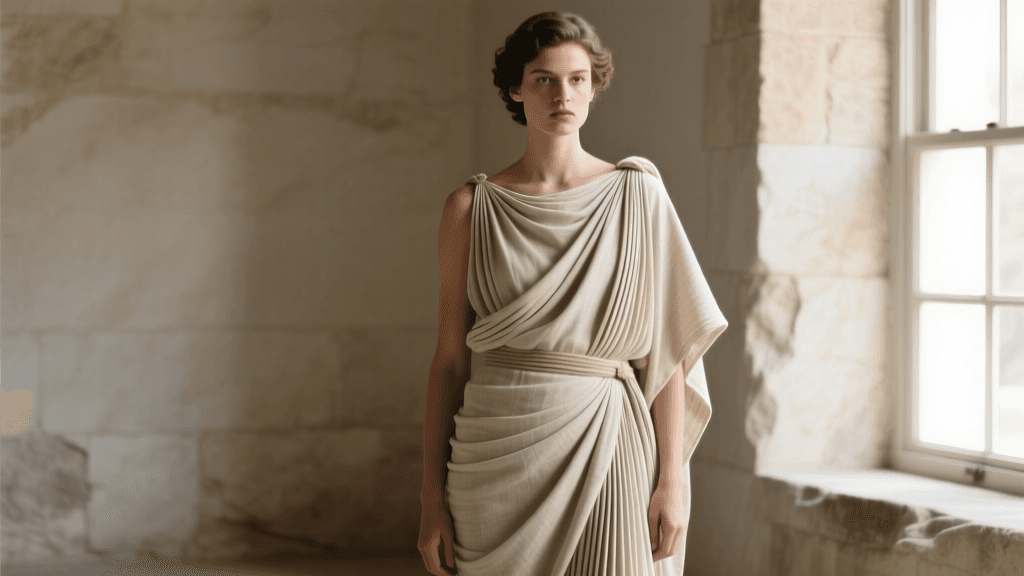
Begin by folding the top edge of the fabric down by the calculated overfold amount. Wrap the fabric around the body, ensuring the fold hangs on the outside. Pin the top layers together at the shoulders using replica bronze or iron fibulae (brooches). According to research from The Metropolitan Museum of Art, these pins were not merely functional but served as crucial decorative elements denoting wealth. Tie a woven wool belt (zona) around the waist, and gently pull the fabric up and over the belt to create the bloused effect, adjusting the hemline to the desired length.
The Ionic Chiton: Elegance and Complexity
While the Doric chiton relied on heavy wool and simple shoulder pins, the Ionic chiton was a testament to the luxury of the eastern Mediterranean. Popularized during the Archaic and Classical periods, this garment utilized much finer, lighter fabrics to create intricate, sleeve-like structures.
Sourcing Modern Linens for Historical Accuracy
For a 2026 reconstruction, source semi-sheer, tightly woven European linen or peace silk. The fabric must be exceptionally wide—often 1.5 to 2 times the wearer's arm span. Instead of a simple overfold, the top edge is left raw or finished with a delicate tablet-woven border. The defining feature of the Ionic chiton is the creation of sleeves. This is achieved by pinning the front and back layers together at multiple intervals along the arm, from the shoulder down to the elbow or wrist. Use small, historically accurate rosette pins or simple stitches to secure these points, allowing the fabric to cascade in elegant, rippling folds.
The Roman Toga and Stola: Status and Structure
Transitioning from Greece to Rome, the drapery becomes more voluminous and heavily codified by social class. The toga was exclusively worn by male Roman citizens, while the stola was the traditional garment of the respectable Roman matron.
Toga Dimensions and the Sinus Drape
The most common misconception in modern classical reenactment is that a toga is a simple semi-circle. By the Imperial period, the toga was an elongated, complex shape, often described as a segment of a circle or a trapezoid with rounded edges. A full Imperial toga requires approximately 18 feet in length and 7 feet in width at its broadest point. Draping the toga requires a second person. The fabric is folded lengthwise, draped over the left shoulder, wrapped around the back, passed under the right arm, and thrown back over the left shoulder. The resulting pouch, known as the sinus, was used to carry small items, while the umbo (a decorative knot of fabric) anchored the heavy wool on the chest.
The Roman Stola: Matronly Modesty
While the toga dominated male public life, the stola was the defining garment of the Roman matron. Worn over a base tunica, the stola was a long, sleeveless dress suspended from the shoulders by straps known as the instita. In 2026, accurate reconstructions of the stola emphasize the V-shaped neckline and the use of a contrasting border at the hem, which signaled the wearer's social standing. The fabric was typically gathered at the waist with a belt, creating a modest, structured silhouette that contrasted sharply with the flowing, unrestrained nature of the male toga.
Comparison Chart: Greek vs. Roman Base Garments
| Garment Type | Cultural Origin | Primary Fabric | Fastening Method | Social Significance |
|---|---|---|---|---|
| Doric Chiton | Ancient Greece | Heavy Wool / Linen | Shoulder Fibulae | Standard everyday wear |
| Ionic Chiton | Ancient Greece | Fine Linen / Silk | Multiple arm pins | Luxury, eastern influence |
| Toga | Ancient Rome | Massive Wool Fleece | Friction & Draping | Male citizenship & status |
| Stola | Ancient Rome | Linen / Wool / Cotton | Shoulder straps (instita) | Female modesty & marriage |
Sourcing Authentic Fibers and Natural Dyes in 2026
Achieving true historical authenticity in 2026 requires moving away from synthetic chemical dyes. The ancient Mediterranean palette was derived from nature. Madder root (Rubia tinctorum) was the primary source for reds and oranges, while woad (Isatis tinctoria) and indigo provided blues. For yellows, weld (Reseda luteola) and saffron were heavily utilized. When sourcing fabric, look for heritage mills in Italy, Greece, and the UK that still practice traditional shuttle looming. The slight irregularities in hand-loomed or vintage shuttle-loomed textiles mimic the ancient weaving process far better than modern, mass-produced power-loomed fabrics.
Furthermore, the finishing of the fabric edges is crucial. Ancient garments rarely featured modern rolled hems. Instead, edges were finished using tablet weaving or left with a decorative fringe created by twisting the warp threads. Incorporating these edge finishes into your 2026 projects will elevate your reconstruction from a simple costume to a museum-quality textile artifact.
Care and Maintenance of Heavy Historical Textiles
Wool and linen garments of this scale require specialized care. Do not machine wash a 15-pound wool toga or a heavily pinned linen chiton. Instead, embrace historical cleaning methods: air the garments out in direct sunlight, which naturally kills bacteria and removes odors, and use a soft-bristled brush to remove surface dust. For spot cleaning, use a mild, pH-neutral soap derived from olive oil, mirroring the ancient use of olive oil and strigils for personal and textile hygiene. Proper storage involves rolling the garments around acid-free cardboard tubes to prevent permanent creasing of the delicate fibers.
Conclusion
Reconstructing the chiton and toga is an exercise in understanding the geometry, sociology, and artistry of the ancient world. By adhering to precise measurements, selecting historically accurate fibers, and mastering the intricate draping techniques outlined in this 2026 guide, you can bring the elegance of classical antiquity to life with unparalleled authenticity.