Ancient Greek Chiton Guide 2026: Doric and Ionic Draping
The Enduring Legacy of the Chiton in 2026
As we navigate the vibrant historical reenactment, museum exhibition, and cultural festival scenes in 2026, the ancient Greek chiton remains a cornerstone of classical European folk dress. Far from being a simple bedsheet wrapped around the body, the chiton is a masterclass in structural draping, mathematical proportion, and textile manipulation. Whether you are preparing for the 2026 Athens Hellenic Heritage Festival, participating in academic living history demonstrations, or simply studying the foundations of Western garment construction, understanding the precise mechanics of the chiton is essential.
According to the Metropolitan Museum of Art's Heilbrunn Timeline of Art History, ancient Greek clothing was fundamentally based on the draping of rectangular pieces of fabric rather than the cutting and sewing of tailored shapes. This zero-waste approach to garment construction has seen a massive resurgence in 2026, as modern sustainable fashion movements look back to classical antiquity for inspiration. In this comprehensive guide, we will break down the two primary iterations of this iconic garment: the heavy, structured Doric chiton (often referred to as the peplos) and the lighter, flowing Ionic chiton.
Understanding the Two Primary Styles
The distinction between Doric and Ionic styles is not merely geographical; it represents a fundamental difference in textile weight, draping philosophy, and fastening techniques. The World History Encyclopedia notes that while the Doric style favored heavy wools and a singular, bold structural fold, the Ionic style embraced the luxurious, translucent linens of the East, requiring multiple fastening points to create intricate sleeve structures.
The Doric Chiton (Peplos)
The Doric chiton, predominantly worn by women in ancient Greece, is characterized by its use of heavy woolen fabric. The defining feature of the Doric style is the apoptygma—a deep overfold at the top of the garment that drapes over the chest and back, creating the illusion of a separate bodice or tunic. This overfold provides structural weight, allowing the garment to hang in deep, sculptural vertical flutes that echo the fluting of Doric architectural columns. In 2026, historical costumers favor a dense, fulled wool weighing between 250 and 350 GSM (grams per square meter) to achieve this statuesque silhouette. The garment is typically fastened at the shoulders with heavy, singular pins, leaving the sides open or loosely stitched.
The Ionic Chiton
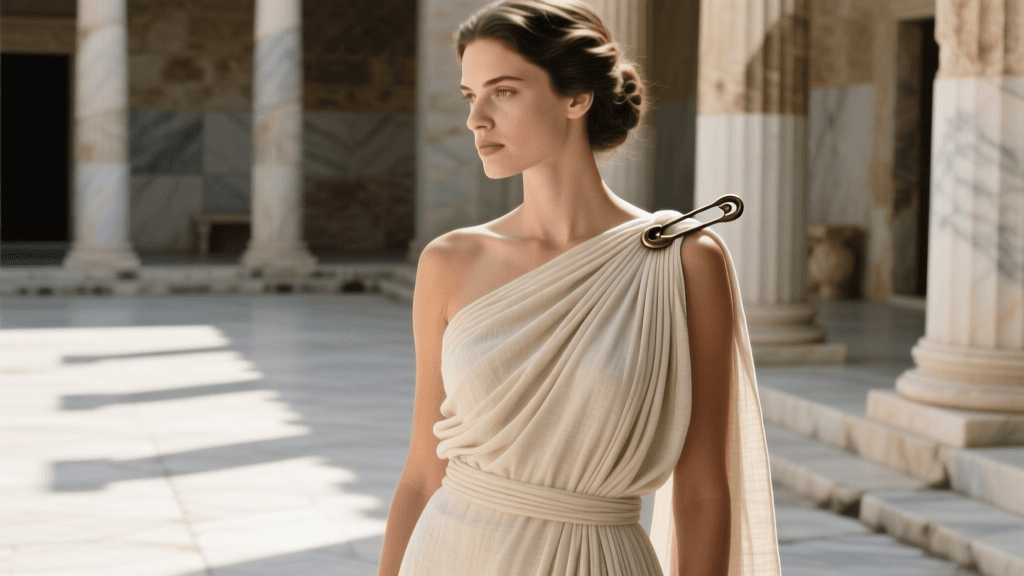
In contrast, the Ionic chiton is a study in fluidity and volume. Worn by both men and women, this style utilizes wide panels of lightweight linen or fine silk. Because the fabric lacks the heavy drape of wool, it cannot rely on a single shoulder pin. Instead, the Ionic chiton is gathered and pinned multiple times along the upper arm, creating a series of draped loops that form elegant, faux sleeves. The modern 2026 textile market offers incredible access to historically accurate, unbleached European flax linens in the 120 to 150 GSM range, allowing reenactors to achieve the delicate, crinkled textures seen in classical marble statuary.
Doric vs. Ionic: A Structural Comparison
To help you select the right style for your specific historical interpretation or contemporary design project, refer to the comparison table below:
| Feature | Doric Chiton (Peplos) | Ionic Chiton |
|---|---|---|
| Primary Fabric | Heavy Wool (Fulled/Twill) | Lightweight Linen or Fine Silk |
| Recommended 2026 GSM | 280 - 350 GSM | 110 - 160 GSM |
| Defining Feature | Apoptygma (Chest Overfold) | Multiple shoulder pins creating sleeves |
| Fastening Method | Large Perone (straight pin) or Fibula | Small buttons, knots, or miniature fibulae |
| Side Seams | Often left open on the left side | Usually sewn completely closed |
| Worn By | Primarily Women | Men and Women |
Sourcing Authentic Materials for Modern Reenactors
One of the most significant shifts in the historical costuming community as of 2026 is the demand for botanically dyed, heritage-breed textiles. For the Doric chiton, avoid modern, synthetic-blend suit wools. Instead, seek out 100% undyed or madder-dyed Melton wool. The fabric must have enough 'bite' and friction to hold the overfold in place without excessive slipping. For the Ionic chiton, medium-weight linen is paramount. The linen should be pre-washed in hot water to remove modern sizing and induce the natural slubbing and crinkle that the ancient Greeks prized. Many contemporary artisans use a technique called 'twist-tie dyeing' before weaving, or tightly pleat the wet linen and let it dry in the sun, to mimic the permanent crinkling seen in the chitons of the Caryatids on the Athenian Acropolis.
Step-by-Step Draping Instructions
Draping a chiton requires precise measurements and an understanding of how gravity interacts with your chosen textile. Below are the actionable steps for both styles.
Draping the Doric Chiton
- Cut the Fabric: Measure your wingspan (fingertip to fingertip with arms extended). Add 20 centimeters to this measurement for the width. For the height, measure from your shoulder to your ankle, then add 35 centimeters to allow for the apoptygma overfold and the hem blousing.
- Create the Overfold: Lay the fabric flat. Fold the top 35 centimeters of the fabric downward. This creates the apoptygma.
- Wrap the Body: Wrap the fabric around your torso, ensuring the folded edge is at the top. The open edge of the fabric should fall on your left side, a traditional marker of classical Greek dress.
- Pin the Shoulders: Bring the front and back layers of the fabric (including the overfold) together at your collarbones. Secure them with heavy, historically accurate bronze or brass fibulae (brooches) or a sturdy perone (straight pin). Space the pins about 10 centimeters apart from the neck edge.
- Belt and Blouse: Tie a woven wool zone (belt) around your natural waist. Pull the fabric up and over the belt to create a kolpos (a bloused overhang) that hides the belt and adjusts the hemline to your desired length.
Draping the Ionic Chiton
- Cut the Fabric: The Ionic chiton requires significantly more width to create the signature sleeves. Cut a rectangle of linen that is twice your wingspan in width, and the distance from your shoulder to the floor in height.
- Sew the Side Seam: Fold the fabric in half widthwise and sew the vertical edges together, creating a massive fabric tube. Leave the top 20 centimeters of the seam open for armholes.
- Mark the Fastening Points: Along the top edge, mark intervals every 8 to 10 centimeters. You will need at least 5 to 7 fastening points per arm.
- Pin the Sleeves: Starting at the center front and center back of the neck, bring the front and back top edges together. Pinch the fabric and secure it with small knot buttons, cloth ties, or miniature safety-style fibulae. Continue this process down the length of both arms, creating a series of draped loops.
- Belting: The Ionic chiton is highly voluminous. Cinch it tightly at the waist, and optionally add a second belt at the hips to create a layered, cascading bloused effect. Cross the belts in an 'X' at the back for a highly decorative silhouette popular in the late classical period.
Essential Accessories: Fibulae and Zonai
No chiton is complete without its functional hardware. In 2026, 3D printing and lost-wax casting have made museum-quality replicas of ancient bronze hardware highly accessible to the public. For the Doric chiton, the perone (a long, heavy straight pin with a decorative head) is the most historically accurate choice, though the tortoise-bow fibula is also widely accepted and provides better security during active reenactment. For the Ionic chiton, small rosette buttons or simple knot fastenings are preferred to prevent tearing the delicate linen. The zone, or belt, was historically a woven wool or leather band. Modern interpretations often utilize tablet-woven bands featuring geometric meander (key) patterns, adding a vital pop of color and structural integrity to the draped ensemble.
Conclusion
Mastering the chiton is a rewarding journey into the intersection of ancient engineering and textile art. Whether you are constructing a heavy, column-like Doric peplos for a winter academic symposium, or a breezy, multi-pinned Ionic chiton for a summer Mediterranean festival, the principles of proportion, fabric weight, and structural draping remain unchanged. By sourcing historically mindful textiles and utilizing precise mathematical measurements, modern enthusiasts can keep the vibrant legacy of ancient Greek folk dress alive and beautifully relevant in 2026 and beyond.