Doric Vs Ionic Chiton Sewing Patterns Guide For 2026
Introduction to Classical Drapery in 2026
The intersection of historical European folk dress and contemporary sustainable fashion has reached a fascinating milestone in 2026. As modern makers and historical reenactors increasingly reject fast fashion in favor of zero-waste, historically grounded garments, the ancient Greek chiton and its Roman descendants have emerged as the ultimate masterclass in draped construction. Unlike modern tailored clothing that relies on complex pattern drafting and fabric waste, classical antiquity garments were woven to shape and draped directly onto the body. This comprehensive guide will walk you through the precise measurements, fabric requirements, and draping techniques needed to reconstruct the Doric chiton, the Ionic chiton, and the Roman stola with museum-quality accuracy this year.
According to the Metropolitan Museum of Art's Heilbrunn Timeline of Art History, the fundamental principle of ancient Greek dress was that clothing was not cut and sewn, but rather consisted of rectangular lengths of fabric draped and fastened around the body. This zero-waste philosophy resonates deeply with the 2026 slow fashion movement, where makers prioritize textile integrity and versatile, multi-functional garments.
The Doric Chiton: Mastering the Wool Peplos
The Doric chiton, often referred to as the peplos, is the older and more structured of the two primary Greek garments. Traditionally worn by women in mainland Greece, it is characterized by its heavy woolen fabric and distinctive overfold, known as the apoptygma. To reconstruct an authentic Doric chiton in 2026, you must abandon modern cotton blends and source 100% heavyweight wool crepe or melton.
Measurements and Cutting
The Doric chiton requires a single rectangular piece of fabric.
- Width: Measure your bust circumference and add 12 to 15 inches. The Doric style is not meant to be excessively full; it should wrap around the body with a slight overlap at the side seam.
- Height: Measure from the top of your shoulder down to the floor, then add 12 to 14 inches. This extra length is crucial, as it will be folded down at the top to create the apoptygma.
The Draping Technique
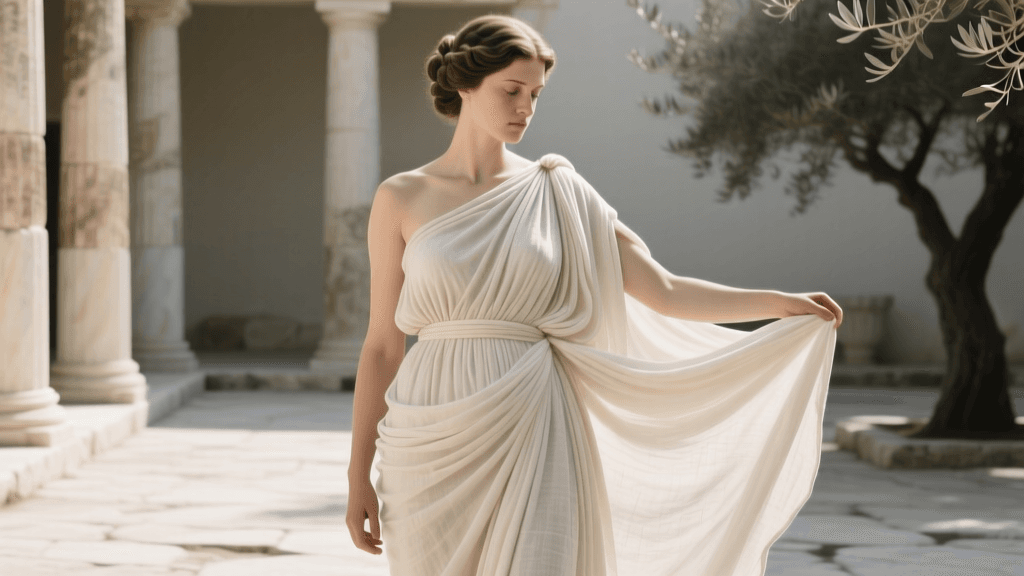
To drape the Doric chiton, fold the top edge down to the waistline, creating the overfold. Wrap the rectangle around your body so that the open edge falls along your right side. Pin the front and back layers together at both shoulders using heavy, historically accurate bronze or iron fibulae (brooches). Finally, tie a woven wool belt around the waist, hidden beneath the apoptygma, and gently pull the fabric up and over the belt to create a bloused effect known as the kolpos. The kolpos is not merely a stylistic choice; it served a highly practical function. By pulling the fabric up over the belt, the wearer could adjust the hemline for walking or working, while also creating hidden pockets within the bloused fabric to carry small personal items, coins, or herbs.
The Ionic Chiton: Elegance and Linen Pleats
Emerging later and influenced by Eastern Mediterranean trade, the Ionic chiton represents a shift toward lighter, more voluminous textiles. While the Doric style relied on the structural weight of wool, the Ionic chiton utilized fine, lightweight linen. As detailed in the Met's comprehensive essay on classical and Roman dress evolution, the introduction of finer textiles allowed for intricate pleating and the creation of true sleeves, a hallmark of the Ionic style.
Measurements and Fabric Selection
For a modern 2026 reconstruction, source a high-quality, semi-sheer European flax linen with a weight of approximately 130 to 150 GSM (grams per square meter).
- Width: The fabric width should be at least twice your full arm span (fingertip to fingertip). This extreme width is necessary to create the flowing sleeves.
- Height: Measure from the shoulder to the floor, adding only 4 to 6 inches for a modest blousing effect at the waist. The Ionic chiton does not feature the deep overfold of the Doric style.
Constructing the Ionic Sleeves
The sleeves of the Ionic chiton are not sewn; they are formed by pinning the top edge of the fabric at regular intervals along the arms. Fold the fabric in half widthwise. Starting at the center front and back (the neck opening), pin the top edges together every 2 to 3 inches, extending all the way down to the wrists. When you slip your arms through the gaps between the pins, the fabric naturally cascades into elegant, flowing sleeves. For historical accuracy, use small, decorative gold or silver fibulae, or sew small linen ties if you prefer a more secure, modern adaptation for active reenactment.
The Roman Evolution: Tunica and Stola
As Greek culture permeated the Italian peninsula, Roman dress adapted the chiton into the tunica and the stola. The Roman stola, the traditional garment of the respectable Roman matron, was essentially an Ionic chiton adapted with specific cultural markers. The most notable addition was the institia, a distinct border or flounce at the hem, and the use of shoulder straps called vittae. The stola was legally protected; only Roman citizen women of good standing were permitted to wear it. It was a visual marker of modesty and social rank, distinguishing the respectable matron from those of lower social classes or those who had lost their civic standing.
In 2026, historical societies focusing on Roman provincial life emphasize the use of brightly dyed linens and silks for the stola, reflecting the vast trade networks of the Roman Empire. To construct a stola, follow the Ionic chiton measurements but add a 4-inch contrasting silk border to the bottom hem. Instead of pinning the shoulders with standard fibulae, the stola was often suspended by wide, woven shoulder straps that tied or buttoned, creating a distinct V-neckline that was uniquely Roman.
Comparative Analysis: Classical Garment Structures
To help you select the right project for your historical wardrobe, consult the comparison chart below. This table outlines the critical differences in fabric, construction, and cultural context for each garment type.
| Feature | Doric Chiton (Peplos) | Ionic Chiton | Roman Stola |
|---|---|---|---|
| Primary Fabric | Heavyweight Wool (250+ GSM) | Lightweight Linen (130-150 GSM) | Linen, Silk, or Fine Wool |
| Width Ratio | Bust + 12 inches | 2x Arm Span | 1.5x to 2x Arm Span |
| Overfold (Apoptygma) | Yes (Deep fold to waist) | No | No |
| Sleeve Construction | Sleeveless (Open sides) | Pinned intervals along arm | Pinned or strapped (Vittae) |
| Distinctive Trim | Woven geometric borders | Subtle embroidered hems | Institia (Contrasting hem flounce) |
Sourcing Authentic Materials in 2026
The success of any historical reconstruction relies entirely on the textile. In 2026, the market for heritage textiles has expanded significantly, but buyers must remain vigilant against synthetic blends marketed as historical. When purchasing wool for a Doric chiton, look for undyed or naturally dyed yarns woven on shuttle looms. Mills in the UK and Scandinavia currently produce the most accurate wool crepes that mimic the drape of ancient Greek textiles. For the Ionic chiton and Roman stola, seek out European flax linen that has been wet-finished to remove the modern, stiff sizing.
Essential Accessories: The Himation and Fibulae
No chiton was considered complete in public without an outer wrap. The himation, a large rectangular cloak measuring approximately 4 yards by 2 yards, was draped over the left shoulder and wrapped around the body. To properly drape a himation, allow the fabric to fall down the back, bring it under the right arm, across the chest, and throw the remainder over the left shoulder. The right arm remains free, while the left arm is concealed within the heavy folds. In cooler months, a heavyweight wool himation provided essential warmth. Secure your garments with cast bronze or iron fibulae. Modern artisan metalworkers on specialized historical craft platforms offer museum-grade reproductions of the bow fibula and the annular brooch, which are vastly superior to the mass-market costume jewelry of previous decades.
Conclusion: Embracing Antiquity in Modern Wardrobes
Reconstructing the Doric and Ionic chitons, alongside the Roman stola, offers a profound connection to European folk dress and classical history. By adhering to precise measurements, utilizing authentic zero-waste draping techniques, and sourcing high-quality natural fibers, modern makers can achieve unparalleled historical accuracy. As the slow fashion and historical reenactment communities continue to thrive in 2026, these ancient garments stand as a testament to the timeless elegance and ingenious engineering of classical textile arts. Whether you are preparing for a museum exhibition, a historical festival, or simply expanding your sustainable wardrobe, mastering the chiton is an essential milestone in the study of European historical dress.