Recreating the Ancient Greek Chiton: 2026 Draping Guide
Introduction to the Chiton in 2026 Reenactment and Theater
The landscape of historical reenactment and theatrical costuming has evolved dramatically as we move through 2026. Audiences and historical societies now demand rigorous authenticity, moving far beyond the inaccurate, mass-produced polyester "togas" of past decades. At the heart of ancient Mediterranean wardrobes is the chiton, the foundational garment of ancient Greece that heavily influenced the Roman tunica. Whether you are costuming a university production of Euripides, participating in a Hellenistic living history event, or studying ancient textile engineering, understanding the precise drape, weight, and construction of the chiton is essential.
Unlike modern tailored clothing, the chiton was not cut and sewn to fit the body's contours. Instead, it was a masterclass in geometric draping, relying on the tension of woven fabrics, gravity, and strategic pinning to create elegant, flowing silhouettes. This comprehensive 2026 guide will walk you through the historical distinctions, modern fabric sourcing, and step-by-step draping techniques required to recreate the Doric and Ionic chitons with museum-quality accuracy.
Doric vs. Ionic Chiton: Key Historical Differences
To accurately recreate ancient Greek dress, one must first understand the two primary variations of the chiton: the Doric and the Ionic. While both served the same fundamental purpose, their construction, fabric choices, and regional origins were distinctly different.
The Doric chiton (also known as the peplos in its heavier, female-specific iteration) is the older and more austere of the two. Originating in the mountainous regions of the Peloponnese, it was traditionally woven from heavyweight wool. Its defining feature is the apoptygma—a deep overfold at the top of the garment that draped over the chest and back. It was typically fastened at the shoulders with heavy, singular fibulae (brooches) and left open or partially sewn along the right side.
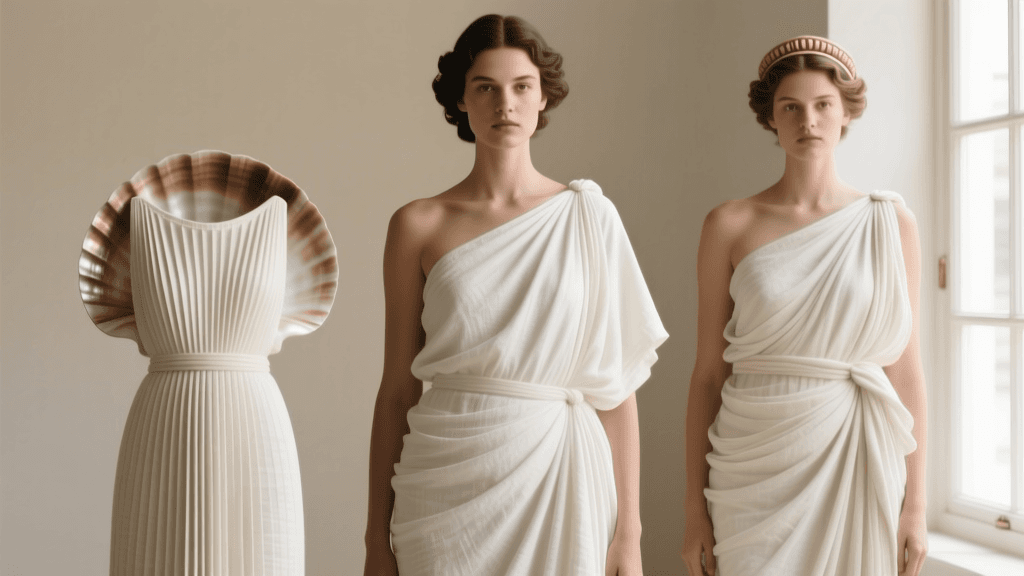
Conversely, the Ionic chiton emerged from the warmer climates of Ionia (modern-day western Turkey) and the Aegean islands. Woven from lightweight, finely pleated linen or imported silk, it lacked the heavy overfold of the Doric style. Instead, it was sewn completely closed along the side seams and fastened along the upper arms with a series of small pins or buttons, creating the illusion of short, flowing sleeves.
Comparison Chart: Doric vs. Ionic Chiton
| Feature | Doric Chiton / Peplos | Ionic Chiton |
|---|---|---|
| Primary Fabric | Heavyweight Wool (250-350 GSM) | Fine Linen or Silk (100-150 GSM) |
| Silhouette | Structured, columnar, heavy overfold | Fluid, pleated, sleeve-like draping |
| Fastening Method | Single large fibula per shoulder | Multiple small pins/buttons along the arm |
| Side Seams | Often left open on the right side | Fully sewn closed |
| Historical Era Peak | Archaic to Early Classical (c. 600–450 BCE) | Late Classical to Hellenistic (c. 450–30 BCE) |
From Greek Chiton to Roman Tunica: The Evolution
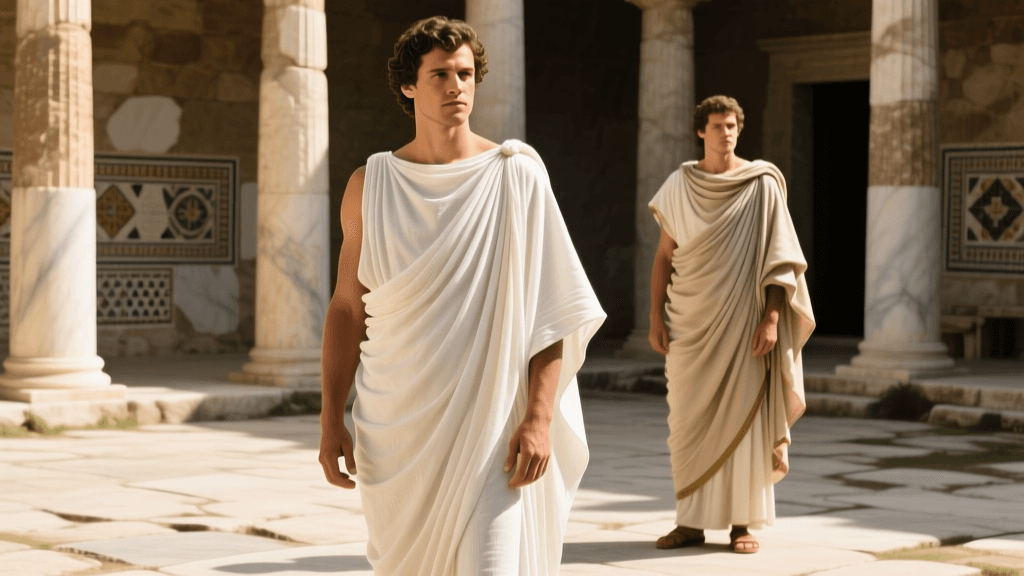
As Hellenistic influence spread across the Mediterranean and eventually gave way to Roman hegemony, the Greek chiton evolved into the Roman tunica. By the time of the Roman Republic and early Empire, the tunica had become the standard undergarment and everyday wear for both men and women across all social classes. While the Roman tunica was more frequently sewn into a T-shape rather than draped from a single rectangular loom-width, the fundamental principles of belting at the waist and using the clavus (a decorative woven stripe) to denote social rank were direct descendants of Greek textile traditions. For 2026 reenactors portraying the transitional periods of the 2nd and 1st centuries BCE, blending the draped Ionic chiton with early Roman tailoring techniques provides a highly accurate representation of cultural syncretism.
Sourcing Authentic Fabrics for 2026 Productions
The success of a chiton relies entirely on the drape of the fabric. A modern, stiff cotton blend will not behave like ancient textiles. As of 2026, the European Flax certification has become the gold standard for sourcing historically appropriate linen, ensuring the long-staple fibers necessary for a fluid, heavy drape that mimics ancient hand-woven cloth.
Recommended Fabric Specifications
- For the Doric Chiton (Wool): Seek out 100% worsted wool or wool crepe with a weight of 250 to 300 GSM (grams per square meter). The fabric must have a matte finish and enough weight to pull the apoptygma down smoothly without excessive bulk at the shoulders. Avoid modern brushed wools or flannels.
- For the Ionic Chiton (Linen): Opt for medium-to-heavyweight linen (180 to 220 GSM). While ancient Ionic chitons were famously sheer and fine, modern theatrical and reenactment contexts usually require a slightly heavier weight to maintain modesty while still achieving the signature micro-pleats. Look for "half-bleached" or natural ecru linen, as stark, chemically bleached white was rare and expensive in antiquity.
For those studying the primary sources and visual evidence of these garments, The Metropolitan Museum of Art's Greek and Roman Art Collection provides an invaluable digital archive of marble statuary, allowing costumer to study how these specific fabric weights clung to and draped over the human form in classical sculpture.
Step-by-Step Draping and Construction
Draping a chiton requires an understanding of ancient proportions. The Greeks were deeply influenced by mathematical harmony, and this extended to their clothing. The width and height of the fabric rectangle were not arbitrary; they were calculated based on the wearer's wingspan and height.
Measurements and Cutting
- Width: Measure the wearer's wingspan (fingertip to fingertip with arms outstretched). Add 12 to 18 inches to this measurement to allow for the kolpos (the bloused overhang created by belting). For an Ionic chiton with sleeve effects, add an additional 24 inches.
- Height: Measure from the highest point of the shoulder down to the floor (or ankle, depending on the wearer's gender and status). Add 15 to 20 inches to this measurement to account for the kolpos drop and the hem.
- The Apoptygma (Doric only): If creating a Doric chiton, fold the top edge of the fabric down by 12 to 18 inches before pinning. This creates the signature chest overfold.
The Art of the Kolpos and Fibulae
The kolpos is the defining silhouette of the ancient Greek wardrobe. To achieve it, wrap the rectangular fabric around the body and fasten it at the shoulders using bronze or iron fibulae. For a historically accurate Doric look, use a single, large penannular or arched fibula at each shoulder point. For the Ionic style, gather the top edge into small, even pleats and pin them at 2-inch intervals along the upper arm.
Once the shoulders are secured, tie a woven wool or leather cord (the zone) around the natural waist. Pull the fabric up and over the belt, allowing it to blouse out evenly. This blousing hides the belt, creates a graceful, peplum-like overhang, and allows the wearer to adjust the hemline for walking or working. The depth and evenness of the kolpos were considered a mark of elegance and refinement in classical Athens.
Accessories: Belts, Footwear, and Jewelry
No chiton was worn in isolation. The complete ensemble required specific accessories to anchor the drape and signify social status.
- The Himation and Diplax: For outdoor wear or formal occasions, a heavy woolen cloak was draped over the chiton. The himation (for men and women) was wrapped diagonally across the torso and over the left shoulder, leaving the right arm free. The diplax was a smaller, square shawl pinned at both shoulders, often featuring a woven geometric border.
- Footwear: Indoors, the ancient Greeks typically went barefoot to protect the woven rugs and mosaics. Outdoors, they wore krepides (strapped leather sandals) or embades (closed leather boots) for traveling. In 2026, custom cordwainers specializing in historical footwear utilize vegetable-tanned leathers and hand-forged iron hobnails to recreate these accurately.
- Jewelry and Adornment: Gold and electrum were the metals of choice for the elite. Hair was often bound in a kekryphalos (a woven hairnet) or tied back with a simple ribbon. For modern budget theater productions, 3D-printed resin accessories finished with metallic leafing have become a popular, lightweight alternative to cast bronze, though living historians continue to favor lost-wax cast bronze replicas.
Preserving and Maintaining Your Chiton
Proper care of natural fibers is crucial for maintaining the drape and longevity of your garment. Wool chitons should rarely be washed; instead, they should be aired out and spot-cleaned with a mild lanolin-based soap to preserve the natural water-resistant properties of the fleece. Linen chitons can be hand-washed in cool water and line-dried. To achieve the crisp, vertical pleats seen in classical sculpture, dampen the linen and use wooden clothespins to weight the hem while it dries, allowing gravity to set the pleats naturally without the need for modern heat-pressing.
Conclusion
Recreating the ancient Greek chiton and its Roman descendants is an exercise in geometric precision and textile appreciation. By abandoning modern tailoring conventions and embracing the mathematical harmony of the draped rectangle, you unlock a garment that is as functional as it is beautiful. Whether you are sourcing certified European flax for an Ionic masterpiece or draping heavyweight wool for a Spartan reenactment, the principles of the apoptygma, the kolpos, and the fibula remain timeless. For further reading on primary source translations regarding ancient Mediterranean textiles and daily life, the Perseus Digital Library at Tufts University remains an indispensable academic resource for historians and costumers alike.
As we continue to refine our historical accuracy in 2026, the chiton stands as a testament to the ancient world's profound understanding of the relationship between the human body and the woven thread. Master these draping techniques, and you will bring the elegance of antiquity to life with every step.