Authentic Chiton & Toga Draping Techniques for 2026
The Resurgence of Classical Antiquity in 2026
The world of historical reenactment and classical fashion has experienced a massive renaissance in 2026. Driven by a global interest in sustainable, zero-waste clothing and the recent "Threads of Antiquity" museum exhibitions touring Europe and North America, modern enthusiasts are looking back to the ancient Mediterranean for inspiration. Ancient Greek and Roman garments—specifically the chiton, peplos, and toga—are masterclasses in zero-waste design. They rely entirely on the art of draping, folding, and pinning rather than cutting and sewing.
Whether you are preparing for a university classics seminar, a high-fidelity historical reenactment event, or simply integrating neoclassical silhouettes into your contemporary wardrobe, mastering the drape is essential. This comprehensive 2026 guide will walk you through the exact measurements, fabric choices, and draping techniques required to recreate authentic ancient Greek and Roman garments.
The Anatomy of the Ancient Greek Chiton
The chiton was the foundational garment for both men and women in ancient Greece. According to The Metropolitan Museum of Art's Greek and Roman Art Department, the chiton evolved significantly from the Archaic to the Hellenistic periods, primarily splitting into two distinct styles: the Doric and the Ionic.
The Doric Chiton (Peplos)
The Doric chiton, often referred to as a peplos when worn by women, is the older, heavier, and more structured of the two. It is typically made from a single rectangular piece of heavyweight wool or dense linen.
- Measurements: The width should be equal to your wingspan plus 12 inches. The height should be the distance from your shoulder to the floor, plus an additional 12 to 18 inches for the apoptygma (the signature top fold).
- Draping Technique: Fold the top edge down by 12-18 inches to create the apoptygma. Wrap the fabric around your body so the open edge falls on your right side. Pin the top layers together at both shoulders using heavy bronze or iron fibulae (brooches). Finally, belt the waist. You can pull the fabric up and over the belt to create a secondary drape (kolpos) that hides the waistline and adjusts the hem length.
The Ionic Chiton
The Ionic chiton is lighter, more fluid, and characterized by its "sleeves." It is best crafted from lightweight, finely woven linen or modern sustainable bamboo-linen blends that mimic the sheer fabrics of antiquity.
- Measurements: The width is much greater—often twice your wingspan—to allow for deep, luxurious folds. The height is shoulder-to-floor plus 6 inches.
- Draping Technique: Unlike the Doric style, there is no top fold. The fabric is wrapped around the body, and instead of just two shoulder pins, the top edges are pinned at multiple intervals along the arms, creating the illusion of short sleeves. A belt is tied around the waist, and the fabric is bloused over it.
Mastering the Roman Toga: A 2026 Reenactor's Manual
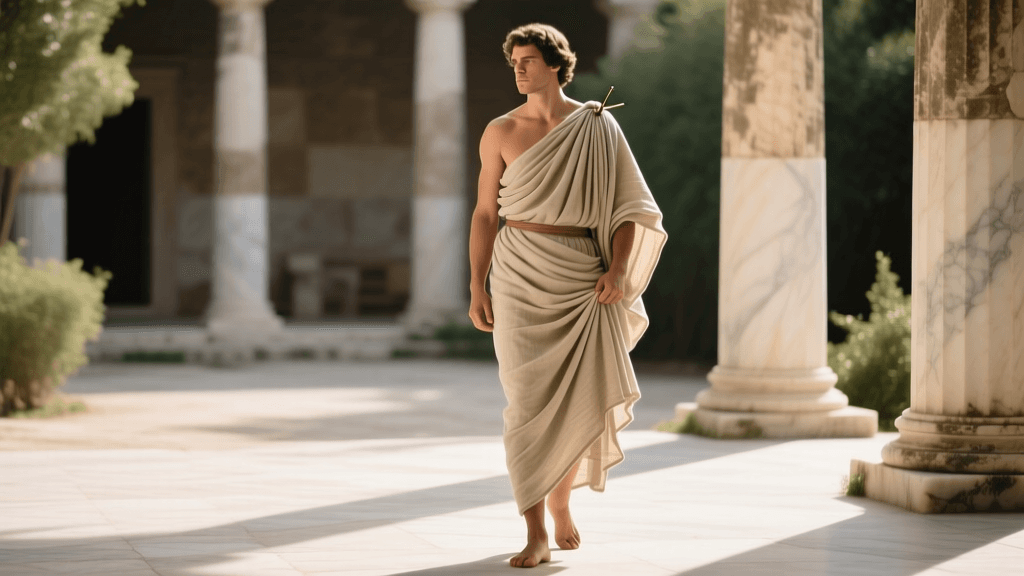
While the Greeks favored the practical chiton, the Romans elevated the toga to a symbol of citizenship, status, and civic duty. The toga was exclusively worn by male Roman citizens in public life. Primary texts and visual records available via The Perseus Digital Library at Tufts University reveal that the toga was not a simple blanket, but a highly engineered, semi-circular garment that required immense skill to drape correctly.
Sizing and Cutting the Toga
By the Imperial period, the toga had grown to massive proportions. For a modern adult male, you will need a semi-circular piece of lightweight wool or raw silk noil.
- The Cut: The straight edge (the diameter of the semi-circle) should be approximately 18 to 20 feet long. The curved edge should have a depth of about 7 to 8 feet at its deepest point.
- Preparation: The fabric must be heavily steamed and pressed with pleats before draping. In 2026, many reenactors use temporary, water-soluble fabric sprays to hold the deep pleats in place while draping.
The Draping Process: Sinus and Umbo
Draping a toga requires a helper and about 15 minutes of patience.
- The First Drape: Throw the left end of the straight edge over your left shoulder so it hangs down to your calves in the front.
- The Back Wrap: Bring the bulk of the fabric across your back, under your right arm (leaving the right arm entirely free), and across your chest.
- The Sinus: As you pull the fabric across your front, allow the lower curved edge to dip down to your knees, creating a deep, sweeping pouch called the sinus. This could historically be used as a pocket or to cover the head during religious rites.
- The Umbo: Throw the remaining fabric over your left shoulder again. Gather a fistful of the fabric from the front drape and pull it up and over the shoulder to create a decorative, knotted pouch at the chest known as the umbo.
2026 Fabric Sourcing and Sustainability Guide
The success of any classical garment relies entirely on the drape of the fabric. Modern synthetic blends will cling, shine, and ruin the historical silhouette. In 2026, the historical costuming community has heavily pivoted toward traceable, eco-friendly European mills that produce historically accurate weaves. Below is a comparison of the best fabrics for ancient garments available on the market this year.
| Fabric Type | Weight (GSM) | Drape Quality | Best Garment | 2026 Avg. Cost/Yard |
|---|---|---|---|---|
| Organic European Linen | 150-180 | Fluid, crisp | Ionic Chiton, Stola | $28 - $35 |
| Lightweight Merino Wool | 200-220 | Structured, warm | Doric Chiton, Toga | $40 - $55 |
| Bamboo-Linen Blend | 130-150 | Silky, highly fluid | Summer Chiton | $22 - $28 |
| Raw Silk Noil | 100-120 | Matte, luxurious | Toga Praetexta | $60 - $85 |
Essential Accessories: Fibulae, Belts, and Footwear
A chiton or toga is incomplete without its hardware and footwear. Artifacts housed in The British Museum's Classical Antiquities Collection demonstrate the incredible craftsmanship of ancient metalworkers and cobblers.
Fibulae (Brooches)
The fibula is the ancient equivalent of the safety pin, but far more decorative. For a Doric chiton, you need heavy, bow-style fibulae capable of piercing thick wool without bending. In 2026, several artisan blacksmiths on historical crafting forums offer 3D-scanned and cast bronze replicas based directly on Pompeii excavations, ensuring perfect weight and tensile strength.
Footwear: Caligae and Sandals
For Greek garments, simple leather hypodemata (sandals) that lace up the calf are appropriate. For Roman reenactors, the caliga (the heavy-soled military sandal) or the calceus (the enclosed leather shoe worn by senators with the toga) are mandatory. Modern historical cobblers now use vegetable-tanned leather and hand-forged iron hobnails to replicate the exact traction and sound of Roman footsteps.
Women's Garments: The Stola and Palla
While women in Greece wore the chiton and peplos, the respectable Roman matron wore the stola over her basic linen tunica. The stola was a sleeveless, floor-length dress suspended by straps (institia) from the shoulders. It was always belted high under the bust and featured a colorful border (limbus) at the hem. Over the stola, women draped the palla, a large rectangular mantle similar to the Greek himation, which could be pulled over the head when outdoors.
Caring for Your Ancient Garments
Maintaining zero-waste, draped garments requires specific care to preserve the fabric's natural fibers and historical drape.
- Washing: Never machine wash heavyweight wool togas. In 2026, we recommend using modern lanolin-based wool washes and laying the garment flat to dry. Linen chitons can be machine washed on cold, but must be line-dried to maintain their crisp stiffness.
- Storage: Do not hang heavy wool togas on standard hangers, as the weight will distort the fibers. Roll them around acid-free cardboard tubes to prevent deep, unnatural creases.
- Pressing: Always use a steam iron on the appropriate setting. For linen, iron while the fabric is still slightly damp to achieve the sharp, statuesque folds seen in classical marble sculptures.
Conclusion
Recreating the chiton, peplos, and toga is a deeply rewarding exercise in understanding the intersection of ancient engineering, textile arts, and cultural identity. By sourcing historically accurate, sustainable fabrics and mastering the precise geometry of the drape, you can bring the elegance of the ancient Mediterranean to life. Whether you are stepping into a 2026 reenactment arena or curating a classical fashion editorial, the timeless silhouettes of Greece and Rome remain as powerful and beautiful today as they were two millennia ago.