Greek Chiton & Roman Stola Guide: 2026 Historical Revival Trends
The Resurgence of Classical Antiquity in 2026
The fascination with classical antiquity has reached new heights in the 2026 historical reenactment and folk dress revival communities. Across Europe and the Mediterranean, festivals celebrating Hellenic and Roman heritage are drawing record crowds, and participants are demanding unprecedented accuracy in their garments. Moving away from the costume-shop approximations of the past, today's revivalists focus on authentic drape, period-accurate textiles, and historically informed construction techniques. Whether you are preparing for a major summer solstice festival or a university-sponsored historical symposium this year, mastering the ancient Greek chiton and the Roman stola is essential for achieving a truly classical silhouette.
According to the World History Encyclopedia's guide to Greek Dress, the fundamental principle of ancient Mediterranean clothing was that garments were rarely cut or tailored. Instead, they were woven to specific dimensions on looms and then draped, folded, and pinned directly onto the body. This zero-waste approach to fashion is resonating deeply with the sustainable textile movements of 2026, making these ancient techniques highly relevant for modern makers.
Understanding the Greek Chiton: Doric vs. Ionic
The chiton was the foundational garment for both men and women in ancient Greece, but its execution varied significantly based on regional influences and the weight of the fabric. The two primary variations are the Doric chiton (often referred to as a peplos when worn by women) and the Ionic chiton.
The Doric Chiton (Peplos)
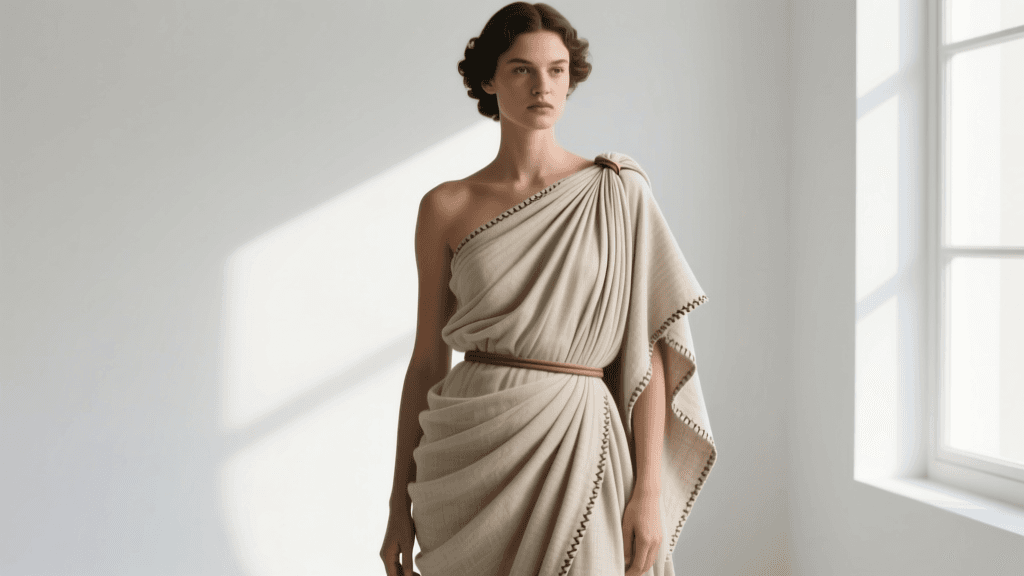
The Doric style is the older, more austere of the two. It was typically woven from heavyweight wool, which allowed the fabric to drape in thick, sculptural folds. The defining feature of the Doric peplos is the apoptygma—an overfold created by folding the top edge of the fabric down to the waist or hips before pinning it at the shoulders. This overfold not only provided warmth but also created a visually striking layered effect that is highly sought after in 2026 museum-quality reenactments.
The Ionic Chiton
In contrast, the Ionic chiton emerged later and was crafted from lightweight, finely woven linen or silk. Rather than a single overfold, the Ionic chiton was made from a much wider piece of fabric. It was pinned or sewn at multiple points along the upper arm, creating the illusion of short sleeves. The lighter fabric resulted in a multitude of delicate, flowing vertical pleats, offering a softer, more fluid silhouette compared to the structured Doric style.
The Roman Wardrobe: Tunica, Stola, and Toga
While Greek dress relied heavily on the drape of rectangular textiles, Roman clothing incorporated more structured elements and distinct social markers. For women, the stola was the ultimate symbol of respectability and citizenship.
The Roman Stola
Worn over a basic linen tunica intima, the stola was a long, sleeveless dress suspended from the shoulders by straps or short sleeves. The critical identifying feature of the stola was the instita—a decorative border or flounce sewn to the lower hem. In 2026, historical textile artisans are recreating the instita using tablet-woven bands or embroidered wool, elevating the garment from a simple shift to a marker of high social status. The stola was typically girdled high under the bust and again at the waist, creating a bloused effect that allowed for ease of movement.
The Complexity of the Roman Toga
For Roman men, the toga was the ultimate civic garment, though it was notoriously difficult to drape. As detailed in the World History Encyclopedia's article on the Roman Toga, the toga was not a simple semi-circle, but rather a complex, elliptical shape that could measure up to 18 feet in length by the Imperial period. The draping required the creation of the sinus (a deep pouch-like fold across the chest) and the umbo (a decorative knot or cluster of folds at the center). Modern reenactors in 2026 often use hidden internal stitching or small, discreet weights in the hem to maintain these structural folds during active festival participation.
Sourcing Period-Accurate Fabrics in 2026
The success of any classical garment lies entirely in the textile. Modern commercial fabrics often contain synthetic blends or feature weaves that are too tight and stiff, preventing the fabric from clinging and draping like ancient wool or linen. When sourcing materials for the 2026 reenactment season, prioritize natural fibers with an open, slightly textured weave.
The Metropolitan Museum of Art's Greek and Roman Art collection provides excellent visual references for the drape and opacity of surviving textile fragments and sculptural depictions, reminding us that ancient fabrics had a distinct, organic slub and weight.
| Fabric Type | Recommended Weight | Historical Application | 2026 Sourcing Tips |
|---|---|---|---|
| 100% Linen | 5.0 - 7.0 oz (Medium) | Ionic Chiton, Tunica Intima, Summer Stola | Seek 'half-bleached' or 'natural' slub linen. Avoid stiff, heavily sized craft linens. |
| 100% Wool | 8.0 - 12.0 oz (Heavy) | Doric Peplos, Toga, Winter Palla | Look for 'tropical wool' for lighter drapes or 'melton' for structured overfolds. Ensure it is not felted. |
| Silk Noil | 3.5 - 5.0 oz (Light) | Luxury Ionic Chiton, Elite Stola | A modern, affordable substitute for ancient wild silk. Provides excellent matte drape and period-accurate texture. |
Step-by-Step Draping Guide: The Doric Chiton
Creating a Doric chiton requires no sewing, only precise measurements and the right hardware. Follow these steps to achieve a museum-accurate drape for the 2026 festival circuit.
- Calculate Your Dimensions: Measure your wingspan from elbow to elbow. Add 12 inches to this measurement for the width. For the height, measure from your shoulder to your ankle, then add 12 to 18 inches to allow for the apoptygma (overfold) and the kolpos (blousing).
- Hem the Edges: While the ancients often used the selvedge edges of the loom, modern makers should roll and whip-stitch the cut edges to prevent fraying. A contrasting color thread on the top and bottom borders adds historical visual interest.
- Create the Overfold: Fold the top edge of the fabric down to the outside, aligning the new folded edge with your waist or high hip.
- Pin the Shoulders: Wrap the fabric around your body. Bring the front and back layers together at your collarbones. Secure them using authentic penannular or bow fibulae (brooches). For a standard Doric look, use one pin per shoulder; for a wider neckline, use two or three.
- Girdle the Waist: Tie a woven wool belt around your waist, over the overfold. Pull the fabric up and over the belt to create the bloused kolpos effect. Adjust the length so the hem falls gracefully to your ankles.
- Secure the Side: The left side of the Doric chiton was traditionally left open to allow for leg movement, but for modern modesty and practicality, you can discreetly pin the side seam from the thigh down to the hem.
Essential Accessories for the Classical Silhouette
No ancient garment is complete without its functional accessories. The fibula is the most critical component. In 2026, artisan metalworkers are producing highly accurate bronze and iron fibulae using lost-wax casting methods. Avoid modern safety-pin styles; instead, invest in sprung bow fibulae or hinged pin brooches that securely hold heavy wool without tearing the fabric.
Footwear is equally important. For Greek dress, simple leather spartiates (strapped sandals) that wrap up the calf are appropriate. For Roman ensembles, the calceus (a fully enclosed leather shoe) was worn by citizens in the city, while the caliga (military sandal) is reserved for legionary reenactors. Ensure your footwear features historically accurate hobnails or stacked leather soles for durability on uneven festival grounds.
Natural Dyeing Trends for 2026 Reenactors
The stark white toga and the pristine white linen chiton are iconic, but the ancient world was incredibly colorful. The 2026 historical dress community is heavily focused on natural dyeing to replicate the vibrant hues of antiquity. Madder root is being used to achieve deep, colorfast reds for the borders of stolae and military cloaks. Weld and woad are combined to create the rich, complex greens and purples favored by Hellenistic elites. By utilizing mordants like alum and iron, modern dyers are achieving a depth of color that synthetic dyes simply cannot replicate, bringing a breathtaking, living vibrancy to the classical revival movement.
Conclusion
Mastering the chiton, stola, and toga is a journey into the intersection of mathematics, textile arts, and cultural history. As the 2026 reenactment season unfolds, the emphasis on authentic drape, natural fibers, and historically informed accessories continues to elevate the standard of European folk dress and historical revival. By understanding the mechanics of these ancient garments, you do more than wear a costume; you embody the living, breathing textile traditions of the classical world.