2026 Silk Road Finds: Astana Samite Textiles & Dye Analysis
The Historical Crossroads of Turpan and the Astana Tombs
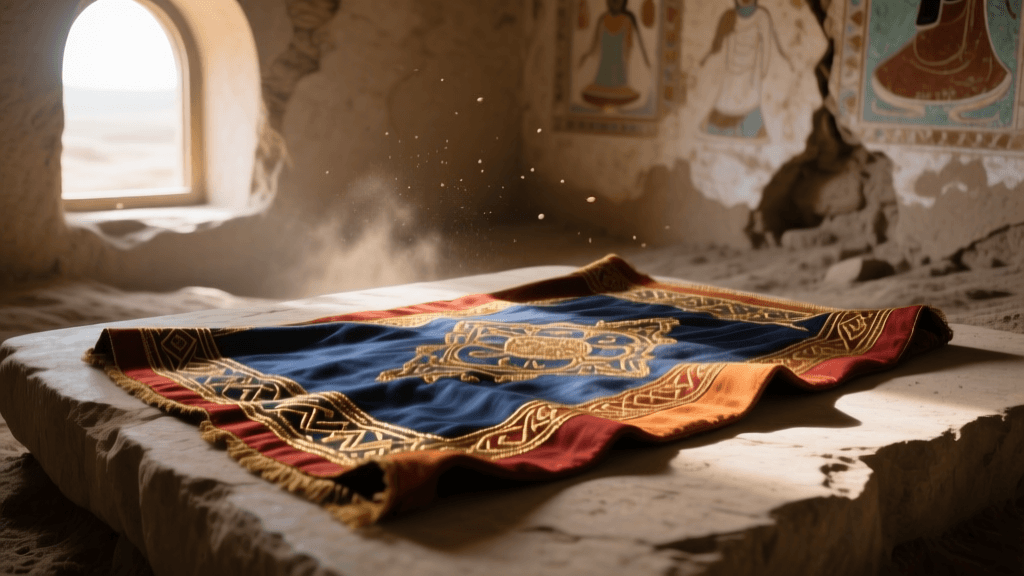
The Silk Road was never merely a conduit for spices, jade, and precious metals; it was a vibrant, sprawling artery of aesthetic and technological exchange that permanently altered the trajectory of global material culture. At the heart of this transcontinental network lies the Tarim Basin, and more specifically, the Astana Tombs near Turpan in modern-day Xinjiang. Often referred to as the 'Underground Museum,' the Astana cemetery complex has yielded some of the most pristine organic artifacts from the first millennium CE. As we navigate the archaeological landscape in 2026, the focus has shifted from mere excavation to the hyper-detailed molecular analysis of these surviving textiles, offering unprecedented insights into Sino-Sogdian cultural synthesis.
Because of the Taklamakan Desert's extreme aridity, organic materials that would have decomposed centuries ago in more humid climates have survived in astonishing condition. In 2026, international conservation teams, working in tandem with the Xinjiang Cultural Relics and Archaeology Institute, are utilizing advanced non-invasive spectral imaging to study these fragile fabrics without causing micro-abrasions. The findings are reshaping our understanding of how Chinese weavers absorbed, adapted, and ultimately mastered foreign textile technologies, creating a hybrid material culture that defined the Tang Dynasty's cosmopolitan zenith.
Decoding Samite: The Sino-Sogdian Weaving Revolution
Among the most significant textile categories recovered from the Astana Tombs is samite, a luxurious weft-faced compound twill. Prior to the intensive Silk Road exchanges of the 6th and 7th centuries, traditional Chinese silk weaving was overwhelmingly dominated by warp-faced structures, such as jin and early damasks. These warp-faced textiles were brilliant for displaying intricate, flowing, cloud-and-dragon motifs but were structurally limited in their ability to render the bold, geometric, and repeating patterns favored by Sasanian Persian and Sogdian merchants.
When Central Asian merchants brought weft-faced samite to the Tang capitals of Chang'an and Luoyang, it triggered a technological revelation. Chinese weavers reverse-engineered the complex drawloom setups required to produce weft-faced compound twills. By 2026, digital reconstructions of the drawlooms used in these ancient workshops have confirmed that weavers developed specialized harness systems to accommodate the heavy, multi-colored weft threads necessary for samite. The resulting textiles featured striking Central Asian motifs—such as the 'pearl roundel,' confronting peacocks, and Sasanian boars—executed with the unparalleled luster of Chinese silk.
The textiles of the Astana Tombs are not merely fabrics; they are the physical manifestation of a globalized ancient world, where the loom became a diplomatic instrument and a canvas for cross-cultural dialogue.
Structural Comparison: Traditional Han Weaves vs. Silk Road Samite
| Feature | Traditional Warp-Faced (e.g., Han Jin) | Silk Road Weft-Faced (Samite) |
|---|---|---|
| Structural Basis | Warp threads dominate the surface; weft is hidden. | Weft threads dominate the surface; warp acts as a binder. |
| Pattern Capability | Fluid, asymmetrical, curvilinear, and elongated motifs. | Bold, geometric, repeating, and highly symmetrical motifs. |
| Cultural Origin | Indigenous to early Chinese weaving traditions. | Originated in the Near East/Central Asia; adapted by Tang weavers. |
| Common Motifs | Cloud scrolls, mythical beasts, geometric lattices. | Pearl roundels, confronting horses, lotus palmettes. |
| 2026 Conservation Focus | Stabilizing brittle warp tensions and ancient sizing agents. | Mapping weft float degradation and heavy metallic thread oxidation. |
2026 Breakthroughs in Organic Dye Analysis
Beyond the structural revolution of the drawloom, color was a heavily guarded secret and a primary driver of Silk Road commerce. In 2026, the application of High-Performance Liquid Chromatography (HPLC) coupled with non-destructive Mass Spectrometry has allowed researchers to identify trace organic dyes and metallic mordants on microscopic fiber samples. This analytical leap has solved decades-old mysteries regarding the provenance of the colors found in the Astana Tombs.
For instance, the vibrant reds found in several 7th-century samite fragments were previously assumed to be derived exclusively from Chinese madder (Rubia tinctorum). However, 2026 spectroscopic analyses have revealed the presence of specific biomarkers indicating the use of insect-based dyes, such as lac or kermes, which were imported from India and the Mediterranean. Furthermore, the brilliant yellows and pinks, once thought to be simple safflower (Carthamus tinctorius) extracts, have been found to contain complex tannin-based mordants that allowed these fugitive dyes to survive centuries of desert burial.
Key Dyes Identified in Recent Astana Analyses
- Safflower Red/Pink: Extracted from the petals of Carthamus tinctorius. Requires an alkaline extraction process and an acid bath to precipitate the red pigment, a technique mastered by Tang dyers.
- Indigo Blue: Derived from Polygonum tinctorium (Japanese indigo) or Isatis tinctoria (woad). 2026 isotopic analysis helps distinguish between locally grown indigo and imported varieties.
- Lac Dye: A resinous secretion from the Kerria lacca insect, imported via southern trade routes, providing a deep, colorfast crimson that rivaled Mediterranean kermes.
- Amur Cork Tree Yellow: Derived from the bark of Phellodendron amurense, containing berberine, which not only provided a vibrant yellow hue but also acted as a natural insect repellent for the stored garments.
Digital Archiving and Global Accessibility
The preservation of these archaeological finds is no longer confined to physical climate-controlled vaults. In 2026, the push toward digital democratization has brought the Astana textiles to a global audience. Collaborative initiatives, such as those championed by the International Dunhuang Project, have expanded their high-resolution 3D scanning protocols to include intricate textile weaves. By utilizing photogrammetry and micro-CT scanning, conservators are creating interactive, gigapixel models of samite fragments. These digital twins allow researchers worldwide to study the interlacing of warp and weft threads without risking physical handling.
Furthermore, the broader context of these trade routes is meticulously documented by organizations like the UNESCO Silk Roads Programme, which continues to highlight the Chang'an-Tianshan corridor as a vital network of human heritage. The UNESCO World Heritage Centre recognizes this corridor not just for its monumental architecture, but for the intangible heritage of craftsmanship that flowed along its paths. The 2026 exhibition circuits in major global museums now feature augmented reality (AR) stations where visitors can 'drape' digitally reconstructed Astana samite garments onto virtual mannequins, observing how the heavy weft-faced fabrics caught the light and moved with the wearer.
The Enduring Legacy of Silk Road Textiles
The archaeological finds from the Astana Tombs serve as a profound testament to the fluidity of ancient borders. The silk threads spun in the Yellow River valley were woven on looms inspired by Persian engineering, dyed with pigments sourced from the Indian subcontinent, and tailored into garments worn by the cosmopolitan elite of the Tang Empire. As 2026 conservation technologies continue to peel back the layers of history on a molecular level, we are reminded that the Silk Road was the world's first great engine of collaborative design. The study of these ancient textiles bridges the gap between art history and hard science, ensuring that the vibrant colors and complex geometries of the past remain vividly alive for future generations.