Astana Silk Road Textile Finds 2026: Sogdian Samite Guide
The Astana Cemetery: A Time Capsule of Silk Road Exchanges
The Silk Road was never merely a conduit for the trade of raw materials; it was a vibrant artery of cultural, artistic, and technological exchange. Nowhere is this more evident than in the Astana Cemetery, located near the ancient oasis city of Gaochang in the Turfan Depression of Xinjiang, China. Due to the region's extreme aridity, the cemetery has served as an unparalleled time capsule, preserving organic materials—including paper, wood, and most importantly, textiles—that would have perished in more humid climates. As of 2026, ongoing archaeological analysis and advanced conservation techniques continue to reveal the staggering complexity of the garments and fabrics buried with the elite of the Tang Dynasty and their Sogdian contemporaries.
The Sogdians, an Eastern Iranian people whose homeland was centered in modern-day Uzbekistan and Tajikistan, were the premier merchants of the Silk Road. They acted as the vital middlemen between the Chinese empires, the Sassanian Persians, and the Byzantine world. According to the Metropolitan Museum of Art's extensive research on Sogdian culture, these merchants did not just transport goods; they transported aesthetic paradigms. The textiles found at Astana perfectly encapsulate this cross-pollination, featuring Chinese weaving techniques executed with Persian and Central Asian motifs, such as the iconic pearl roundels enclosing confronting roosters, boars, and the mythical senmurv (a bird-dog composite creature).
Deconstructing Sogdian Samite: The Weave Structure
To truly appreciate the Astana finds, one must understand the technical mastery behind samite. Derived from the Greek word for "six-threaded," samite is a heavy, weft-faced compound twill. Unlike standard plain weaves or simple twills, samite utilizes a complex system of main warps, binder warps, and multiple colored wefts. This structure allowed ancient weavers to create large, uninterrupted blocks of vivid color and intricate, sweeping curves necessary for the elaborate Sogdian roundel motifs.
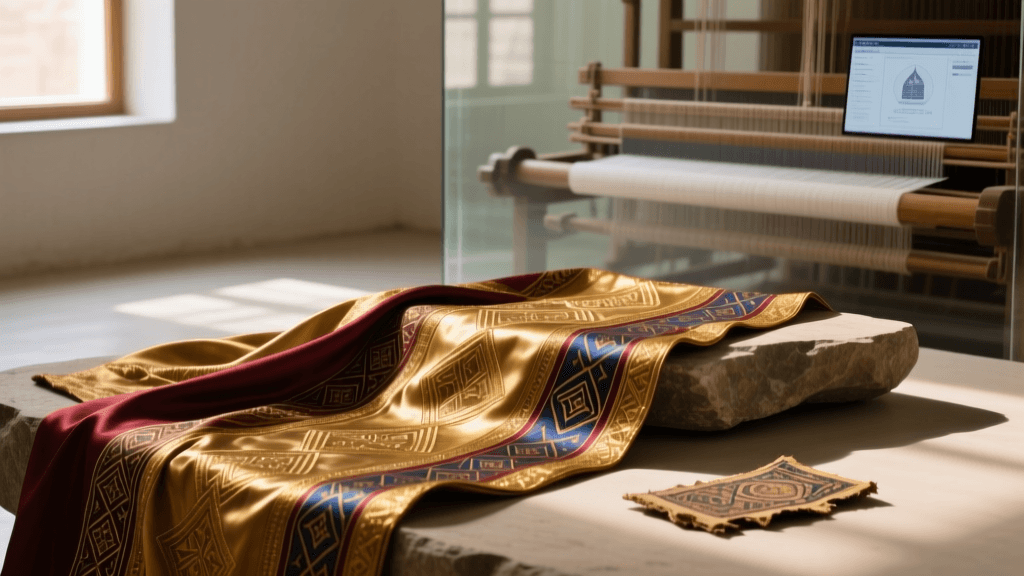
In the 8th century, producing samite required a massive drawloom, often operated by a master weaver and a drawboy who manually lifted the complex warp sequences. Today, the structural analysis of these ancient textiles provides the blueprint for modern replication. Below is a comparison between the historical Astana originals and the museum-grade replicas produced using 2026 digital weaving technologies.
| Feature | 8th-Century Astana Original | 2026 Museum-Grade Digital Replica |
|---|---|---|
| Loom Technology | Wooden Drawloom (Manual) | AI-Calibrated Electronic Jacquard Loom |
| Weft Density | 40-60 wefts per cm | 60-80 wefts per cm (High-Definition) |
| Dye Sources | Madder, Indigo, Safflower, Weld | Botanically Identical Lab-Synthesized Naturals |
| Production Time (1 Meter) | 3 to 6 weeks | 18 to 24 hours |
| Estimated Cost (USD) | N/A (Historical Barter/Tribute) | $450 - $850 per linear meter |
2026 Conservation and Digital Replication Technologies
The landscape of textile conservation and replication has evolved dramatically by 2026. Institutions along the UNESCO Silk Roads Programme network are now utilizing non-invasive multispectral imaging and portable Raman spectroscopy to analyze the Astana textiles without extracting physical samples. These tools allow conservators to map the exact chemical composition of 1,300-year-old dyes, identifying the precise mineral mordants used to fix colors like madder red and weld yellow to the silk fibers.
Once the chemical and structural data is captured, it is fed into advanced CAD (Computer-Aided Design) weaving software. Modern electronic Jacquard looms, equipped with micro-piezo weft insertion systems, can now replicate the exact tension and weft-density of the ancient samite. In 2026, the integration of machine learning algorithms helps predict how the silk threads will behave under tension, correcting for the slight irregularities of hand-spun historical yarns by introducing mathematically modeled "flaws" that give the modern replica an authentic, organic drape rather than a sterile, mass-produced appearance.
Sourcing Authentic 2026 Samite Replicas for Collections
For museum curators, historical reenactors, and high-end fashion archivists looking to acquire authentic Sogdian samite replicas, the market in 2026 is highly specialized. The China National Silk Museum in Hangzhou remains the premier authority on the replication of Tang Dynasty and Silk Road textiles. Their specialized replication workshop utilizes customized 14,400-hook Jacquard machines specifically programmed with the structural data from the Astana and Yingpan cemetery finds.
When commissioning a replica, buyers should request a "structural fidelity report," which guarantees that the weave is a true weft-faced compound twill rather than a cheaper digital print on a satin base. Expect to pay a premium for authentic natural dyeing; while synthetic equivalents are visually identical under standard lighting, natural dyes exhibit the correct dichroic shifts and aging properties required for serious historical preservation and academic study.
Practical Guide: Caring for Silk Samite Replicas
Whether you are preserving an original fragment or a 2026 high-fidelity replica, samite requires stringent environmental controls. The compound twill structure, while durable, traps dust and particulate matter deep within the weft layers. Follow these actionable preservation steps:
- Climate Control: Maintain a strict relative humidity (RH) between 45% and 55%. Fluctuations beyond this range cause the silk fibroin to expand and contract, leading to micro-fractures in the weft threads.
- Light Exposure: Limit illumination to 50 lux or less. Even with 2026 UV-filtering LED museum lighting, cumulative photon exposure will degrade the peptide bonds in the silk protein over time.
- Storage Protocol: Never fold samite. The heavy weft threads can crease permanently, breaking the binder warps. Always roll the textile face-out around an acid-free, archival-grade honeycomb cardboard tube, interleaving the layers with unbuffered, acid-free tissue paper.
- Cleaning: Avoid all liquid solvents. Use a museum-grade micro-vacuum with a HEPA filter and a low-suction screen attachment to gently lift surface particulates from the twill valleys.
The Xin Zhongshi Movement: Ancient Motifs in 2026 Fashion
The archaeological revelations from the Astana cemetery are not confined to museum vitrines; they are actively shaping the contemporary fashion landscape. The Xin Zhongshi (New Chinese Style) movement of 2026 has seen a massive surge in designers looking past the standard Ming and Qing Dynasty silhouettes, reaching further back into the cosmopolitan brilliance of the Tang Dynasty and its Silk Road partners.
Top-tier Asian fashion houses are currently licensing the digital weave files of Astana samite to produce limited-edition outerwear and structured corsetry. The bold, geometric symmetry of the Sogdian pearl roundels provides a striking contrast to the fluid, minimalist draping favored in modern avant-garde design. By merging 8th-century cross-cultural motifs with 2026 sustainable silk farming and zero-waste digital weaving, the legacy of the Sogdian merchants continues to traverse the globe, proving that the Silk Road remains an enduring wellspring of sartorial innovation.