Best Kimono Storage Preservation 2026: Archival Collection Guide
The Vulnerability of Vintage Silk in Modern Collections
Preserving a vintage kimono is an act of cultural stewardship. Whether you possess a vibrant Taisho-era meisen, a heavily embroidered Uchikake, or a delicate Edo-period kosode, the protein-based structure of silk makes it inherently vulnerable to environmental degradation. As of 2026, the global market for vintage Japanese textiles has surged, bringing renewed attention to the science of garment preservation. Unlike synthetic fibers, silk is highly susceptible to hydrolysis, photo-oxidation, and biological pests. For serious collectors and museum curators alike, implementing a rigorous, archival-grade storage protocol is no longer optional; it is essential for ensuring these garments survive for future generations.
The primary enemies of silk are fluctuating humidity, direct ultraviolet light, acidic contact materials, and protein-eating insects. In this comprehensive 2026 guide, we break down the exact materials, environmental controls, and traditional folding techniques required to maintain a pristine kimono collection, drawing on the latest conservation standards and smart-home technology.
The Science of Silk Degradation
Silk fibroin is a natural protein fiber that requires a delicate moisture balance to maintain its tensile strength. When relative humidity (RH) drops below 40%, silk becomes brittle and prone to shattering along fold lines. Conversely, when RH exceeds 65%, the risk of mold spores germinating on the organic sizing agents and metallic threads increases exponentially. According to the Canadian Conservation Institute, maintaining a stable microclimate is the single most critical factor in preventing the mechanical failure of historic textiles. Furthermore, weighted silks—common in late Meiji and early Taisho garments—contain metallic salts that accelerate dry rot, making their storage requirements even more stringent than unweighted silks.
Archival Wrapping: The Evolution of Tatou-shi
In Japan, the traditional method of storing kimono involves wrapping them in tatou-shi (wrapping paper). However, not all paper is safe for long-term archival storage. Standard commercial papers contain lignin and acidic sizing agents that will off-gas and cause yellowing or burning of the silk fibers over time.
Selecting the Right Archival Tissue
For 2026 collection management, collectors must source unbuffered, acid-free, lignin-free archival tissue paper. Buffered papers (which contain an alkaline reserve like calcium carbonate) are excellent for cotton and linen but can damage protein fibers like silk and wool over extended periods. Look for tissue paper that meets the ISO 18902 standard for imaging and archival materials. Brands like University Products and Lineco continue to dominate the 2026 archival market, offering unbuffered, neutral-pH tissue sheets perfectly sized for standard kimono dimensions (typically 36 x 60 inches).
- Unbuffered Acid-Free Tissue: Mandatory for all silk, wool, and metallic-thread garments.
- Buffered Acid-Free Tissue: Safe for cotton, hemp, and ramie summer garments (yukata and jinbei).
- Tyvek Envelopes: Useful for storing small accessories like obijime and obidome, preventing them from snagging on delicate silk weaves.
Storage Vessels: Tansu vs. Archival Boxes
The vessel in which you store your wrapped kimono dictates its long-term exposure to atmospheric pollutants and pests. The traditional Japanese tansu (chest) made from Paulownia wood (kiri) has been the gold standard for centuries. Paulownia is lightweight, naturally resistant to insects, and possesses unique hygroscopic properties that allow it to absorb and release moisture, buffering the interior against rapid humidity shifts.
However, authentic, high-quality Paulownia tansu are increasingly rare and expensive in 2026. As an alternative, museum-grade corrugated archival boxes constructed from acid-free, lignin-free board have become the standard for institutional and serious private collections.
| Storage Material | Pros | Cons | 2026 Verdict |
|---|---|---|---|
| Paulownia Wood (Kiri Tansu) | Natural humidity buffer, traditional aesthetic, pest-resistant. | Very expensive, heavy, requires periodic maintenance. | Best for high-value heirlooms and display rooms. |
| Archival Corrugated Board Boxes | Acid-free, lightweight, stackable, cost-effective. | Lacks natural humidity buffering, utilitarian appearance. | Best for large collections and off-site climate storage. |
| Plastic Bins (Polypropylene) | Waterproof, cheap, readily available. | Traps moisture, off-gasses VOCs, promotes mold. | Never use for long-term silk storage. |
Climate Control and Smart Monitoring in 2026
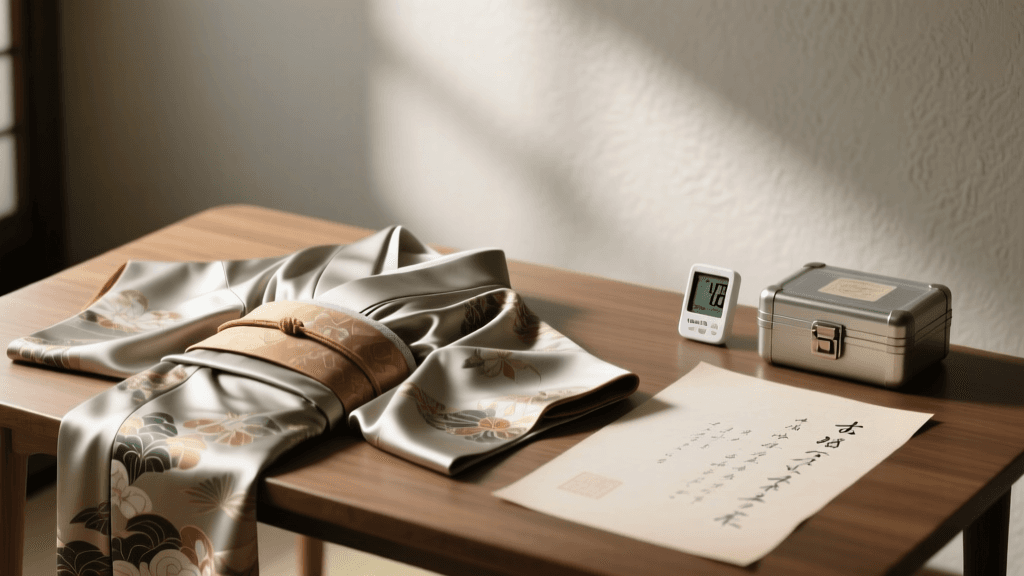
Relying solely on passive storage is no longer sufficient for high-value collections. In 2026, the integration of smart-home environmental sensors has revolutionized private collection management. Devices like the SwitchBot Wi-Fi Thermohygrometer or the Govee H5179 allow collectors to monitor temperature and RH levels in real-time via smartphone applications, complete with push notifications if the environment deviates from safe parameters.
The ideal storage environment for a silk kimono collection is a dark, interior room with a stable temperature of 65°F to 68°F (18°C to 20°C) and a relative humidity strictly maintained between 45% and 55%. If you live in a humid climate, integrating a desiccant-based dehumidifier (which is gentler on textiles than compressor-based models) connected to a smart plug ensures the room never crosses the dangerous 60% RH threshold. The Victoria and Albert Museum emphasizes that avoiding rapid fluctuations in these metrics is just as important as the absolute numbers, as expansion and contraction of fibers cause mechanical stress.
The Hon-Datami Folding Technique
Improper folding is a leading cause of structural damage in vintage textiles. The traditional Japanese folding method, known as hon-datami, is specifically designed to align the seams and minimize stress on the fabric. When preparing a kimono for storage in 2026, follow these steps to ensure archival safety:
- Preparation: Lay the kimono face down on a clean, acid-free surface. Ensure your hands are clean and free of lotions, or wear unbleached cotton conservation gloves.
- Sleeve Alignment: Fold the left sleeve back over the body of the kimono, aligning the edge with the center back seam. Repeat with the right sleeve.
- Side Folds: Fold the left side of the garment toward the center back seam. Then, fold the right side over the left, ensuring the front panels overlap neatly.
- Length Folds: Fold the bottom hem up to meet the collar. To prevent hard creases from forming over decades, place rolled twists of acid-free tissue paper inside every fold line. This creates a soft, rounded edge rather than a sharp, fiber-breaking crease.
- Wrapping: Wrap the folded kimono completely in your unbuffered archival tissue paper, sealing it with an acid-free paper tape or a cotton twill tie. Never use adhesive tapes directly on the garment or the wrapping paper.
Pest Management: Pheromones and Prevention
Webbing clothes moths and carpet beetles are the apex predators of a silk collection. In the past, collectors relied heavily on chemical mothballs (naphthalene or paradichlorobenzene), which are now recognized as toxic to humans and capable of reacting with metallic threads to cause blackening and tarnishing. Furthermore, the strong odors can permanently permeate the silk.
Modern 2026 preservation protocols utilize integrated pest management (IPM). Sticky pheromone traps are placed strategically around the storage perimeter to monitor and intercept male moths before they can mate. For active deterrence, natural alternatives like sustainably harvested cedar blocks or dried lavender sachets can be placed inside the storage room, but never in direct contact with the silk, as the natural oils in cedar can stain the fabric if they leach. Regular inspection cycles—unwrapping and airing out the garments every six months in a shaded, climate-controlled room—remain the most effective biological deterrent.
Digital Collection Management and Provenance Tracking
As collections grow, physical memory is insufficient for tracking the provenance, condition, and rotation schedules of dozens or hundreds of garments. In 2026, digital collection management is a cornerstone of professional preservation. Utilizing specialized database software or even robust relational tools like Airtable or Notion, collectors can catalog each piece with high-resolution macro photography, detailing any pre-existing weak points, stains, or repairs.
Tagging each physical storage box with an NFC chip or a QR code allows for instant retrieval of the garment's digital record via a smartphone. This digital ledger should include the date of the last inspection, the specific folding method used, the acquisition provenance, and any conservation treatments applied. By marrying the ancient art of the hon-datami fold with modern digital archiving, collectors ensure that the history and physical integrity of their kimono are preserved in tandem, safeguarding these masterpieces of Asian textile tradition for the next century.