Anime Cosplay Guide: Styling Traditional Japanese Garments
The Intersection of Anime and Traditional Japanese Garments
The global explosion of anime and manga has done more than just popularize Japanese storytelling; it has sparked a massive renaissance in the appreciation of historical Japanese clothing. Iconic series like Demon Slayer (Kimetsu no Yaiba), Inuyasha, Rurouni Kenshin, and Gintama feature protagonists adorned in meticulously designed traditional garments. For modern cosplayers, replicating these looks has evolved from assembling cheap, mass-produced Halloween costumes to embracing authentic kitsuke (the art of wearing traditional Japanese clothing). According to the Japan National Tourism Organization (JNTO), traditional garments remain a vital, living part of Japanese culture, and understanding their historical context elevates any cosplay from a simple costume to a wearable tribute.
This comprehensive guide bridges the gap between historical accuracy and the practical realities of anime conventions. Whether you are aiming to recreate the Taisho-era military aesthetics of the Demon Slayer Corps or the Edo-period samurai silhouettes of Rurouni Kenshin, mastering the foundational garments is essential.
Essential Garments for the Anime Cosplayer
To build an accurate anime cosplay, you must understand the building blocks of the traditional Japanese wardrobe. Most anime character designs are rooted in three primary garments: the haori, the hakama, and the juban.
The Haori: The Iconic Anime Jacket
The haori is a traditional hip- or thigh-length jacket worn over a kimono or modern clothing. In anime, it is often used to signify a character’s rank, clan, or elemental affinity. Tanjiro Kamado’s black-and-green checkered haori and Inuyasha’s fiery Hinezumi robe are prime examples. Unlike a kimono, the haori is left open at the front and does not require an obi (sash). Instead, it is secured using a haori himo, a decorative braided cord tied at the chest. For cosplayers, the haori is incredibly versatile; it can be thrown over modern convention attire for a subtle, casual cosplay or layered over a full kimono for screen-accurate accuracy.
The Hakama: Pleated Trousers of the Samurai
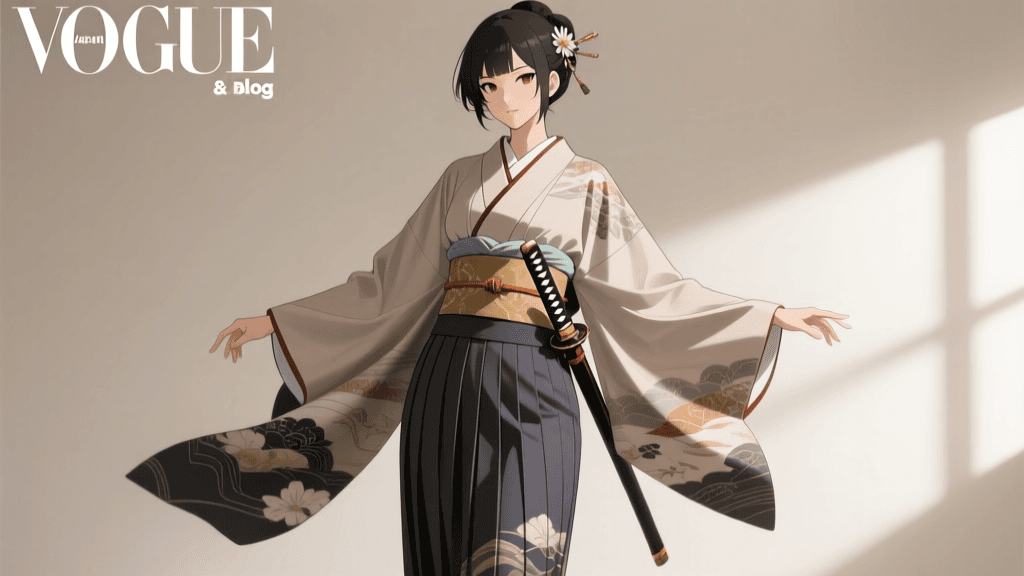
The hakama are wide, pleated trousers traditionally worn by samurai, martial artists, and Shinto priests. In anime, they are the staple of the wandering swordsman or the disciplined martial artist. A formal sendaihira hakama features exactly seven pleats: five in the front and two in the back, which are historically said to represent the seven virtues of the samurai (benevolence, courtesy, courage, honesty, honor, loyalty, and piety). Characters like Kenshin Himura and Gintoki Sakata are rarely seen without them. The hakama is secured by four long ties (himo) that wrap around the waist and tie in a specific knot at the lower back, resting against the koshiita (a rigid back board).
The Juban: The Hidden Foundation
The juban (or nagajuban) is the under-robe worn beneath the outer kimono. Its primary purpose is to protect the expensive outer silk from sweat and body oils, but in anime cosplay, it provides the crucial layered collar effect. The white or contrasting collar of the juban peeking out from beneath the outer garment is a hallmark of authentic Japanese dress. As noted by the Victoria and Albert Museum, the evolution of the under-robe (kosode) was instrumental in the development of the modern kimono silhouette, making it a non-negotiable layer for high-end cosplayers seeking historical depth.
Character Case Studies: Bringing Anime to Life
Case Study 1: The Demon Slayer Corps Uniform
The standard Demon Slayer uniform is a fascinating hybrid of Western military garb and traditional Japanese wear. It consists of a black gakuran-style tunic, Western-style trousers, and a white hakama worn over the pants. To cosplay this accurately, avoid buying a pre-made 'ninja' costume. Instead, source a high-quality black military tunic, pair it with a stiff, cotton-blend white hakama, and finish with your character’s specific haori. The hakama should be tied high at the natural waist, not the hips, to maintain the anime’s stylized proportions.
Case Study 2: Rurouni Kenshin’s Samurai Attire
Kenshin’s everyday Edo-period attire requires a deep understanding of layering. He wears a plain, dark cotton kimono tucked into a dark grey hakama. The key to this cosplay is the obi (belt) and the katanagake (sword sling). The kimono must be folded and tucked securely into the hakama ties so that no excess fabric bunches at the waist. The prop katana is not simply shoved through the belt; it is suspended by a woven sageo cord, allowing it to rest at the correct downward angle for a samurai’s quick draw (iaijutsu).
Traditional Kitsuke vs. Convention Cosplay
While traditional kitsuke is beautiful, it is not always practical for a three-day anime convention. Authentic dressing relies on tension, using multiple cotton ties (koshihimo) and wide silk belts (datejime) to secure garments without pins or velcro. Sitting on crowded convention center floors, waiting in long autograph lines, and navigating dealer halls can cause traditional ties to slip.
The Cosplay Compromise: Modern cosplayers often employ 'con-hacks' to maintain the illusion of traditional dress while ensuring comfort. Replacing the rigid back board of a hakama with a flexible plastic insert prevents back pain during long photoshoots. Similarly, using heavy-duty safety pins to secure the kimono collar to the juban prevents the dreaded 'wardrobe malfunction' when bending over. While purists may object, the Japan Guide acknowledges that modern adaptations of traditional clothing are increasingly common even in Japan, prioritizing mobility and ease of wear for festivals and daily activities.
Comparison Chart: Authentic Silk vs. Cosplay-Grade Polyester
Choosing the right fabric is critical for both your budget and your convention survival. Below is a comparison of traditional materials versus modern cosplay alternatives.
| Feature | Authentic Silk / Wool | Cosplay-Grade Polyester / Cotton |
|---|---|---|
| Cost (USD) | $150 - $800+ | $40 - $120 |
| Weight & Drape | Heavy, fluid, authentic movement | Lightweight, can look stiff or floaty |
| Breathability | Excellent (Silk) / Warm (Wool) | Poor (Traps heat in crowded con halls) |
| Maintenance | Dry clean only, highly delicate | Machine washable, wrinkle-resistant |
| Convention Suitability | Best for short photoshoots & VIP events | Ideal for all-day wear & active panels |
Pro Tip: If you choose polyester for a summer convention, line the hakama with a breathable cotton mesh to prevent the synthetic fabric from sticking to your skin when sweating.
Sizing, Measurements, and Tailoring
Unlike Western clothing, traditional Japanese garments are generally sized by length rather than width, as they are wrapped and tied to fit the wearer's girth. When ordering custom pieces or buying vintage, you must take precise measurements.
- Hakama Length: Measure from your navel (where the hakama will sit) down to your ankle bone. Subtract 2 inches if you plan to wear zori sandals, as the hem should not drag on the ground.
- Haori Length: Measure from the base of your neck down to your desired hemline (usually mid-hip). Anime designs often exaggerate haori length for dramatic effect; measure down to the back of the knee for a stylized, flowing look.
- Sleeve Drop (Sode): Anime characters frequently feature exaggerated, flowing sleeves. Standard kimono sleeves drop about 19 inches. For a dramatic, action-ready anime silhouette, request a 24-inch to 30-inch drop from your tailor.
Accessorizing: Footwear and Props
No traditional Japanese cosplay is complete without the correct footwear. Tabi (split-toe socks) are mandatory when wearing zori (flat sandals) or geta (wooden clogs). White tabi are standard for formal wear and most anime protagonists, while black or navy tabi are used for stealthy or rugged characters. Actionable advice: Buy your tabi a month before the convention and wear them around the house with socks over them to stretch the stiff cotton. Blisters from rigid new tabi can ruin a convention weekend.
When it comes to props, securing a katana to a hakama requires a sageo (sword cord). Never rely on convention-center security to understand how a sword is worn; ensure your prop is securely tied to your waist using traditional knotting methods so it doesn't clatter to the floor in crowded aisles. Always check your specific convention’s weapon policy regarding wooden, foam, or metal props before finalizing your build.
Budgeting and Where to Buy
Building a traditional anime cosplay doesn't have to break the bank. If you want authentic silk or wool pieces, look into Japanese thrift stores (like the Hard-Off chain) or proxy services for Yahoo! Auctions Japan, where vintage hakama and haori can be purchased for as little as $20 to $40. For modern, durable cosplay-grade garments, platforms like Etsy host independent tailors who specialize in anime-accurate cuts using breathable cotton-linen blends. Expect to spend around $150 for a custom-tailored hakama and haori set. By investing in the foundational garments rather than flimsy, pre-packaged costumes, you ensure your cosplay will look spectacular, move authentically, and last for years of convention adventures.