Ancient Greek Chiton & Roman Toga Guide 2026: Patterns & Styling
The Enduring Legacy of Classical Antiquity Garments
The fascination with classical antiquity continues to shape textile arts, historical costuming, and contemporary fashion in 2026. From high-fashion runways in Milan to dedicated historical reenactment societies across Europe, the ancient Greek chiton and Roman garments remain foundational to our understanding of European folk and historical dress. Unlike the tailored, pattern-cut garments that emerged in the late Middle Ages, classical Mediterranean clothing was defined by the art of draping. The beauty of these garments lay not in complex stitching, but in the quality of the textile, the geometry of the weave, and the skill of the wearer in manipulating fabric around the human form.
Whether you are a theatrical costumer, a living historian, or a sustainable fashion enthusiast looking to incorporate zero-waste draping techniques into your 2026 wardrobe, mastering the chiton, toga, and stola requires an understanding of both historical context and practical textile manipulation. This comprehensive guide explores the construction, fabric sourcing, and draping techniques of ancient Greek and Roman garments, providing actionable patterns and styling advice for the modern maker.
The Greek Chiton: Understanding Doric and Ionic Variations
The chiton was the quintessential garment of ancient Greece, worn by both men and women. It was essentially a rectangular piece of fabric draped around the body and fastened at the shoulders. However, the style, weight, and draping method varied significantly between the two primary forms: the Doric and the Ionic.
The Doric Chiton (Peplos)
Often referred to as the peplos when worn by women, the Doric chiton was the older, heavier, and more structured of the two styles. According to the World History Encyclopedia, the Doric chiton was typically made from heavyweight wool, which provided warmth and created deep, sculptural folds. The fabric width was roughly equal to the wearer's arm span, and the length was the wearer's height plus an additional 40 centimeters to allow for the signature *apoptygma* (the overfold that draped over the chest and back). It was pinned at the shoulders with large, heavy fibulae (brooches) and belted at the waist, with the excess fabric bloused over the belt to create the *kolpos*.
The Ionic Chiton
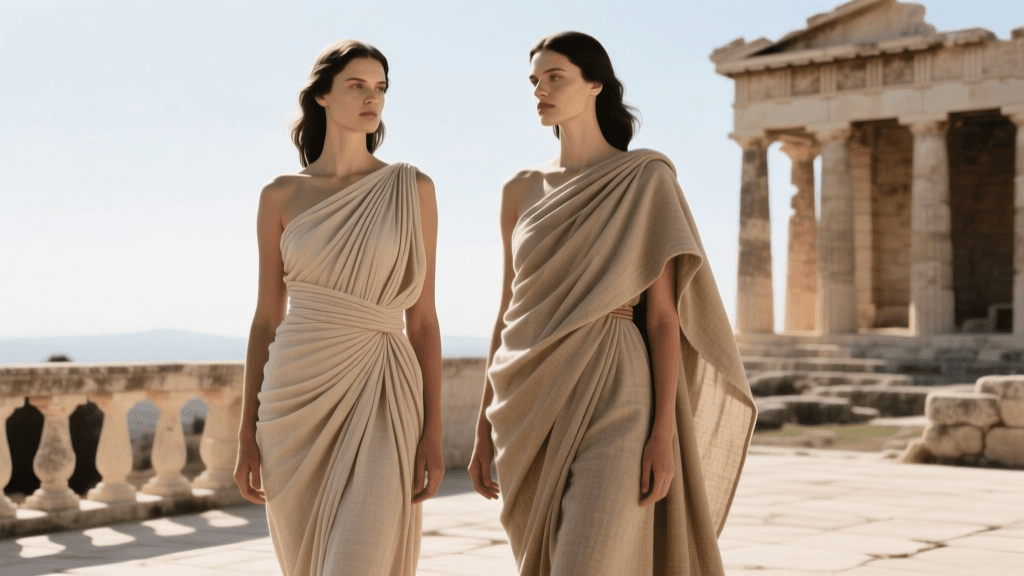
Emerging later and favored during the warmer months, the Ionic chiton was crafted from much lighter, wider fabrics, primarily linen or fine silk imported from the East. Because the fabric was significantly wider—often twice the width of the wearer's outstretched arms—it was not folded over at the top. Instead, it was pinned or sewn at intervals along the upper arms, creating a series of delicate, sleeve-like drapes. The Ionic chiton relied on the sheer volume and lightness of the textile to create its elegant, flowing silhouette, a style frequently depicted in classical marble sculptures.
The Roman Wardrobe: Toga, Stola, and Palla
While the Romans adopted many elements of Greek dress, their clothing system was deeply intertwined with social status, citizenship, and gender roles. The Roman wardrobe was complex, layered, and strictly regulated by sumptuary laws.
The Toga: Symbol of Citizenship
The toga was the ultimate symbol of Roman male citizenship. It was a massive, semicircular piece of white wool, measuring up to 6 meters in length and 2.5 meters in width. Draping a toga correctly was an art form that required the assistance of a slave or servant. The complex folds, such as the *sinus* (the deep pocket-like drape across the chest) and the *umbo* (the decorative knot at the waist), were meticulously arranged. As noted in the comprehensive guide to Roman Dress, variations like the *toga praetexta* (featuring a purple border) were reserved for magistrates and freeborn youths, while the *toga picta* (solid purple and embroidered with gold) was worn exclusively by triumphant generals and later, emperors.
The Stola and Palla: The Matron's Attire
Respectable Roman women did not wear the toga; instead, their formal public attire was the stola. Worn over a base tunic (the *tunica intima*), the stola was a long, sleeveless or short-sleeved dress suspended from the shoulders by straps or brooches. It was typically belted high under the bust and featured an *instita*, a decorative woven border at the hem that signaled the wearer's status as a married matron. When venturing outdoors, a Roman woman would wrap herself in the *palla*, a large rectangular mantle draped over the head and shoulders, functioning much like the Greek himation.
Comparative Analysis of Classical Garments
To help historical costumers and designers select the appropriate garment for their 2026 projects, the table below outlines the core differences between these foundational pieces.
| Garment | Origin | Primary Material | Fastening Method | Social Significance |
|---|---|---|---|---|
| Doric Chiton (Peplos) | Greece | Heavyweight Wool | Large shoulder fibulae | Traditional, modest, older style |
| Ionic Chiton | Greece | Lightweight Linen/Silk | Multiple small pins or sewing | Elegant, modern, luxury |
| Toga | Rome | Massive White Wool | Complex tension draping | Male citizenship, political status |
| Stola | Rome | Wool or Linen | Shoulder straps, high belt | Married female citizen (matron) |
Sourcing Authentic Textiles in 2026
One of the most significant shifts in historical costuming and slow fashion in 2026 is the demand for traceable, sustainable, and historically accurate textiles. To achieve the correct drape for a chiton or stola, modern synthetic blends will not suffice; they lack the necessary weight and bias stretch. The Metropolitan Museum of Art's Greek and Roman collection showcases the incredible fineness of ancient weaves, which modern heritage mills are now replicating using traditional loom technologies.
- For the Doric Chiton: Seek out 100% European flax linen or lightweight merino wool in the range of 180-220 GSM (grams per square meter). The fabric must have enough body to hold the sharp, geometric folds of the apoptygma. Expect to pay between €25 and €40 per meter from heritage mills in Ireland or Italy.
- For the Ionic Chiton: Opt for handkerchief-weight linen, ramie, or peace silk (80-120 GSM). The fabric should be nearly translucent and possess a fluid drape. Modern organic ramie is an excellent, sustainable substitute for historical eastern silks, offering a similar crisp yet fluid hand-feel.
- For the Roman Toga and Stola: You will need substantial yardage. A lightweight, fulled wool flannel or a heavy linen-canvas blend (250+ GSM) works best. The fabric must be wide enough (at least 150cm) to minimize seaming, as ancient garments were woven to shape on broad looms.
Step-by-Step Draping and Construction Guide
Unlike modern garments, classical dress requires minimal cutting and sewing. The focus is on precise measurements and strategic pinning. Here is how to construct and drape the most versatile of these garments.
Draping the Ionic Chiton
- Cut the Fabric: Cut a rectangle of lightweight linen. The width should be twice the distance from your elbow to your elbow when your arms are outstretched. The length should be your height from shoulder to floor, plus 15 cm for blousing.
- Finish the Edges: Hem all four sides. In antiquity, the edges were often left fringed or finished with tablet-woven borders, but a clean rolled hem is appropriate for modern wear.
- Pin the Shoulders: Fold the fabric in half widthwise. Starting at the neck opening (leave about 15 cm in the center unpinning for the head), use small safety pins or replica fibulae to pin the front and back layers together at 5 cm intervals along the top edge, stopping at the wrists.
- Belt and Blouse: Wrap the garment around your body. Tie a woven wool or leather *zona* (belt) around your waist. Pull the fabric up and over the belt to create the *kolpos*, ensuring the hem falls evenly at your ankles.
Styling the Roman Stola
The stola requires a base layer. Begin by donning a simple, fitted linen tunica. Cut the stola fabric into a wide rectangle, allowing for deep side pleats. Sew the side seams from the hem up to the waist, leaving the top open. Attach shoulder straps (*anadesma*) or use decorative brooches to secure the front and back panels over the shoulders. The defining feature of the stola is the *instita*—a contrasting woven band sewn to the bottom hem. In 2026, many costumers are using naturally dyed madder root or woad bands to replicate the vibrant colors of Pompeian frescoes. Belt the stola high, just under the bust, using a cord or woven sash to create the characteristic high-waisted Roman silhouette.
Contemporary Revival and Modern Styling
In 2026, the revival of classical garments extends beyond museum replicas and theater stages. The principles of zero-waste fashion have brought the chiton and the himation back into the spotlight as sustainable, size-inclusive wardrobe solutions. Because these garments are not cut to specific body measurements, they are inherently adaptable, eliminating the need for complex grading and reducing textile waste to near zero.
Modern stylists are pairing the ancient Greek Ionic chiton with contemporary accessories, such as structured leather corset belts or minimalist metallic cuffs, bridging the gap between antiquity and modern avant-garde fashion. Meanwhile, historical reenactors are utilizing 3D-printed bronze fibulae and laser-cut leather sandals to achieve unprecedented levels of historical accuracy at a fraction of the traditional cost. Whether you are studying the socio-political implications of the Roman toga or simply seeking a breathable, elegant linen dress for the summer, the garments of classical antiquity offer timeless lessons in the art of the drape.