2026 Guide to Draping the Greek Chiton and Roman Stola
The 2026 Revival of Classical Draped Garments
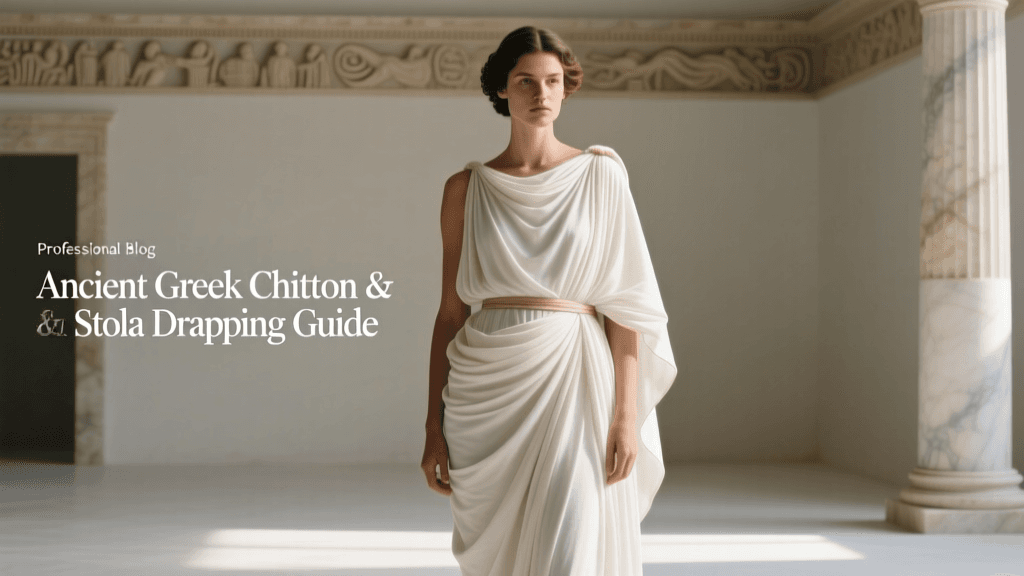
As we move through 2026, the intersection of sustainable fashion and historical accuracy has sparked a massive resurgence in classical antiquity clothing. Modern historical reenactors, theater costumers, and eco-conscious fashion enthusiasts are turning away from synthetic, mass-produced costumes and embracing the elegant, zero-waste construction of ancient Mediterranean garments. The Greek chiton and the Roman stola represent the pinnacle of ancient draped textile art. Unlike modern tailored clothing, these garments were not cut and sewn into complex shapes; instead, they relied on the masterful manipulation of rectangular woven fabrics, secured with pins and belts, to create flowing, dynamic silhouettes.
According to the World History Encyclopedia, the beauty of ancient Greek dress lay in its simplicity and its reliance on the natural drape of the fabric to accentuate the human form. Today, mastering these ancient techniques allows us to connect with European folk and historical traditions in a deeply tactile way. This comprehensive guide will walk you through the history, material sourcing, and step-by-step draping techniques required to recreate authentic classical garments for the modern era.
Understanding the Greek Chiton: Doric vs. Ionic
The chiton was the foundational garment for both men and women in ancient Greece, evolving significantly over the centuries. By studying museum collections, such as those detailed by the Metropolitan Museum of Art, we can identify two primary styles that dominate historical reconstruction: the Doric and the Ionic chiton.
The Doric Chiton (Peplos)
The Doric chiton, often referred to as a peplos when worn by women, is the older and heavier of the two styles. Traditionally woven from wool, it features a distinctive overfold (apoptygma) at the top. The fabric is wrapped around the body, pinned at the shoulders with heavy fibulae (brooches), and belted at the waist. The overfold can be left hanging loose to create a blousing effect or pulled up over the belt to adjust the hemline. In 2026, reenactors favor heavyweight, fulled wool for the Doric chiton, as it provides the structured, geometric folds seen in classical marble sculpture.
The Ionic Chiton
Emerging later and favored for its luxurious drape, the Ionic chiton is made from much wider and lighter fabrics, typically linen or fine silk. Instead of a single overfold and two shoulder pins, the Ionic chiton is gathered and pinned multiple times along the upper arm, creating the illusion of short sleeves. This style requires a fabric width that is at least twice the wearer's shoulder width. The resulting garment is highly voluminous, often belted high under the bust or crossed at the back and brought to the front to create a complex, corset-like bodice effect.
The Roman Stola: Symbols of Matronly Virtue
While Greek dress focused on the aesthetic drape, Roman clothing was deeply codified to indicate social status, citizenship, and gender. The stola was the traditional, defining garment of the married Roman woman (matrona). Worn over a basic linen tunica, the stola was a long, sleeveless, or short-sleeved dress suspended from the shoulders by small straps or a knotted yoke.
The most critical visual marker of the stola was the instita—a decorative, often brightly colored or embroidered band sewn to the lower hem. According to historical analyses of Roman dress, the stola was designed to conceal the female form, projecting modesty and moral virtue. Over the stola, a Roman woman would drape the palla, a large rectangular mantle that could be pulled over the head when in public. Recreating the stola in 2026 requires attention to the distinct V-shaped neckline and the careful application of the institia, which modern crafters often achieve using tablet-woven trims or naturally dyed silk bands.
Sourcing Authentic Materials in 2026
The success of any classical drape relies entirely on the weight, weave, and fiber content of the fabric. Modern synthetics like polyester chiffon will cling, static, and drape poorly, ruining the historical silhouette. For the 2026 reenactment season, the focus is on sustainable, natural fibers.
- Linens: For the Ionic chiton and Roman tunica, seek out GOTS-certified medium-weight linen (approx. 5 to 6 oz per square yard). Look for 'slub' or handwoven textures that mimic ancient loom imperfections.
- Wools: For the Doric chiton and Roman palla, lightweight worsted wools or tropical wools are ideal. They drape beautifully without causing overheating during summer festivals.
- Natural Dyes: The 2026 artisan market has seen a revival in botanical dyeing. Madder root (for reds and oranges), woad (for blues), and weld (for yellows) were historically accurate and are now widely available from sustainable textile cooperatives.
Step-by-Step Draping Guide: The Ionic Chiton
Draping an Ionic chiton requires patience and a willing model. Here is a precise, actionable method for achieving the classical sleeved look.
- Measure and Cut: You need a rectangle of lightweight linen. The width should be your wingspan plus 12 inches. The length should be from your shoulder to the floor, plus 12 inches for blousing (kolpos).
- Hem the Edges: Ancient garments were woven to size, but since we are cutting modern fabric, roll and stitch the raw edges to prevent fraying.
- First Shoulder Pin: Wrap the fabric around the body. Bring the two front top corners together at the edge of your collarbone and secure them with a fibula or a modern safety pin concealed by a decorative brooch.
- Creating the Sleeves: Moving outward along the top edge, pinch the front and back layers of the fabric together every 3 to 4 inches along the arm. Pinch and pin these intervals to create the 'sleeve' openings. Leave the very last edge open for your arm to pass through.
- Belt and Blouse: Tie a woven wool or leather cord around your natural waist. Pull the fabric up and over the belt evenly all the way around until the hem grazes your ankles. This overhang is the kolpos.
- The Cross-Belt (Optional):strong> For a more fitted look, take a second, thinner cord, tie it under the bust, cross it in the back, and bring it forward to tie under the bust again, pulling the fabric taut across the shoulder blades.
Comparative Garment Analysis
| Garment | Primary Fabric | Fastening Method | Key Feature | Historical Context |
|---|---|---|---|---|
| Doric Chiton | Heavyweight Wool | Two large shoulder fibulae | Apoptygma (overfold) | Archaic/Classical Greece |
| Ionic Chiton | Fine Linen/Silk | Multiple pins along the arm | False sleeves, high volume | Classical/Hellenistic Greece |
| Roman Stola | Wool/Linen blend | Shoulder straps (pattae) | Instita (decorative hem band) | Roman Republic/Empire |
| Roman Palla | Lightweight Wool | Draped and tucked (no pins) | Functions as a mantle/veil | Roman Republic/Empire |
Accessories: Fibulae, Footwear, and Styling
No classical garment is complete without its functional and decorative accessories. The fibula (brooch) was essential for securing the heavy wools of the Doric chiton and the Roman cloak. In 2026, historical jewelers and metalworkers are utilizing 3D-scanned museum archives to cast highly accurate bronze and silver fibulae, such as the 'knee-brooch' and the 'crossbow fibula,' making museum-quality replicas accessible to the public.
Footwear is equally important. For Greek ensembles, the krepides (strapped leather sandals) are the standard. These should be made from vegetable-tanned leather with rawhide laces that wrap up the calf. Roman women would typically wear the solea (a simple sandal) indoors, but transition to the calceus (a soft, enclosed leather shoe) when stepping outside. Avoid modern rubber soles; seek out artisan cobblers who specialize in historically stitched, turn-shoe construction or nailed leather soles.
'The elegance of antiquity was not found in the complexity of the tailoring, but in the profound understanding of how woven fibers interact with gravity and the human form.' — Dr. Aris Thorne, Textile Historian, 2025 Symposium on Mediterranean Antiquities.
Conclusion
Recreating the Greek chiton and Roman stola is a deeply rewarding endeavor that bridges the gap between ancient history and modern sustainable practices. By sourcing ethical, natural textiles and mastering the geometric logic of classical draping, you can achieve a silhouette that is both historically authentic and breathtakingly elegant. Whether you are preparing for a 2026 historical festival, a theatrical production, or simply expanding your knowledge of European folk and ancient dress, the timeless art of the drape remains an essential skill for any garment historian.