Ancient Greek Chiton Draping Guide: 2026 Reenactment Tips
The Timeless Elegance of Classical Draping in 2026
As we navigate the historical reenactment and living history landscape in 2026, the demand for authentic, meticulously researched ancient garments has never been higher. The chiton and the peplos stand as testaments to the ingenuity of ancient Greek and Roman textile traditions. Unlike modern tailored clothing, which relies on complex cutting and sewing patterns, classical antiquity garments were masterclasses in geometric draping. They utilized the full, uncut width of the loom-woven fabric, relying on folds, pins, and gravity to create elegant, flowing silhouettes. Whether you are preparing for a Mediterranean heritage festival this summer or seeking to incorporate classical draping into a contemporary 2026 fashion capsule, understanding the precise mechanics of the chiton is essential.
The Philosophy of the Uncut Garment
To truly appreciate the chiton, one must adopt the mindset of the ancient weaver. In ancient Greece and Rome, fabric was incredibly labor-intensive to produce. Every thread was spun and woven by hand, making textiles a highly valuable commodity. Cutting fabric into curved armholes or fitted bodices was not only wasteful but economically unfeasible for most citizens. Instead, garments were constructed from simple rectangles. The beauty of the garment was not in the tailoring, but in the draping—the way the fabric cascaded over the body, the depth of the folds, and the placement of the fastening pins known as fibulae. According to the Metropolitan Museum of Art's Heilbrunn Timeline of Art History, this reliance on rectangular draping allowed garments to be easily adjusted, shared among family members, and repurposed, reflecting a deeply sustainable approach to clothing that resonates strongly with modern 2026 eco-conscious fashion movements.
2026 Fabric Sourcing and GSM Guide for Reenactors
The success of your chiton or peplos relies entirely on selecting the correct fabric weight and fiber content. In 2026, the historical textile market has expanded significantly, offering heritage-grade linens and wools that closely mimic ancient weaves. When sourcing materials, you must pay close attention to the GSM (grams per square meter) to ensure the fabric drapes correctly without looking like modern upholstery or cheap costume synthetics.
- Heritage Flax Linen (120-150 GSM): Ideal for the Ionic chiton. This lightweight, semi-sheer linen catches the wind beautifully and allows for the intricate, multi-pin sleeve draping characteristic of the Ionic style. Look for European-grown flax, which has seen a massive resurgence in sustainable agriculture this year.
- Medium-Weight Worsted Wool (180-220 GSM): The historically accurate choice for the Doric peplos. Wool holds sharp, deep pleats and provides the structural integrity needed for the heavy apoptygma (overfold). Avoid modern merino knits; you need a tightly woven, fulled wool tabby or twill.
- Raw Silk Noil (140-160 GSM): While silk was a rare luxury import in the classical Greek era, it became more prevalent in the later Roman Empire. For high-status Roman reenactments, raw silk noil provides a matte, textured finish that mimics ancient wild silks far better than shiny modern charmeuse.
Comparison Chart: Classical Garment Variations
Understanding the structural differences between the primary garments of antiquity is crucial for accurate portrayal. The following table breaks down the core characteristics of the three most prominent draped garments.
| Garment Type | Primary Fabric | Fastening Method | Sleeve Construction | Historical Era |
|---|---|---|---|---|
| Doric Peplos | Heavy Wool / Linen | Single large fibula per shoulder | Sleeveless, open side | Archaic / Early Classical |
| Ionic Chiton | Lightweight Linen | Multiple small pins along arms | Integrated draped sleeves | Classical / Hellenistic |
| Roman Tunica | Wool / Linen Blend | Sewn shoulder seams (later eras) | Short, wide T-shape sleeves | Republic / Empire |
Step-by-Step Guide: Draping the Doric Peplos
The Doric peplos is perhaps the most iconic garment of early Greek antiquity, instantly recognizable by its heavy folds and distinctive overfold. The World History Encyclopedia notes that the peplos was traditionally associated with Athena and was considered the quintessential garment of the Dorian Greeks. To recreate this in 2026, follow these precise measurements and draping steps.
Measurements: You will need a single rectangular piece of wool. The width should be equal to your arm span plus 12 inches (to allow for wrapping around the body). The height should be the distance from your shoulder to the floor, plus an additional 18 inches for the apoptygma (the overfold that hangs down from the waist).
The Draping Process:
- Lay the fabric flat and fold the top 18 inches down, creating the apoptygma. This fold should be on the outside of the garment.
- Wrap the fabric around your body, ensuring the fold sits at chest level. The left side of the fabric should overlap the right side, creating a closed seam. (Note: Some regional variations leave the right side open, but the closed left side is standard for modesty and warmth).
- Gather the top layer of the overfold and the back layer of the fabric at your left shoulder. Pin them together securely using a heavy bronze or iron penannular fibula.
- Repeat the pinning process at the right shoulder. The neck opening should be wide enough to slip over your head but not so wide that it falls off the shoulders.
- Tie a woven wool or leather zoni (belt) around your waist, over the apoptygma. Pull the fabric up slightly over the belt to create a kolpos (a bloused effect), which adjusts the hemline to the ankles and creates a beautiful secondary drape.
Step-by-Step Guide: Draping the Ionic Chiton
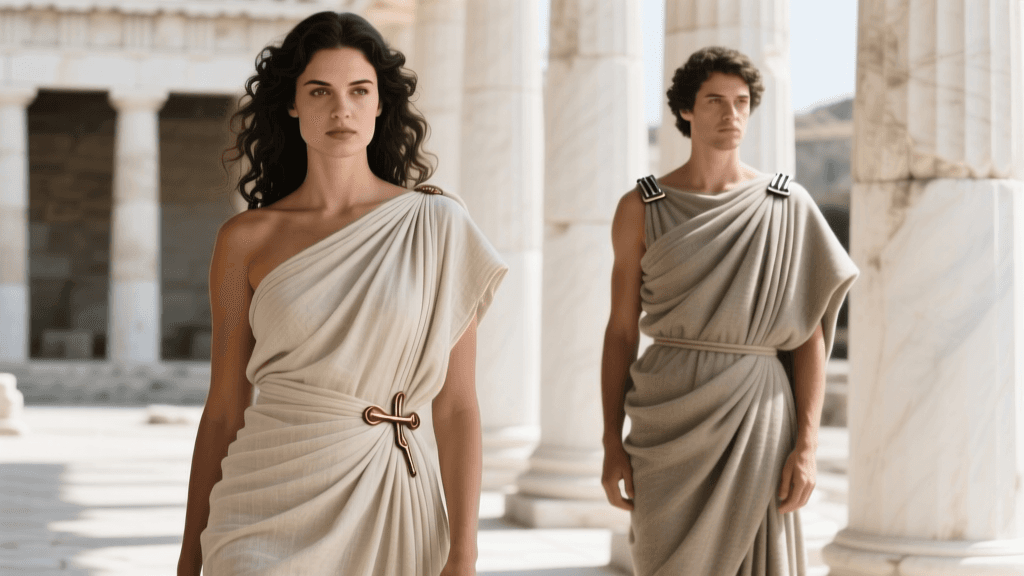
Unlike the heavy, structured peplos, the Ionic chiton is characterized by its light, airy fabric and the illusion of sleeves created through multiple shoulder fastenings. This garment requires significantly more fabric and a delicate touch to drape correctly.
Measurements: The width of the linen rectangle should be at least twice your arm span. This excess width is what creates the voluminous sleeves and deep vertical folds. The height is simply the distance from your shoulder to the floor, plus 4 inches for a hem allowance and blousing.
The Draping Process:
- Lay the lightweight linen flat. Unlike the peplos, there is no structural overfold at the top.
- Wrap the fabric around your body, overlapping the edges at the side or back.
- Starting at the front left shoulder, pinch a small amount of fabric and pin it to the corresponding back fabric using a small, decorative fibula or a simple rosette pin.
- Move two to three inches down your arm toward the elbow, and pin the front and back layers together again. Repeat this process 3 to 5 times along the arm. This creates the iconic 'sleeve' of the Ionic chiton, which is actually just the top edge of the rectangle pinned at intervals.
- Repeat the pinning sequence on the right arm. Ensure the pins are evenly spaced on both sides for symmetry.
- Secure the garment with a thin, braided linen cord or a delicate chain belt at the high waist. The Ionic chiton is traditionally bloused heavily over the belt, sometimes even double-belted at the waist and the hips for a more complex, layered silhouette.
Accessorizing: Fibulae and the Zoni
No classical garment is complete without its hardware. In 2026, museum-quality replica fibulae are widely available from specialized historical artisans. For the Doric peplos, you need large, sturdy bow fibulae or heavy penannular brooches capable of supporting the weight of thick wool without tearing the fibers. Always reinforce the pinning points on your wool garment with a small, hidden square of leather or densely woven linen on the inside to prevent the metal pin from ripping through the weave over time.
The zoni (belt) is equally important. While modern belts use buckles, ancient belts were typically long, woven bands or leather straps that were wrapped tightly around the waist and tied in a simple knot or bow at the front or side. The tension of the zoni is what gives the chiton its shape, pulling the loose rectangles into a fitted bodice and allowing the skirt to flare naturally from the hips.
Care and Maintenance of Heritage Textiles
Proper care of your chiton ensures it will last for many reenactment seasons. Heritage linens and wools require specific handling. Never machine wash your hand-woven wool peplos; instead, air it out in the shade and spot clean with a mild, lanolin-rich soap. For linen Ionic chitons, hand washing in cool water and line-drying in the sun will naturally bleach and soften the fibers, enhancing the drape. Store your garments rolled rather than folded to prevent permanent crease lines that disrupt the natural flow of the classical folds.
By mastering these ancient techniques, you not only preserve a vital piece of European folk and historical dress but also embrace a sustainable, zero-waste approach to fashion that remains profoundly relevant in 2026. The chiton is more than a costume; it is a living, breathing textile tradition that transforms the wearer into a part of classical history.