Guide to Ainu Attush and Ryukyuan Ryusou Garments
Introduction to Japan's Indigenous and Minority Dress
While the Yamato Japanese kimono is globally recognized, Japan's indigenous Ainu people of Hokkaido and the Ryukyuan people of Okinawa possess equally rich, yet distinct, sartorial heritages. For collectors, cultural enthusiasts, and respectful practitioners, understanding these minority dress traditions requires moving beyond mainstream fashion and engaging directly with indigenous craftsmanship. The garments of these cultures are not merely clothing; they are deeply spiritual artifacts that reflect the unique climates, cosmologies, and histories of their respective regions. This comprehensive guide provides actionable advice on sourcing, measuring, and respectfully wearing traditional Ainu and Ryukyuan garments, ensuring your engagement with these cultures is both authentic and supportive of local artisans.
The Ainu Attush: Elm Bark Craftsmanship and Sourcing
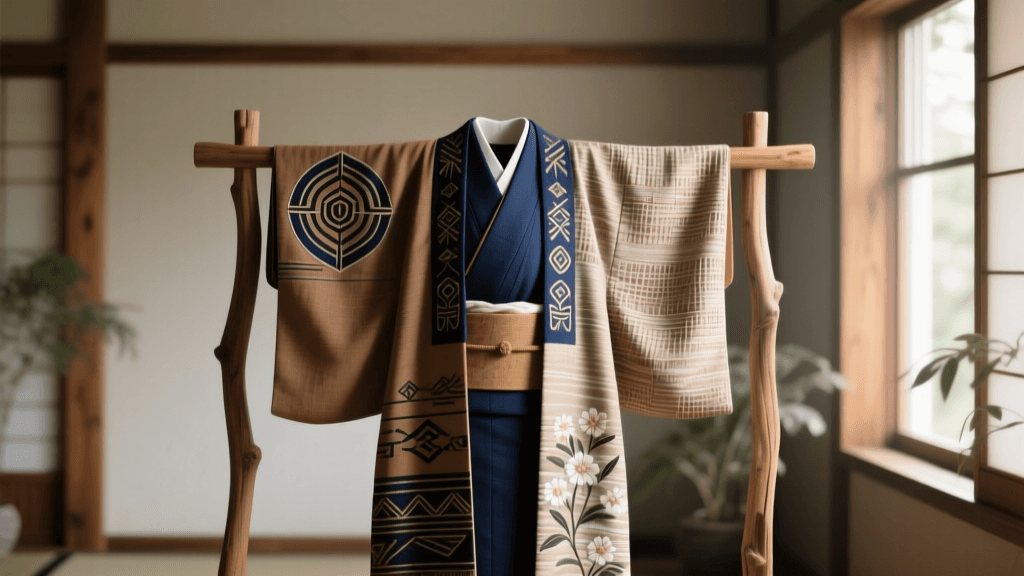
The traditional clothing of the Ainu people, indigenous to Hokkaido, Sakhalin, and the Kuril Islands, is defined by its profound connection to the natural world. The most iconic Ainu textile is attush, a durable, breathable cloth woven from the inner bark of the elm tree. The creation of attush is a labor-intensive process that begins with harvesting the bark, soaking it in rivers, and painstakingly splitting it into fine, even threads before weaving it on a traditional backstrap loom. According to the Upopoy National Ainu Museum and Park, this textile was historically prized for its water-resistant qualities and durability in the harsh northern winters.
Understanding Morew and Appliqué Techniques
While attush forms the base of many traditional garments, the Ainu are equally renowned for morew and kaparamip—cotton garments featuring intricate appliqué and embroidery. The swirling, thorn-like patterns known as morew are not merely decorative; they are spiritual talismans placed at the openings of the garment (neck, cuffs, and hem) to prevent evil spirits from entering the wearer's body. When sourcing authentic Ainu clothing, it is crucial to distinguish between everyday cotton adaptations and the highly ceremonial elm-bark attush robes.
Actionable Advice: Sourcing and Costs
To acquire authentic Ainu garments, buyers should look directly to artisan cooperatives in Nibutani, Hokkaido, the recognized heartland of Ainu craftsmanship. The Association for the Promotion of Traditional Craft Industries officially designates Nibutani-attush as a protected traditional craft, ensuring quality and authenticity.
- Small Accessories: Authentic attush woven pouches, coasters, or small table runners typically range from ¥5,000 to ¥15,000. These are excellent entry points for collectors.
- Modern Adaptations: Cotton jackets featuring traditional morew appliqué patterns usually cost between ¥30,000 and ¥60,000.
- Full Ceremonial Robes: A fully hand-woven, traditional attush robe with intricate elm-bark embroidery is a museum-grade investment. Expect to pay between ¥150,000 and ¥300,000+, with a lead time of 6 to 12 months if commissioned directly from a master weaver.
Care Instructions: Attush garments should never be machine washed. They must be spot-cleaned with a damp cloth and air-dried in the shade to prevent the natural fibers from becoming brittle.
The Ryukyuan Ryusou and Bingata Textiles
Traveling south to the subtropical islands of Okinawa, we encounter the ryusou, the traditional dress of the Ryukyu Kingdom. Unlike the heavily layered and restrictive Yamato kimono, the ryusou is designed for a hot, humid climate. It is characterized by its loose, flowing silhouette, wide sleeves, and lightweight fabrics—traditionally woven from hemp, banana fiber (bashofu), or cotton. The garment is typically worn with a cross-collar jacket (dujin) and a wrap skirt or wide trousers, secured with a long, woven sash called an ushimaki.
The Vibrant World of Bingata
The most famous textile associated with Ryukyuan dress is bingata, a stunning stencil-resist dyeing technique. Historically reserved for royalty and the aristocracy, bingata features bold, vibrant motifs inspired by the subtropical environment, including hibiscus flowers, palm trees, and ocean waves. As detailed by Kogei Japan, the process involves carving intricate designs into mulberry paper stencils, applying a rice-paste resist, and hand-painting the fabric with natural pigments like gamboge, indigo, and cochineal before steaming to set the colors.
Actionable Advice: Commissioning a Bingata Garment
Commissioning a custom bingata ryusou or kimono is a significant undertaking that requires patience and a substantial budget. Most authentic workshops are located in Naha and the surrounding Okinawan prefecture.
- Timing: A fully custom, hand-painted bingata garment requires a lead time of 8 to 14 months. The humid Okinawan summer is often avoided for the dyeing process, as excess moisture can cause the rice paste resist to bleed.
- Costs: A standard cotton bingata yukata-style garment starts around ¥100,000 to ¥150,000. For a formal silk bingata kimono with a matching hand-woven obi sash, costs easily exceed ¥500,000, with master-crafted pieces reaching over ¥1,000,000.
- Product Names to Request: When speaking with Okinawan tailors, ask for a Bingata Kata-ginu (a traditional sleeveless summer vest) for a more affordable and highly wearable piece, typically costing ¥40,000 to ¥70,000.
Comparative Guide: Ainu vs. Ryukyuan Textiles
Understanding the distinct material and structural differences between these two traditions is vital for collectors and wearers. The following table outlines the primary characteristics of Ainu and Ryukyuan garments.
| Feature | Ainu Attush / Morew | Ryukyuan Ryusou / Bingata |
|---|---|---|
| Primary Material | Elm tree inner bark, cotton, nettle | Bashofu (banana fiber), hemp, silk, cotton |
| Dyeing / Decoration | Appliqué, embroidery, natural indigo | Stencil-resist dyeing, hand-painting, weaving |
| Motif Inspiration | Thorns, animal eyes, geometric wards | Flora, fauna, ocean waves, Chinese cloud motifs |
| Climate Adaptation | Insulating, water-resistant, layered | Breathable, loose-fitting, moisture-wicking |
| Average Custom Cost | ¥150,000 - ¥300,000 (Full Robe) | ¥150,000 - ¥500,000+ (Silk Bingata) |
| Standard Lead Time | 6 - 12 Months | 8 - 14 Months |
Practical Guide: Measurements and Fitting
Whether you are purchasing a vintage piece or commissioning a new garment, understanding traditional Japanese and minority measurement systems is essential for a proper fit. Unlike Western tailoring, which measures the body, traditional Eastern tailoring measures the fabric and the garment's drape.
Key Measurements for Commissioning
- Yuki (Sleeve Length): Measured from the center back of the neck, across the shoulder, and down to the wrist bone. For a standard woman's ryusou or kimono, this is typically 64cm to 68cm. For men, it ranges from 75cm to 82cm.
- Mitake (Back Length): Measured from the nape of the neck down to the desired hemline. For a full-length ryusou skirt or kimono, this is usually the wearer's height minus 30cm (e.g., a 160cm tall person would have a mitake of roughly 130cm, allowing for the ohashori fold at the waist).
- Katahaba (Shoulder Width): Measured from the outer edge of one shoulder to the other. Ainu attush robes tend to have a wider, more dropped shoulder seam compared to the structured Yamato kimono, often measuring 65cm to 75cm across the back to allow for heavy layering in winter.
When ordering from an Okinawan artisan, specify if you want a traditional ushimaki (sash) included. A standard ushimaki is 3 meters long and 15cm wide, allowing for a secure, multi-wrapped tie that holds the loose ryusou jacket firmly in place without the need for rigid internal padding.
Cultural Etiquette and Respectful Wearing
Engaging with the traditional dress of ethnic minorities requires a high degree of cultural sensitivity. Both the Ainu and Ryukyuan peoples have faced centuries of assimilation policies and marginalization by the central Japanese government. Therefore, wearing their traditional garments is not merely a fashion statement; it is an act of cultural preservation and political visibility.
First, always prioritize purchasing directly from indigenous-owned cooperatives or certified master artisans. Avoid mass-produced, synthetic 'festival wear' sold in tourist traps, as these items often appropriate sacred motifs without benefiting the source communities. For example, the sacred morew patterns of the Ainu should never be printed on cheap polyester; doing so strips the motif of its spiritual protective purpose.
Second, understand the context of the garment. While a cotton bingata yukata is perfectly appropriate for summer festivals and casual wear, a full ceremonial Ainu attush robe adorned with bear motifs is highly sacred and generally reserved for elders and specific spiritual rituals. If you are invited to participate in a cultural exchange or ceremony, always ask your hosts for guidance on appropriate attire, layering, and sash-tying methods. By approaching these magnificent textile traditions with respect, research, and a commitment to supporting living artisans, you help ensure that the sartorial heritage of Japan's indigenous and minority cultures continues to thrive for generations to come.