Ahimsa Peace Silk vs Mulberry Silk for Cheongsam Tailoring 2026
The Evolution of Ethical Textiles in East Asian Fashion
The cheongsam, also known as the qipao, remains one of the most iconic and structurally complex garments in East Asian sartorial history. As we navigate the fashion landscape of 2026, a significant shift has occurred among bespoke tailors and independent designers: the demand for ethically sourced, sustainable textiles has moved from a niche preference to an industry standard. When constructing a modern or traditional cheongsam, the choice of fabric dictates not only the aesthetic drape but also the structural integrity of the garment's signature elements, such as the Mandarin collar and the intricate side slits. Two of the most debated textiles in contemporary ateliers are traditional Mulberry silk and Ahimsa (Peace) silk. Understanding the physical and ethical differences between these two fibers is essential for any tailor, designer, or enthusiast looking to commission or create a cheongsam in 2026.
Understanding the Fibers: Sericulture and Ethics
To make an informed textile choice, one must first understand how these silks are produced. Traditional Mulberry silk is the gold standard of the silk industry, accounting for the vast majority of global silk production. It is produced by the Bombyx mori silkworm, which feeds exclusively on mulberry leaves. In conventional sericulture, the cocoons are boiled with the pupae still inside to prevent the moth from emerging and breaking the continuous silk filament. This process yields a remarkably long, unbroken thread that can be woven into exceptionally smooth, lustrous fabrics like charmeuse and crepe de chine. For a deeper historical and scientific understanding of this process, the Encyclopedia Britannica's comprehensive guide on silk outlines the centuries-old sericulture methods that still dominate the market today.
Ahimsa silk, often referred to as 'Peace Silk,' offers a cruelty-free alternative. The term 'Ahimsa' stems from the Sanskrit principle of non-violence. In this method, the silkworm is allowed to complete its life cycle, metamorphose into a moth, and naturally pierce the cocoon to escape. Because the moth breaks the continuous filament upon exiting, the resulting silk must be spun rather than reeled, much like cotton or wool. This creates a yarn that is slightly textured, matte, and possesses a softer, more organic hand-feel. While Ahimsa silk can be produced from various wild silkworms (such as Tussar or Eri), Peace Mulberry silk is also available, offering a middle ground between the ethical benefits of Ahimsa and the refined diet of the Bombyx mori worm. The Food and Agriculture Organization (FAO) provides extensive resources on how sustainable sericulture practices, including non-violent silk rearing, are impacting global agricultural economics and rural livelihoods in 2026.
Drape, Structure, and Tailoring Considerations
The cheongsam is renowned for its figure-hugging silhouette, achieved through precise darting and strategic seam placement. The behavior of the fabric during the tailoring process is paramount.
Mulberry Silk: The Liquid Drape
When woven into charmeuse or heavy crepe de chine (typically 19 to 30 momme for structured garments), Mulberry silk offers a liquid, reflective drape that clings elegantly to the body. However, its slippery nature makes it notoriously difficult to cut and sew. The fabric shifts easily on the cutting table, requiring extensive pinning or the use of pattern weights and tissue paper stabilization. For the cheongsam's signature high Mandarin collar, Mulberry silk lacks inherent body and requires a robust interfacing—often a combination of silk organza and a lightweight fusible tricot—to maintain its stiff, upright posture without collapsing.
Ahimsa Silk: The Organic Structure
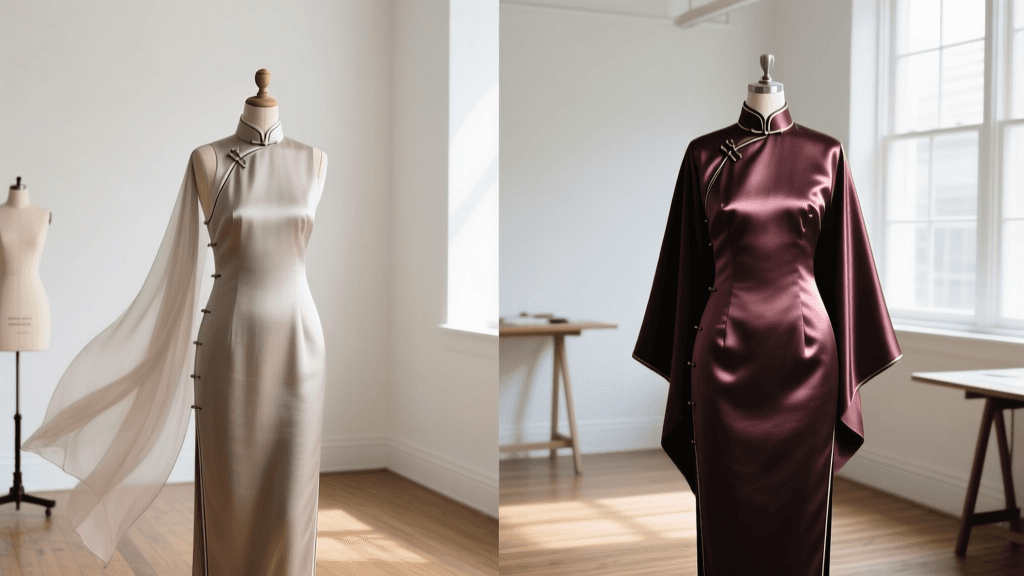
Because Ahimsa silk is spun from broken filaments, it possesses a slight 'tooth' or texture, reminiscent of a fine linen or raw silk. This texture gives the fabric more natural body and structural integrity than its Mulberry counterpart. When tailoring a cheongsam from Ahimsa silk, tailors often find it easier to manipulate, as the fabric grips itself slightly, reducing slippage during sewing. The matte finish of Ahimsa silk absorbs light rather than reflecting it, giving the finished cheongsam a sophisticated, understated elegance that is highly sought after in 2026's minimalist fashion circles. However, because it lacks the fluid drape of Mulberry charmeuse, Ahimsa silk is better suited for A-line or slightly relaxed cheongsam silhouettes rather than ultra-tight, heavily darted designs.
The Art of Piping (Xiangbian) and Frog Buttons (Pankou)
No cheongsam is complete without its decorative piping and knotted frog buttons. This is where the physical differences between the two silks truly manifest.
- Bias Binding and Piping: Creating the ultra-thin, crisp piping lines along the collar and slits requires fabric cut on the true bias. Mulberry silk stretches beautifully on the bias, allowing it to curve smoothly around the tight radius of the Mandarin collar. Ahimsa silk, being spun, has less bias stretch and can sometimes pucker if not eased carefully. Tailors often cut Ahimsa piping slightly wider to compensate for its lack of elasticity.
- Frog Buttons (Pankou):strong> Traditional knotted buttons require fabric strips to be tightly rolled and sometimes filled with cotton yarn. The natural grip and friction of Ahimsa silk make it superior for knotting; the knots hold their shape tightly and are less prone to slipping undone. Mulberry silk's extreme smoothness means frog buttons must be secured with hidden hand-stitches to prevent them from unraveling over time.
2026 Market Pricing and Sourcing Dynamics
The global textile market in 2026 reflects a premium on certified ethical and sustainable materials. Sourcing high-quality silk requires navigating new transparency standards and shifting supply chains.
Traditional Mulberry silk remains widely available, with major hubs in Jiangsu and Zhejiang provinces in China continuing to produce high-grade textiles. A premium 19-momme Mulberry silk charmeuse typically retails between $35 and $45 per yard in 2026. However, the rising demand for traceable, ethical supply chains has pushed the price of certified Ahimsa silk higher. Sourced primarily from specialized cooperatives in Assam, India, and select ethical farms in Southeast Asia, genuine Ahimsa silk commands between $55 and $85 per yard. Buyers must be wary of 'greenwashed' textiles; true Ahimsa silk should come with certifications from recognized ethical textile boards verifying the non-violent harvesting process.
Comparison Chart: Ahimsa vs. Mulberry Silk for Cheongsam
| Feature | Mulberry Silk (Charmeuse/Crepe) | Ahimsa (Peace) Silk |
|---|---|---|
| Filament Type | Continuous, unbroken filament | Spun, broken filament |
| Surface Texture | Ultra-smooth, high luster | Slightly nubby, matte finish |
| Drape | Fluid, liquid, heavy | Structured, organic, moderate |
| Tailoring Difficulty | High (slippery, shifts easily) | Moderate (grips well, easier to handle) |
| Piping & Knotting | Excellent bias stretch, slippery knots | Less bias stretch, secure knots |
| 2026 Avg. Price (per yard) | $35 - $45 USD | $55 - $85 USD |
| Best Cheongsam Style | Form-fitting, evening wear, high-glamour | Relaxed fit, daywear, contemporary minimalist |
Essential Sewing Specifications for 2026
Whether you are a home sewist or a professional tailor, working with these luxurious fibers requires specific notions and machine settings to ensure a flawless finish.
Needles and Thread
For both Mulberry and Ahimsa silks, abandon universal needles. Use a Schmetz Microtex (Sharp) needle, size 70/10. The exceptionally sharp point pierces the tight weave of silk without snagging or causing pulls. For thread, 100% silk thread is traditional and ideal for basting and hand-finished details, but for structural seams, a high-quality, fine polyester thread like Gutermann Mara 100 is recommended in 2026 for its superior tensile strength and slight stretch, which prevents popped seams when the wearer sits or moves.
Seam Finishes
Silk frays notoriously. Raw edges inside an unlined cheongsam are unacceptable in bespoke tailoring. French seams are the gold standard for the side seams and shoulder seams, encasing the raw edges entirely within a clean, narrow finish. For the curved armholes, a narrow silk bias binding (Hong Kong finish) provides a clean, durable edge that lies flat against the skin.
Pressing and Ironing
Silk is highly sensitive to heat and water spots. Always use a dedicated silk setting on your iron. When pressing Mulberry charmeuse, use a dry iron and a Teflon pressing cloth to prevent shine marks. Ahimsa silk can handle a very light mist of water, but it is always safer to use a steam generator iron held slightly above the fabric, allowing the steam to penetrate the fibers without the weight of the iron crushing the spun texture.
Care, Maintenance, and Longevity
A well-constructed cheongsam is an investment piece meant to last generations. The care requirements for Mulberry and Ahimsa silks differ slightly due to their structural differences.
Mulberry Silk: Due to its delicate, continuous filaments and high luster, dry cleaning is generally recommended for fully lined, structured Mulberry cheongsams to preserve the interfacing and prevent water spotting. If hand-washing is attempted, use a pH-neutral silk detergent in cold water, and never wring the fabric; instead, roll it in a clean towel to absorb excess moisture before laying it flat to dry.
Ahimsa Silk: The spun nature of Ahimsa silk makes it surprisingly resilient. It can often be gently hand-washed with mild detergent. Interestingly, washing Ahimsa silk can enhance its soft, lived-in texture. However, the garment must be reshaped while damp and dried away from direct sunlight, which can degrade the protein structure of the silk fibers over time.
Final Thoughts for the Modern Tailor
Choosing between Ahimsa peace silk and traditional Mulberry silk for a cheongsam in 2026 is not merely a question of ethics; it is a fundamental design decision that affects the garment's drape, construction methods, and final aesthetic. Mulberry silk remains unrivaled for glamorous, form-fitting evening wear that demands a liquid sheen. Conversely, Ahimsa silk offers a sustainable, structurally forgiving, and beautifully matte alternative that perfectly aligns with the modern, minimalist interpretation of East Asian traditional dress. By understanding the unique properties of both textiles, tailors and designers can honor the rich heritage of the cheongsam while thoughtfully embracing the sustainable innovations of the present day.