Ahimsa Peace Silk vs Mulberry Silk for Banarasi Saris in 2026
The 2026 Landscape of South Asian Bridal and Festive Textiles
As we navigate the 2026 South Asian bridal and festive season, the conversation surrounding traditional garments has shifted profoundly toward conscious consumerism and textile sustainability. For decades, the Banarasi sari has stood as the undisputed pinnacle of Indian bridal wear, renowned for its opulent brocades and intricate zari (metallic thread) work. However, modern buyers and bespoke designers are increasingly scrutinizing the raw materials that form the canvas of these heirloom garments. The most prominent debate in the 2026 handloom market centers on the choice between traditional Mulberry silk and the rapidly rising Ahimsa (Peace) silk. Understanding the structural, aesthetic, and ethical differences between these two protein fibers is essential for anyone commissioning, collecting, or designing traditional South Asian garments today.
Understanding Traditional Mulberry Silk in Banarasi Weaving
Traditional Banarasi saris have historically been woven using Mulberry silk, derived from the Bombyx mori silkworm. This variety of silk is prized for its continuous filament structure, which yields a thread that is exceptionally smooth, uniform, and possesses a high tensile strength. In the context of the Varanasi handloom clusters, Mulberry silk provides a flawless, high-sheen canvas that is critical for the intricate jala (brocade) patterns and heavy metallic weaving that define the Banarasi aesthetic.
The degumming process used in 2026 for premium Mulberry silk ensures that the natural sericin is removed evenly, allowing the fiber to absorb both natural and azo-free synthetic dyes with brilliant, uniform color fastness. Because the filament is continuous, weavers can pull the warp threads under high tension on traditional pit looms without fear of frequent snapping. This structural integrity is what allows master weavers to execute complex Kadwa weaving techniques—where each motif is woven independently with separate weft threads—resulting in a robust, reversible, and heavily textured fabric that drapes with a distinct, regal weight.
The Rise of Ahimsa (Peace) Silk for Ethical Heirlooms
Conversely, Ahimsa silk, often referred to as Peace silk, represents a paradigm shift in ethical sericulture. Pioneered in the early 2000s and widely adopted by luxury handloom cooperatives by 2026, Ahimsa silk is harvested only after the silkworm has naturally metamorphosed into a moth and vacated the cocoon. This non-violent approach aligns with the strict principles of ahimsa (non-harm), making it highly sought after by eco-conscious brides, vegan-adjacent consumers (though it remains an animal protein), and sustainable fashion advocates. For a deeper historical and technical understanding of this ethical fiber, the foundational principles of Ahimsa silk outline the meticulous patience required in its production.
Because the moth chews its way out of the cocoon, the continuous silk filament is broken into shorter staple fibers. These fibers must then be spun together, much like cotton or wool, rather than reeled. This spinning process gives Ahimsa silk a distinct visual and tactile signature: a slightly slubby, linen-like texture with a muted, organic sheen. While it lacks the mirror-like reflectivity of Mulberry silk, Ahimsa offers a breathable, lightweight, and deeply textured alternative that appeals to contemporary minimalist styling.
Fabric Comparison: Ahimsa vs. Mulberry Silk
When commissioning a bespoke Banarasi sari or lehenga in 2026, buyers must weigh the physical properties of both textiles. The following table outlines the core differences that impact the final garment.
| Feature | Traditional Mulberry Silk | Ahimsa (Peace) Silk |
|---|---|---|
| Surface Texture | Smooth, uniform, high-gloss sheen | Slubby, matte to semi-matte, organic texture |
| Tensile Strength | Extremely high; supports heavy warp tension | Moderate; requires careful loom tensioning |
| Drape and Weight | Heavy, structured, holds stiff pleats well | Lighter, fluid, softer drape with less body |
| Zari Compatibility | Excellent for heavy Kadwa and dense brocades | Best for lighter Jala work and surface embroidery |
| 2026 Market Cost | ₹35,000 – ₹85,000 ($420 – $1,020 USD) | ₹45,000 – ₹1,10,000 ($540 – $1,320 USD) |
Zari Work and Embroidery Compatibility in 2026
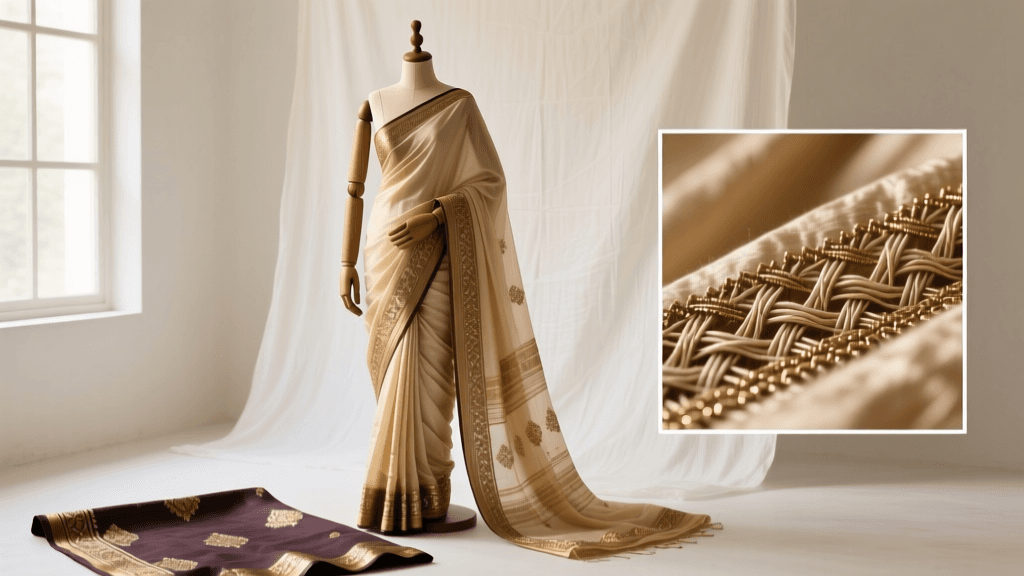
The interaction between the base silk and the metallic zari is where the choice of fabric truly dictates the design. According to the historical weaving traditions of Banarasi saris, the fabric must support the abrasion of metallic threads passing through the warp thousands of times. In 2026, pure silver and gold zari is exceptionally rare and heavily regulated; the market standard is high-grade copper-based zari with silver and gold electroplating, often coated with protective polymers to prevent tarnishing.
Mulberry silk's smooth surface allows the metallic threads to glide through the weave without catching, making it the mandatory choice for dense, full-body brocades (jaal) and heavy Kadwa motifs. The high tensile strength of the continuous filament prevents the fabric from puckering under the weight of the metal. Ahimsa silk, with its shorter staple fibers and uneven surface, presents a challenge for dense metallic weaving. The friction can cause the spun silk fibers to pill or weaken. Therefore, in 2026, master weavers reserve Ahimsa silk for borders (anchal) with intricate zari work, while keeping the main body of the sari relatively plain or adorned with subtle, self-patterned butis (small motifs). For surface embellishments like zardozi or ari embroidery, Ahimsa silk provides a beautiful, rustic canvas that grips the embroidery thread securely.
Dyeing and Color Fastness
The 2026 push for eco-friendly textiles has seen a resurgence in natural dyeing techniques using indigo, madder root, and pomegranate rinds. Mulberry silk takes natural dyes brilliantly, resulting in deep, saturated jewel tones that are a staple of South Asian bridal wear. Ahimsa silk, due to its spun nature and slight residual sericin (which is often left partially intact to maintain the fiber's strength), absorbs natural dyes with a more variegated, heathered effect. This creates a beautiful, antique patina that is highly prized in contemporary boutique designs, though it makes achieving perfectly uniform, solid neon or pastel shades—often requested for daytime receptions—much more difficult.
2026 Sourcing and Pricing Guide
Sourcing authentic Banarasi textiles requires vigilance, as power-loom replicas continue to flood the market. The Ministry of Textiles, Government of India has heavily enforced the Geographical Indication (GI) tag for Banarasi brocades, and as of 2026, most reputable cooperatives and boutique weavers embed scannable QR codes directly into the sari's fall or label, verifying the loom origin, weaver name, and fiber composition.
When sourcing Mulberry silk Banarasi saris, buyers should look for the Silk Mark certification alongside the GI tag. Authentic handloom Mulberry pieces start around ₹35,000 for simpler designs and can exceed ₹1,50,000 for antique-style Shikargah (hunting scene) motifs woven with tested zari. Ahimsa silk Banarasi saris are inherently more expensive despite the ethical premise. The labor-intensive process of hand-spinning the broken filaments, combined with the slower weaving speed required to prevent thread breakage on the pit loom, drives the base price up. Expect to pay a 20% to 30% premium for a certified Ahimsa Banarasi sari compared to a standard Mulberry equivalent. Direct-to-weaver platforms and established ethical fashion houses in Varanasi and Kolkata are the most reliable avenues for procurement in 2026.
Care, Maintenance, and Longevity
The longevity of these heirloom garments depends heavily on post-purchase care. Mulberry silk Banarasi saris should be dry-cleaned for the first two washes to set the zari and dyes. Subsequent maintenance in 2026 often involves specialized eco-friendly wet cleaning by heritage textile conservators. Ahimsa silk is slightly more forgiving and can be hand-washed in cold water using reetha (soapnut) or pH-neutral silk shampoos, though the metallic zari components still require professional handling.
Storage practices have also evolved. The traditional use of naphthalene balls is now strongly discouraged by textile conservators due to the chemical degradation they cause to both the silk proteins and the electroplated zari. In 2026, the standard for preserving both Mulberry and Ahimsa silk involves wrapping the garments in unbleached, acid-free muslin cloth, storing them in cedarwood chests, and using dried neem leaves to naturally repel insects. Refolding the sari every three months is mandatory to prevent permanent crease lines and fiber tearing along the folds.
Conclusion
Choosing between Ahimsa peace silk and traditional Mulberry silk for a Banarasi sari in 2026 is not merely a matter of ethics versus tradition; it is a nuanced decision regarding drape, design complexity, and aesthetic preference. Mulberry silk remains the undisputed champion for heavy, opulent bridal brocades that demand structural integrity and brilliant sheen. Meanwhile, Ahimsa silk offers a profoundly ethical, lightweight, and texturally rich alternative for the modern connoisseur who values organic beauty and sustainable craftsmanship. By understanding the unique properties of both fibers, buyers can make informed decisions that honor the ancient weaving traditions of Varanasi while supporting the sustainable textile innovations of the future.