Miao Provincial Dress: Guizhou Silverwork & Embroidery Guide
The Living Textile Museum: Miao Dress in Guizhou
In the mountainous terrain of southwestern China, Guizhou Province serves as a living textile museum. Here, the Miao (Hmong) people have cultivated one of the most intricate and visually stunning provincial dress traditions in Asia. Historically lacking a widely used written script, the Miao encoded their mythology, migration history, and clan identities into their garments. To wear a traditional Miao outfit is to wear a wearable history book, where every embroidered motif and forged silver ornament tells a story of ancestral resilience and spiritual belief.
Today, Miao provincial dress is not merely a relic of the past; it is a vibrant, evolving craft. From the bustling markets of Kaili to the remote terraced villages of Xijiang, artisans continue to spin, weave, dye, and embroider using techniques passed down through generations. For textile collectors, cultural historians, and fashion enthusiasts, understanding the nuances of Miao dress offers a profound glimpse into China's rich ethnic tapestry.
The Anatomy of a Miao Festival Outfit
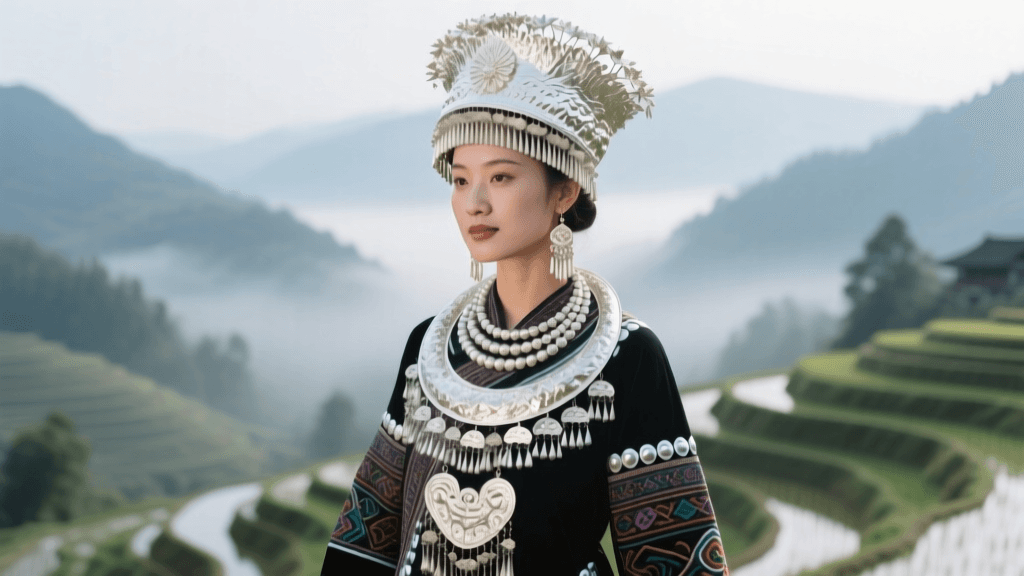
A full Miao festival outfit is a masterclass in layered craftsmanship, combining heavy metallurgy with delicate needlework. The ensemble is typically divided into three primary components: the silver ornaments, the indigo pleated skirt, and the embroidered jacket.
The Silver Headdress and Ornaments
Silver is considered a sacred metal in Miao culture, believed to ward off evil spirits and bring light to the wearer. During major festivals like the Lusheng Festival or the Sisters' Meal Festival, women adorn themselves with elaborate silver crowns, hairpins, neck rings, and chest plates. A full festival silver set can weigh between 5 to 10 kilograms. The crowns often feature motifs of water buffalo horns—symbolizing agricultural wealth—and intricate butterflies. The rhythmic clinking of the silver pendants as the wearer dances is an essential auditory component of Miao celebrations.
The Indigo Pleated Skirt (Baiqun)
The baiqun, or pleated skirt, is a marvel of structural textile engineering. Creating a single skirt requires up to 15 to 20 meters of hand-woven cotton or hemp. The fabric is meticulously folded into 300 to 500 micro-pleats. To ensure the pleats hold their shape permanently, artisans use a traditional stiffening mixture made from ox blood, egg whites, and fermented indigo dye. The skirt is then bound tightly and steamed, resulting in a stiff, accordion-like garment that flares beautifully during traditional circle dances.
Embroidery, Batik, and Symbolism
Miao embroidery is renowned for its complexity. Artisans employ over a dozen distinct stitching techniques, including the double-needle lock stitch, couching, and three-dimensional padded embroidery. According to cultural reports from Sixth Tone, the revival of these embroidery techniques has become a vital economic driver for rural women in Guizhou. Motifs are deeply symbolic: the "Butterfly Mother" (Mais Bangx Mais Lief) represents the mythical ancestor of all living things, while the Ji Yu bird and the dragon signify protection and rain.
Regional Variations Across Guizhou
Guizhou's rugged topography has led to distinct regional variations in Miao dress. The isolation of mountain valleys allowed different sub-groups to develop unique silhouettes, color palettes, and silver styles. Below is a comparison of the primary regional styles.
| Region / Sub-group | Skirt Style & Length | Dominant Motifs & Colors | Silver Characteristics | Best Time to Visit |
|---|---|---|---|---|
| Xijiang (Long Skirt Miao) | Maxi-length, deep indigo, 500+ pleats | Dragons, birds; dark indigo base with vibrant silk | Massive horned crowns, heavy chest plates | October (Miao New Year) |
| Danzhai (Short Skirt Miao) | Mini-length (15-20cm), worn over trousers | Geometric batik (Lajin), white and indigo | Smaller floral hairpins, layered neck rings | Spring (Azalea Festival) |
| Huangping (Gelo Miao) | Midi-length, heavily embroidered pleats | Bright reds, pinks, and yellows; floral motifs | Elaborate silver combs and horned tiaras | Lunar September (Harvest) |
| Rongjiang (River Miao) | Wrap-around aprons over wide-leg trousers | Water motifs, fish, and river flora | Minimalist silver bangles and small earrings | Summer (Dragon Boat Festival) |
Practical Guide: Sourcing, Commissioning, and Costs
For collectors and enthusiasts looking to acquire authentic Miao provincial garments, navigating the markets of Guizhou requires specific knowledge. Mass-produced, machine-embroidered replicas flood the tourist markets in Kaili and Xijiang. To acquire genuine, handcrafted pieces, you must engage directly with village cooperatives or specialized textile dealers.
Measurements and Commissioning
If you are commissioning a bespoke baiqun (pleated skirt) or an embroidered jacket, precise measurements are crucial. Unlike Western tailoring, Miao garments are often constructed from flat, rectangular pieces of fabric that wrap and tie.
- Skirt Commissioning: You will need to provide your waist circumference and desired drop length. Traditional skirts range from 15cm (Danzhai style) to 80cm (Xijiang style). Specify the number of pleats; a high-quality skirt will have at least 400 micro-pleats.
- Jacket Commissioning: Miao jackets are typically drop-shoulder and boxy. Provide your shoulder span, sleeve length (usually measured from the center back neck to the wrist), and bust measurement. Allow extra ease (5-8cm) as traditional garments are meant to be worn in layers.
- Timing: Genuine hand-embroidered jackets take between 6 to 12 months to complete. Indigo dyeing is highly seasonal; the fermentation vats require warm, humid weather, meaning the best dyeing occurs between May and September.
Cost Breakdown
Authentic Miao textiles are an investment in human labor and heritage. Prices vary wildly based on the age of the textile, the complexity of the stitch, and the purity of the silver.
- Vintage Baby Carrier (Beidai): 1,500 – 4,000 RMB ($210 – $560 USD). Highly collectible, featuring dense, protective embroidery.
- New Hand-Woven Indigo Jacket: 800 – 2,000 RMB ($110 – $280 USD), depending on the inclusion of batik or embroidery.
- Full Festival Silver Set: 30,000 – 80,000+ RMB ($4,200 – $11,200+ USD). Priced by the gram of silver plus the artisan's forging fee. Many locals opt to rent these sets for festivals at a cost of 200 – 500 RMB per day.
Caring for Provincial Textiles and Silver
Preserving Miao garments requires specialized care, particularly due to the organic dyes and stiffening agents used.
"Our history is not written in books; it is stitched into our jackets and forged into our silver. To wash away the indigo is to wash away the memory of the mountain." — Local Artisan Proverb, Guizhou.
Indigo and Batik Care: Never wash authentic indigo-dyed cotton in hot water or use alkaline detergents, as this will strip the natural dye and cause severe bleeding. Hand wash gently in cold water with a pH-neutral soap. Do not wring the fabric; press out excess water and dry flat in the shade. Direct sunlight will oxidize and fade the deep blue hues to a dull gray.
Pleated Skirt Maintenance: The ox-blood and egg-white stiffening agent is water-soluble to some degree. Avoid getting the skirt wet. If the pleats begin to relax, the skirt must be re-bound with cotton thread and steamed by a professional to reset the folds.
Silver Maintenance: Miao silver is often an alloy containing a small amount of copper or brass to increase durability. It will tarnish when exposed to humidity and skin oils. Polish regularly with a soft, untreated microfiber cloth. Avoid commercial silver dips, which can damage the intricate oxidized detailing that artisans intentionally leave in the crevices to highlight the relief patterns.
References and Further Reading
To deepen your understanding of Miao provincial dress and the broader context of Chinese ethnic textiles, consult the following authoritative resources:
- The UNESCO Intangible Cultural Heritage listings for China, which document the safeguarding of minority crafts, including Miao epic songs and traditional textile techniques.
- The Metropolitan Museum of Art's Asian Textile Collection, offering high-resolution archival images and curatorial notes on historical Chinese provincial and minority garments.
- Sixth Tone's extensive socio-cultural reporting on the modern economic and cultural revival of rural embroidery cooperatives in Guizhou Province.