2026 Academic Guide to 3D Drape Analysis in Chinese Fashion History
The Evolution of Chinese Fashion History Education in 2026
The academic study of Chinese fashion history has undergone a radical transformation over the past decade. In 2026, the discipline is no longer confined to dusty archives, fragile textile rubbings, and two-dimensional pattern drafting. Today, leading universities and research institutions have fully integrated digital humanities, computational physics, and virtual prototyping into their curricula. This technological renaissance is fundamentally changing how scholars understand, preserve, and teach the intricate garment structures of ancient China, from the flowing Shenyi (deep robes) of the Han dynasty to the heavily structured court garments of the Qing era.
For modern researchers and students, the ability to accurately simulate historical textiles is paramount. The contemporary Xin Zhongshi (新中式), or New Chinese Style movement, has created an unprecedented demand for historical accuracy in commercial fashion. Consumers and designers in 2026 are no longer satisfied with superficial Orientalist motifs; they demand structural authenticity. Consequently, academic research into ancient weaving techniques, fabric drape physics, and digital archiving has become the vital bridge between museum artifacts and the modern runway.
Core Methodologies in Modern Textile Research
3D Fabric Drape Analysis and Physics Simulation
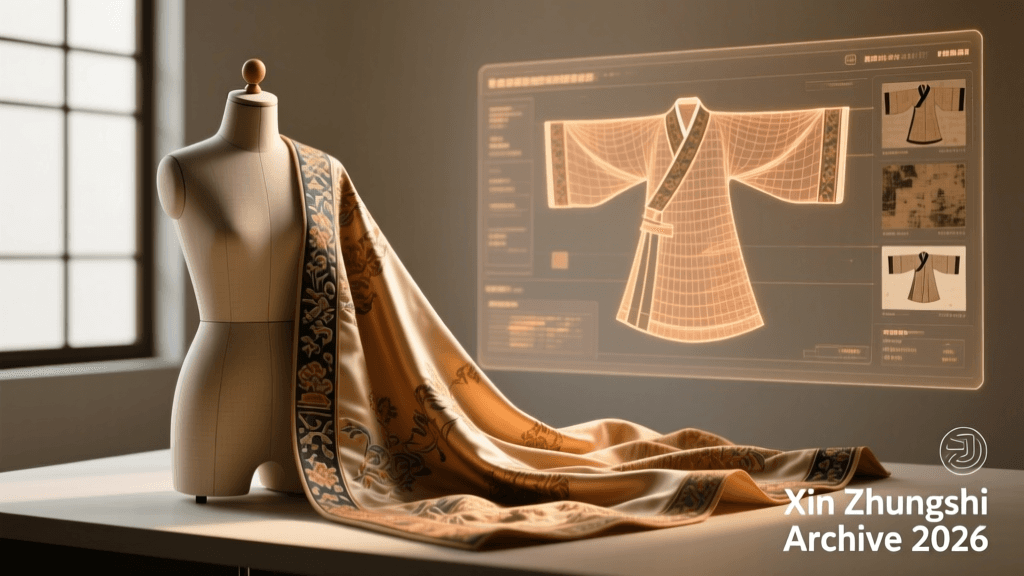
At the heart of 2026's Chinese fashion history research is 3D fabric drape analysis. Understanding how a historical garment moved, folded, and interacted with the human body requires more than just knowing its flat pattern. It requires a deep understanding of textile physics. Academic labs now utilize advanced software ecosystems, such as CLO Virtual Fashion and Browzwear, paired with empirical fabric testing data to simulate ancient materials.
For example, reconstructing a Ming dynasty Mamianqun (horse-face skirt) requires precise manipulation of pleat retention, shear stiffness, and bending length. Researchers use the Kawabata Evaluation System (KES) to measure the physical properties of modern silk equivalents—such as 19-momme silk crepe or heavy silk brocade—and input these exact parameters into 3D simulation engines. This allows scholars to observe how the stiff, flat pleats of the Mamianqun would have flared during a traditional walking gait, providing invaluable insights into historical etiquette and movement constraints.
Digital Archiving and Spectral Imaging
Physical handling of centuries-old garments is strictly limited to prevent degradation. To circumvent this, academic institutions in 2026 rely heavily on non-invasive digital archiving. Multi-spectral imaging and micro-photogrammetry allow researchers to analyze the chemical composition of ancient dyes and the exact warp-and-weft density of fragile textiles without physical contact. Institutions like the China National Silk Museum have pioneered the use of high-resolution 3D scanning to create open-access digital twins of their most prized Silk Road artifacts, enabling global academic collaboration.
Leading Academic Institutions and Programs
The integration of these technologies is spearheaded by several premier institutions in China, each offering specialized master's and doctoral tracks focusing on the intersection of heritage and technology. Below is a comparison of the leading academic programs shaping Chinese fashion history research in 2026.
| Institution | Primary Research Focus | Key Laboratory / Technology | Notable 2026 Curriculum Addition |
|---|---|---|---|
| Donghua University (Shanghai) | Silk Road textiles, Kesi tapestry, ancient weave structures | Digital Textile Heritage Lab (LiDAR & Micro-CT scanning) | Algorithmic Pattern Reconstruction of Tang Dynasty Weaves |
| Beijing Institute of Fashion Technology (BIFT) | Ming/Qing court dress, structural pattern making, 3D drape | Virtual Garment Physics & Ergonomics Center | Kinematic Simulation of Qing Court Ceremonial Robes |
| Tsinghua University (Beijing) | Textile chemistry, ancient dye analysis, sustainable heritage | Advanced Spectrophotometry & Bio-Dye Lab | AI-Assisted Color Matching for Faded Han Dynasty Silks |
Practical Applications: Setting Up a Drape Analysis Lab
For emerging scholars, independent researchers, or university departments looking to establish a digital fashion history lab in 2026, the hardware and software requirements are highly specific. The goal is to capture the physical reality of a textile and translate it into a mathematically accurate virtual environment.
Essential Hardware for 2026
- Portable 3D Scanners: The Artec Leo or similar AI-driven handheld scanners (priced around $32,000 in 2026) are essential for capturing the exact topography and drape of garments on mannequins without the risk of physical stress.
- Spectrophotometers: Devices like the X-Rite Ci7x00 series are required to capture precise color data and metamerism indices of historical dyes, ensuring virtual lighting environments accurately reflect how the garment looked under natural sunlight versus candlelight.
- Fabric Testing Instruments: A digital tensile tester and a drape meter are mandatory to gather the raw physics data (stretch, recovery, bending rigidity) needed for 3D software.
Software and Computational Tools
Beyond standard 3D modeling suites, researchers must master physics-based cloth simulation engines. Academic licenses for enterprise software allow students to run complex particle-based simulations. Furthermore, Python scripting is increasingly taught in 2026 curricula to automate the generation of complex historical weave patterns, such as the intricate cloud-collar motifs found in Yuan and Ming dynasty garments.
'The true value of 3D drape analysis in historical research is not just in creating pretty digital avatars. It is in testing hypotheses. We can virtually dress a historically accurate avatar in a reconstructed Song dynasty Beizi and mathematically prove whether the garment's cut allowed for the specific manual labor tasks described in contemporary agricultural treatises.' — Dr. Lin Wei, Director of Virtual Heritage Studies, 2026.
The Impact on the Xin Zhongshi (New Chinese Style) Movement
The rigorous academic research conducted in these university labs has a direct, lucrative pipeline into the commercial fashion sector. The Xin Zhongshi movement, which blends traditional Chinese sartorial elements with modern, everyday wearability, is projected to dominate the Asian luxury and premium high-street markets throughout 2026. However, the modern consumer is highly educated and quick to critique historical inaccuracies on social media.
Brands are increasingly hiring academic researchers as historical consultants. By utilizing the 3D drape analysis databases compiled by institutions like BIFT and Donghua, commercial designers can adapt historical patterns—such as the bias-cutting techniques of the 1930s Qipao or the structural pleating of the Mamianqun—with absolute precision. This ensures that when a modern garment drrape across the body, it mimics the elegant, fluid silhouettes of antiquity, rather than looking like a stiff, modern costume.
Furthermore, global institutions are taking note. The Victoria and Albert Museum's Asian Collections frequently collaborate with Chinese academic labs to digitally restore and exhibit fragmented textiles, allowing global audiences to experience the dynamic movement of Chinese fashion history through immersive virtual reality exhibits. As we move deeper into 2026, the synergy between academic rigor, digital physics, and cultural pride continues to elevate Chinese fashion history from a niche historical study to a driving force in global sartorial innovation.
Conclusion and Future Outlook
The digitization of Chinese fashion history is an ongoing, dynamic process. As AI-driven predictive modeling improves, 2027 and beyond will likely see algorithms capable of predicting the original drape and color of heavily degraded archaeological textile fragments with near-perfect accuracy. For students and professionals entering the field today, mastering both the historical context of ancient dynasties and the computational physics of modern 3D software is no longer optional—it is the fundamental requirement for preserving the sartorial legacy of Asia.