2026 Guide To Recreating 15th-Century Burgundian Renaissance Gowns
The Resurgence of Burgundian Elegance in 2026
The 15th-century Burgundian court remains the undisputed pinnacle of late medieval and early Renaissance fashion. Characterized by dramatic silhouettes, opulent textiles, and towering headdresses, the clothing of the Valois Dukes of Burgundy and their consorts continues to captivate historians, reenactors, and costume designers. As we navigate the 2026 living history season, the standards for historical accuracy have reached unprecedented heights. Organizations and heritage festivals now demand rigorous adherence to period-correct materials, natural dyes, and traditional construction techniques.
Whether you are preparing for a high-level museum exhibition, a competitive historical reenactment, or a personal endeavor into historical dressmaking, recreating a 15th-century Burgundian gown requires a deep understanding of textile history and geometric tailoring. This comprehensive guide will walk you through the anatomy of the garments, where to source authentic materials in 2026, and the engineering required to bring these iconic silhouettes to life.
Anatomy of the 15th-Century Burgundian Wardrobe
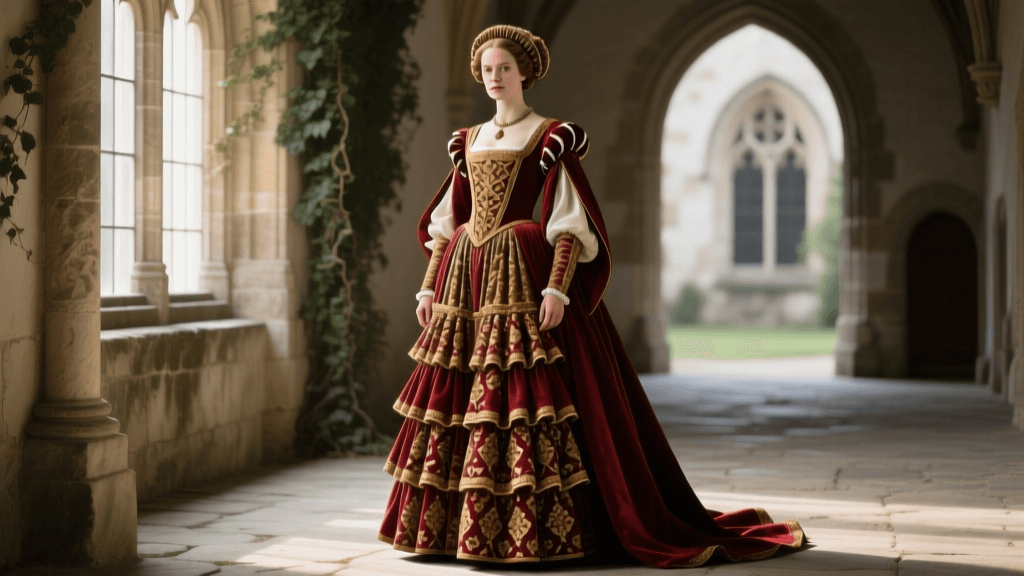
To accurately recreate the Burgundian aesthetic, one must understand the layered complexity of the noblewoman's wardrobe. The silhouette is defined by three primary elements:
- The Chemise (Smock): The foundational layer, crafted from fine, bleached linen. In 2026, historical accuracy dictates that the chemise must be visible at the neckline and cuffs, providing a stark white contrast to the heavy outer garments.
- The Kirtle (Cote): A fitted, supportive under-dress. By the mid-15th century, the kirtle was often laced at the front or side and featured a slightly flared skirt to support the weight of the outer gown.
- The Houppelande and V-Neck Gown: The defining outer layers. The houppelande is a voluminous, floor-length gown with massive, sweeping sleeves (often dagged or scalloped at the edges) and a high, stiffened collar. Alternatively, the deep V-neck gown, trimmed with luxurious fur or contrasting silk, became the dominant style by the 1470s, emphasizing a long, elegant torso.
According to the Metropolitan Museum of Art's Heilbrunn Timeline of Art History, the transition from the flowing houppelande to the more structured, tailored V-neck gowns marks a critical shift in European fashion, moving toward the structured silhouettes that would define the 16th-century Renaissance.
Sourcing Historically Accurate Textiles in 2026
The most significant challenge for modern recreators is sourcing textiles that mimic the weight, weave, and drape of 15th-century fabrics. Modern commercial fabrics often lack the necessary structural integrity or feature synthetic blends that fail the strict authenticity checks of modern heritage guilds.
Wool and Linen Foundations
For the kirtle and the base of the houppelande, you must source 100% natural fibers. Look for tabby-woven or twill-woven wools in the range of 250 to 400 grams per square meter (GSM). In 2026, specialized heritage mills in the UK and Eastern Europe are producing historically accurate, naturally dyed wools using madder (for deep reds), woad (for blues), and weld (for yellows). For the chemise, seek out 'handkerchief weight' or 'medium weight' linen with a visible slub, avoiding the perfectly uniform, machine-processed linens found in modern craft stores.
Silk, Velvet, and Damask
The Burgundian court was famous for its consumption of Italian and Eastern silks. When sourcing silk velvet or damask for gown trims and the iconic V-neck collars, avoid modern rayon or synthetic velvets. Authentic silk pile velvet is expensive, often costing upwards of $150 per yard in the 2026 market, but it is non-negotiable for high-tier museum replicas. Resources and supplier directories frequently updated on platforms like Medievalists.net can help connect independent weavers and small-batch historical textile importers with serious recreators.
Pattern Drafting: Geometric vs. Fitted Construction
Unlike modern clothing, which relies on complex, curved darts to fit the body, 15th-century tailoring was largely geometric. The houppelande is constructed using rectangles, triangles (gores), and circular cuts. The bodice of the V-neck gown, however, requires a more tailored, fitted approach, representing the dawn of modern pattern drafting.
Construction Methods Comparison
| Construction Method | Historical Accuracy | Time Investment | 2026 Reenactment Guild Status |
|---|---|---|---|
| 100% Hand-Stitched (Running & Backstitch) | Maximum | 150 - 250 Hours | Required for 'Master Artisan' rank |
| Machine-Seamed, Hand-Finished Edges | Moderate to High | 60 - 90 Hours | Accepted for standard 'Noble' impressions |
| Machine-Sewn with Serger/Overlock | Low (Anachronistic) | 20 - 30 Hours | Rejected by major heritage festivals |
For the houppelande, the body is typically cut as a large semi-circle or gathered into a fitted yoke. The massive sleeves are cut as full circles or large rectangles that are pleated into the armscye. To achieve the signature heavy, tubular folds seen in Rogier van der Weyden’s paintings, the wool must be heavily fulled, and the lining (often fur or heavy linen) must be pad-stitched to the outer shell to provide structural support.
The Iconic Hennin: Engineering the Conical Headdress
No Burgundian ensemble is complete without the hennin—the towering, conical or truncated headdress draped with a fine veil. Constructing a hennin that survives a windy day at an outdoor 2026 historical festival requires hidden engineering.
Modern recreators often use millinery wire and buckram to form the cone. However, for strict historical accuracy, the base should be formed from hardened linen or lightweight wicker, padded with cotton or wool wadding. The veil, typically made of sheer silk organza or fine linen lawn, is pinned to the apex of the cone and allowed to cascade down the back. A crucial, often forgotten detail is the frontlet—a black velvet or silk band worn across the forehead beneath the hennin, which anchors the piece and frames the face, mimicking the high, plucked hairlines fashionable in the 1400s.
Dyeing Techniques and Color Symbolism
Color in the Burgundian court was heavily regulated by sumptuary laws and immense wealth. The most prized color of the late 15th century was not bright red, but a deep, lustrous black. Achieving a true, colorfast black in the 1400s required multiple overdyeing processes using oak galls, iron mordants, and expensive imported dyes. When selecting your color palette, avoid neon or highly saturated modern chemical dyes. Opt for the muted, complex tones achieved through natural mordanting. Deep madder burgundies, woad navy blues, and oak-gall blacks will instantly elevate the authenticity of your garment.
2026 Budgeting and Material Cost Breakdown
Creating a museum-quality Burgundian gown is a significant financial investment. Below is an estimated cost breakdown for sourcing premium, historically accurate materials in the 2026 market. Prices reflect small-batch heritage suppliers and specialized historical tailors.
| Garment Component | Material Required | Estimated 2026 Cost (USD) |
|---|---|---|
| Chemise (Linen) | 4 yards medium-weight linen | $120 - $160 |
| Kirtle (Wool) | 5 yards naturally dyed twill wool | $250 - $400 |
| Houppelande Outer | 8 yards heavy fulled wool or silk blend | $600 - $950 |
| Lining & Fur Trim | Faux historical fur or rabbit, 3 yards linen | $300 - $500 |
| Hennin & Veil | Buckram, wire, 3 yards silk organza | $150 - $220 |
| Hardware (Pins, Lacing) | Brass lacing rings, hand-forged pins | $80 - $120 |
| Total Estimated Material Cost | $1,500 - $2,350 |
For those looking to purchase pre-made patterns or commission specific elements, specialized historical outfitters like Historic Enterprises offer period-cut pattern drafts and authentic brass hardware that can save dozens of hours in the research and prototyping phases.
Final Thoughts on Historical Accuracy
Recreating 15th-century Burgundian fashion is an exercise in patience, research, and respect for the artisans of the past. As the historical costuming community continues to evolve in 2026, the emphasis has shifted away from 'costume' and toward 'historical dress'—a recognition that these garments were engineered, tailored, and worn with immense pride. By investing in natural fibers, mastering geometric tailoring, and paying close attention to the structural nuances of the hennin and houppelande, you can create a garment that not only looks breathtaking but stands up to the rigorous scrutiny of modern historical scholarship.