2026 Guide: Crafting the 15th-Century Burgundian Houppelande & Hennin
The Allure of the Burgundian Court in 2026 Reenactment
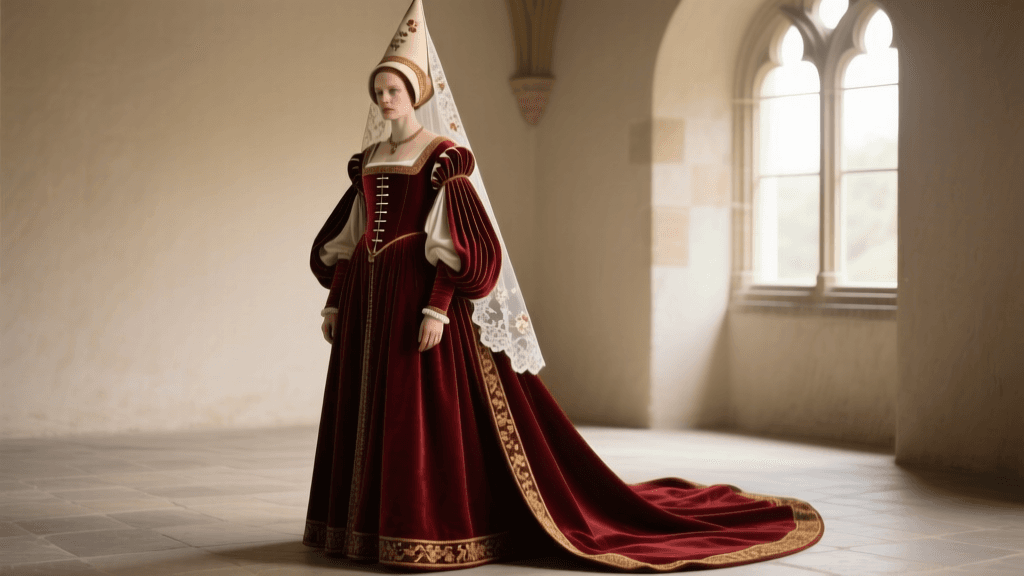
As we navigate the 2026 historical reenactment and living history season, the mid-15th-century Burgundian court remains the absolute pinnacle of late medieval fashion. Ruled by the Dukes of Burgundy, this era produced a silhouette of unmatched drama, characterized by soaring vertical lines, voluminous fabrics, and striking architectural headdresses. For serious costumers and historical interpreters, recreating the iconic houppelande (the sweeping outer gown) and the hennin (the steeple or truncated cone headdress) requires a meticulous blend of historical research and modern structural engineering.
Unlike earlier medieval garments that relied on simple rectangular cuts, the Burgundian houppelande demands an understanding of drape, heavy fabric manipulation, and precise tailoring. Furthermore, the modern 2026 reenactment community has embraced new technologies and sustainable textile sourcing to make these historically accurate garments more comfortable and accessible for long festival weekends. In this comprehensive guide, we will break down the exact measurements, drafting techniques, and material costs required to build a museum-quality Burgundian ensemble today.
Deconstructing the Houppelande: Pattern and Proportions
The houppelande is a massive, floor-length gown featuring a high, stiffened collar, a fitted bodice that flares dramatically into deep tubular folds, and enormous "bag sleeves" (often called pokal sleeves) that can sweep the ground. To achieve the correct 1450s-1470s silhouette, the garment must be cut from circular or semi-circular panels rather than simple gored rectangles.
Taking Measurements and Calculating Yardage
The most common mistake modern reenactors make is underestimating the sheer volume of fabric required. The deep, organ-pipe folds of the skirt are achieved by pleating a massive circumference of fabric into a tightly fitted waistband or bodice. Below is the standard yardage requirement table based on the wearer's height, assuming a standard 54-inch wide historical reproduction wool.
| Wearer Height | Main Fabric (Wool/Silk) | Lining Fabric (Linen/Fustian) | Interfacing (Collar/Cuffs) |
|---|---|---|---|
| Under 5'4" (162 cm) | 7.5 Yards | 7.5 Yards | 1 Yard Heavy Canvas |
| 5'4" to 5'7" (162-170 cm) | 8.5 Yards | 8.5 Yards | 1.25 Yards Heavy Canvas |
| 5'8" to 5'10" (170-178 cm) | 9.5 Yards | 9.5 Yards | 1.5 Yards Heavy Canvas |
| Over 5'10" (178+ cm) | 10.5 Yards | 10.5 Yards | 1.5 Yards Heavy Canvas |
Drafting the Bag Sleeves
The sleeves of a Burgundian houppelande are a focal point. They should be drafted as a full half-circle or even a three-quarter circle, with the wrist opening positioned off-center. The bottom of the sleeve is left open and unsewn for the final 18 to 24 inches, allowing the heavy fabric to drape elegantly toward the floor while the wearer's arm exits through a slit higher up on the forearm. To prevent the sleeves from dragging in the mud during outdoor 2026 reenactment events, many costumers add a discreet, period-acceptable silk ribbon loop inside the sleeve hem to tie around the middle finger when walking.
Selecting 2026 Textiles: Balancing Authenticity and Budget
The textile market for historical reproduction has matured significantly. In 2026, heritage mills in Yorkshire, England, and Biella, Italy, have released new lines of period-accurate 2/2 twill wools specifically dyed using historical plant-based methods (such as woad for deep blues and madder for rich burgundies). These fabrics typically range from $55 to $85 per yard. While expensive, they provide the necessary weight and drape that modern lightweight wools simply cannot achieve.
For the lining, a medium-weight bleached or natural linen is essential. Fustian (a linen-cotton blend) is also highly acceptable and slightly more budget-friendly, usually costing around $18 to $24 per yard. For visual research on the color palettes and textile drapes of the era, historians and costumers frequently consult the Metropolitan Museum of Art's Medieval Art collection, which houses incredible extant textile fragments and tapestries that showcase the exact weight and weave of 15th-century luxury fabrics.
Engineering the Hennin: Millinery Wire and Modern Armatures
No Burgundian ensemble is complete without the hennin. While the towering steeple hennin is the most recognizable, the truncated cone and the "butterfly" (or cornet) variations were equally prevalent. The primary challenge of the hennin is weight distribution; a poorly balanced headdress will cause severe neck strain within hours.
Traditional Buckram vs. 2026 Thermoplastics
Historically, the hennin's cone was stiffened using multiple layers of linen glued together or supported by a wire armature. Today, traditional millinery buckram remains a viable option, but it is heavy and susceptible to humidity. In 2026, the costuming community has widely adopted thermoplastic mesh (such as Fosshape or Wonderflex) and lightweight 3D-printed lattices.
- Thermoplastic Mesh: Activated by steam or a heat gun, this material can be molded directly over a custom head-block. It is breathable, waterproof, and weighs a fraction of traditional buckram.
- 3D-Printed TPU/PLA Lattices: Avant-garde milliners are now using flexible TPU filament to print intricate, honeycomb-patterned internal armatures. These provide immense structural rigidity while remaining virtually weightless.
- Millinery Wire: For the brim and the edge of the veil, 19-gauge stainless steel millinery wire is still the gold standard. It should be sandwiched between the outer silk and the inner linen lining using a catch-stitch.
Attaching the Veil
The veil, often made of crisp silk organza or fine sheer linen, is pinned to the apex of the hennin. To achieve the stiff, floating look seen in the paintings of Rogier van der Weyden, the veil must be heavily starched. Modern liquid starches work well, but for an authentic 15th-century finish, a homemade wheat starch paste, applied and ironed dry, provides an unmatched glass-like stiffness that holds up against outdoor breezes.
Essential Accessories: Poulaines and Belts
To ground the towering verticality of the hennin and houppelande, the footwear must extend the horizontal line. Poulaines (or crackows) are leather shoes with exaggerated pointed toes. In 2026, custom cordwainers specializing in medieval footwear charge between $250 and $400 for a pair of hand-welted, turn-shoe construction poulaines. The toe must be stuffed with dried moss or modern cotton batting to maintain its shape, and a discreet leather chain or cord is often attached from the toe to the ankle to prevent tripping.
The waist is cinched with a wide, ornate belt. Rather than a simple leather strap, Burgundian belts were often made of silk velvet or brocade, heavily embroidered and fastened with a cast-brass or silver-gilt buckle. Sourcing reproduction hardware from specialized European foundries has become much easier, with detailed CAD-cast replicas of extant 15th-century buckles now widely available for under $60.
2026 Material Cost and Sourcing Breakdown
Building a complete, high-end Burgundian ensemble is an investment. Below is a realistic cost breakdown for a premium, historically accurate outfit sourced in 2026.
| Garment / Component | Primary Materials | Estimated 2026 Cost (USD) |
|---|---|---|
| Houppelande (Gown) | Heritage Wool, Linen Lining, Canvas | $550 - $750 |
| Kirtle (Underdress) | Lightweight Wool Flannel | $120 - $180 |
| Hennin & Veil | Thermoplastic Mesh, Silk Organza, Wire | $85 - $140 |
| Poulaines (Footwear) | Vegetable-Tanned Leather, Custom Lasts | $250 - $400 |
| Belt & Hardware | Silk Velvet, Cast Brass Buckle | $90 - $150 |
| Total Estimated Investment | Complete Ensemble | $1,095 - $1,620 |
Final Thoughts on Historical Silhouette
The key to mastering 15th-century Burgundian fashion lies in the proportions. The houppelande must swallow the body in heavy, luxurious folds, while the hennin must elongate the neck and skull to an almost unnatural degree. By leveraging modern 2026 materials like thermoplastic armatures and sustainably milled heritage wools, today's reenactors can achieve a breathtaking, museum-quality silhouette without sacrificing comfort. For further visual inspiration and to study the drape of extant garments, we highly recommend exploring the digital archives of the Victoria and Albert Museum's Fashion Collection, which offers unparalleled high-resolution imagery of late medieval and early Renaissance textiles. Whether you are attending a major European heritage festival or a localized living history event, a properly constructed Burgundian ensemble will undoubtedly command the field.