15th-Century Burgundian Houppelande Sewing Guide 2026
Introduction to the Burgundian Houppelande
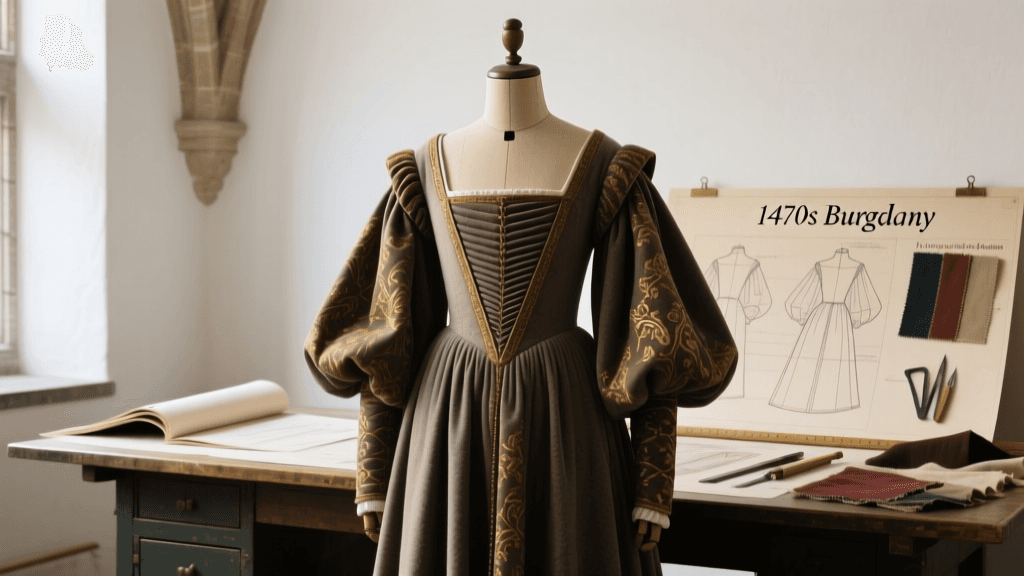
The Burgundian houppelande represents the absolute pinnacle of late 14th and 15th-century European fashion. Characterized by its sweeping, floor-length skirts, massive bell-shaped sleeves, and high, stiffened collars, this garment was a symbol of immense wealth and aristocratic status. For modern historical costumers, reenactors, and textile artists, recreating a houppelande in 2026 requires a delicate balance of historical accuracy and modern sewing ergonomics. Unlike the tailored, close-fitting garments of the later Renaissance, the houppelande relies entirely on geometric draping, heavy pleating, and the luxurious drape of premium textiles. This comprehensive guide will walk you through the historical context, modern fabric sourcing, digital prototyping, and step-by-step construction techniques required to bring this medieval masterpiece to life.
Historical Context and the 15th-Century Silhouette
Emerging from the courts of Burgundy and France, the houppelande was worn by both men and women, though the styling varied significantly by gender. Men often wore shorter versions, belted at the waist, paired with hose and poulaines (pointed shoes). Women's versions were universally floor-length, belted high just beneath the bust, creating a voluminous, cascading silhouette that completely obscured the natural waistline. According to the Encyclopedia Britannica's overview of medieval dress, the excessive use of fabric in the houppelande was a direct response to the sumptuary laws and a display of economic power, as textiles were among the most expensive commodities of the era. The Victoria and Albert Museum's fashion archives also highlight how the garment's high collar, often lined with contrasting fur or velvet, framed the face and complemented the towering hennin headdresses popular among noblewomen of the period.
Sourcing Authentic Fabrics in the 2026 Market
The success of a houppelande relies almost entirely on the weight, drape, and historical accuracy of the chosen textiles. In 2026, the historical costuming community has seen a massive shift toward traceable, heritage-breed wools and sustainable silks. While synthetic brocades and polyester velvets were common in the early 2010s, today's discerning makers prioritize natural fibers that mimic the behavior of 15th-century broadcloths.
Silk velvet remains the gold standard for noble-class houppelandes, but pricing has surged. As of early 2026, authentic silk velvet averages between $95 and $140 per yard, making it a significant investment. For those seeking historical accuracy on a moderate budget, heavily fulled wool broadcloth is the most historically ubiquitous choice. The Metropolitan Museum of Art's Costume Institute frequently showcases extant fragments that highlight the dense, felted nature of medieval wools, which held deep, cartridge-pleated folds beautifully without fraying.
| Fabric Type | 2026 Avg. Price/Yard | Historical Accuracy | Best Use in Houppelande |
|---|---|---|---|
| Silk Velvet | $95 - $140 | High (Nobility) | Outer shell, sleeve linings |
| Wool Broadcloth | $45 - $75 | Very High (All classes) | Primary outer shell, winter wear |
| Linen Canvas | $25 - $40 | High (Undergarments/Lining) | Bag-lining, interlining |
| Silk Taffeta | $60 - $90 | High (Nobility) | Sleeve linings, contrasting trims |
Digital Prototyping: A 2026 Necessity
Because a full-length houppelande can require upwards of 8 to 12 yards of expensive fabric, modern makers in 2026 frequently utilize 3D draping software before cutting into their textiles. Programs like CLO 3D and Marvelous Designer allow costumers to input the exact gram-per-square-meter (GSM) weight and bending stiffness of their chosen wool or silk. By simulating the cartridge pleating process digitally, you can adjust the circumference of your skirt panels to ensure the fabric pools correctly at the floor without overwhelming your frame. This digital-first approach has drastically reduced textile waste in the historical costuming community over the past three years.
Drafting the Pattern: Geometric Proportions
The houppelande is not drafted using modern, close-fitting bodice blocks. Instead, it is rooted in geometric shapes—primarily massive circles and rectangles. The most common method for recreating the female Burgundian silhouette is the 'yoke and pleated skirt' method, or the 'modified circle' method. For this guide, we will focus on the modified rectangle and circle hybrid, which provides the best drape for heavy wools.
Step-by-Step Measurement Chart
Before drafting, take the following measurements over your foundational linen kirtle and undergarments:
- High Bust to Floor: Measure from just beneath the bust (where the belt will sit) down to the floor. Add 4 inches for hem allowance and pooling.
- Shoulder to Wrist (Extended): Measure from the base of the neck, over the shoulder, down to the knuckles. Houppelande sleeves historically extended past the hands.
- Neck Circumference: Measure the base of the neck loosely. The collar will be drafted as a separate, stiffened band.
- Belt Circumference: Measure snugly just under the bust. This determines the top circumference of your pleated skirt panels.
- Sleeve Bicep Depth: Measure around the upper arm, then multiply by 3 or 4 to allow for the massive drop of the bell sleeve.
The bodice is essentially a fitted yoke that sits on the shoulders, while the skirt is composed of multiple rectangular panels that are cartridge-pleated into the lower edge of the yoke. The sleeves are drafted as large right-angled triangles or half-circles, with the wrist opening cut on a curve to allow the back of the sleeve to drag on the floor while the front clears the hands.
Construction Techniques for Modern Historical Makers
Bag-Lining the Sleeves
Given the immense size of the bell sleeves, bag-lining is essential to hide raw edges and provide structural weight. Cut your outer fabric (e.g., wool) and your lining fabric (e.g., silk taffeta or linen) using the exact same sleeve pattern. Sew them together along the bottom hem and the curved wrist opening, right sides facing. Turn the sleeve right side out and press. The top raw edges of the sleeve are then basted together and pleated directly into the armhole of the bodice yoke.
Mastering Cartridge Pleating
Cartridge pleating, historically referred to as gauging, is the defining construction technique of the houppelande. Unlike standard knife pleats or box pleats, cartridge pleats fold the fabric back on itself in uniform, tubular intervals, creating a rounded, organ-pipe effect that pushes the heavy skirt outward from the body.
To execute this in 2026 without hand-sewing thousands of inches of thread, many makers use a heavy-duty sewing machine with a specialized gathering foot, or they employ a laser-guided marking pen to dot the fabric at exact 1/2-inch intervals. Run three parallel rows of strong, waxed linen thread through the top edge of your skirt panels. Pull the threads simultaneously to gather the fabric tightly. The resulting pleats are then whip-stitched directly to the finished lower edge of the bodice yoke, catching only the very top fold of each pleat to maintain the tubular shape.
The Stiffened High Collar
The iconic high collar of the Burgundian houppelande requires internal structure. Historically, this was achieved with multiple layers of stiffened linen or buckram. Today, you can use heavy-weight tailor's canvas interfacing, padded with a layer of cotton batting to protect the neck. Cut the collar on the bias so it curves gently around the back of the neck while standing rigidly at the front. Edge the collar with faux fur, velvet, or intricate metallic embroidery to match the sleeve linings.
Essential Accessories: The Hennin and Girdle
No 15th-century Burgundian ensemble is complete without its accompanying accessories. The steeple hennin—a towering, cone-shaped headdress draped with a sheer silk veil—is the most recognizable silhouette of the era. In 2026, milliners specializing in historical headwear utilize lightweight thermoplastic bases covered in silk velvet, ensuring the hennin remains secure and comfortable during long hours at reenactment events or museum exhibitions. The veil, typically made of crisp silk organza or fine linen, is pinned to the tip of the cone and allowed to cascade down the back.
The girdle (belt) is equally important. For women, a woven silk tablet-woven belt or a leather belt adorned with cast brass D-rings is worn high under the bust. The excess length of the belt is allowed to hang down the front of the skirt, often terminating in a decorative brass chape or a silk tassel. Men's belts are worn at the natural waist and are typically wider, featuring intricate tooling and heavy metal buckles.
Conclusion and Further Research
Constructing a 15th-century Burgundian houppelande is a rewarding endeavor that bridges the gap between historical research and advanced textile arts. By prioritizing historically accurate, heavy-weight natural fibers, utilizing modern digital prototyping to conserve expensive materials, and mastering the art of cartridge pleating, you can achieve a breathtaking silhouette that honors the master tailors of the Burgundian court. As the historical costuming community continues to evolve in 2026, the emphasis remains on deep research, sustainable sourcing, and a profound respect for the geometric brilliance of medieval garment construction. Whether you are building your first houppelande or refining your tenth, the enduring elegance of this garment ensures it will remain a centerpiece of European folk dress and historical fashion for generations to come.