Schuhplattler Dance Tracht: Authentic Bavarian Costumes for 2026
The Intersection of Folk Dance and Sartorial Heritage
As we approach the 2026 European festival season, the revival of traditional folk dance has reached unprecedented heights. Among the most physically demanding and visually spectacular of these traditions is the Schuhplattler, a traditional Bavarian and Tyrolean folk dance characterized by rhythmic stomping, leaping, and the percussive slapping of thighs, knees, and shoes. To perform the Schuhplattler authentically at regional Gaufeste (costume festivals) or major cultural events, dancers cannot rely on mass-produced tourist souvenirs. Authentic Tracht (traditional dress) is an engineered garment, designed specifically to withstand the rigorous biomechanics of Alpine folk dance while projecting deep cultural heritage.
According to the Bayerischer Trachtenverband (Bavarian Traditional Costume Association), the preservation of dance-specific Tracht requires strict adherence to historical tailoring techniques, material sourcing, and regional color palettes. In 2026, the demand for bespoke, dance-ready Lederhosen and Dirndls has surged, driven by a younger generation of dancers prioritizing historical accuracy and kinetic functionality over fast-fashion festival wear.
Sourcing Dance-Ready Lederhosen for the Plattler
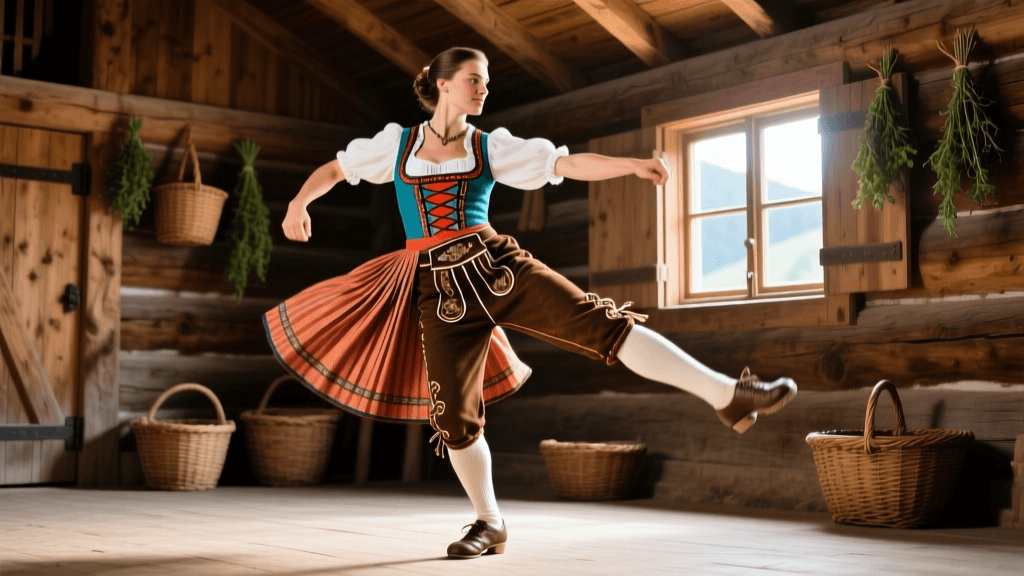
The core of the male Schuhplattler costume is the Kurze Lederhose (short leather breeches). For a dancer, the leather must possess a very specific acoustic and tactile profile. When the dancer strikes his thigh during the Plattler sequence, the leather must produce a sharp, resonant crack. Stiff, heavily finished cowhide will yield a dull thud and restrict the deep squats (Hocken) required in the choreography.
Authentic dance Lederhosen are crafted from Hirschleder (deerskin) or Gamsleder (chamois), tanned using traditional brain-tanning or Sämischt (oil-tanning) methods. This process leaves the leather incredibly supple, breathable, and durable. Furthermore, the construction must feature the Säcklernaht, a raised, hand-stitched saddle seam that reinforces the stress points around the drop-crotch and inner thighs, allowing for maximum lateral mobility during leaps.
2026 Leather Comparison for Folk Dance
| Material | Acoustic Slap Quality | Flexibility & Mobility | 2026 Avg. Cost (EUR) | Break-in Period |
|---|---|---|---|---|
| Hirschleder (Deerskin) | Sharp, loud crack (Excellent) | Exceptional, moves with skin | €900 - €1,400 | 10-15 hours of wear |
| Gamsleder (Chamois) | Deep, resonant pop (Very Good) | High, very soft hand-feel | €1,100 - €1,600 | 5-10 hours of wear |
| Rindsleder (Cowhide) | Dull thud (Poor for dance) | Stiff, restricts deep squats | €300 - €600 | 40+ hours of wear |
| Ziegenleder (Goatskin) | Snappy, bright (Good) | Moderate, lighter weight | €700 - €1,000 | 20 hours of wear |
Engineering the Dirndl for Folk Dance Mobility
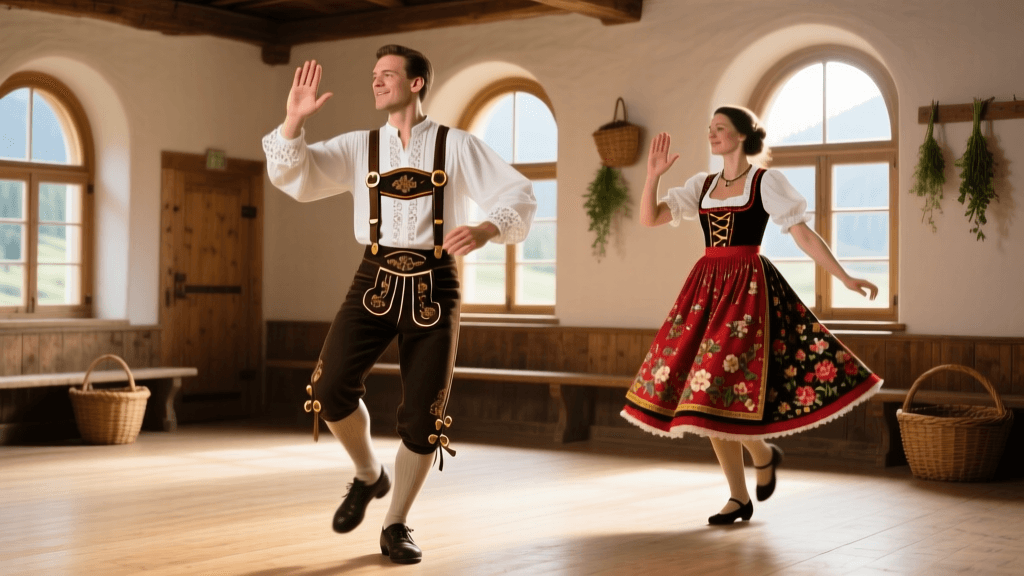
While the male costume is defined by percussive impact, the female dance costume—the Dirndl—is engineered for rotational momentum and structural support. The traditional dance Dirndl differs vastly from the commercialized festival versions sold in Munich shops. For a dancer performing the Boarischer or the rapid waltz sequences, the garment must facilitate the famous Dirndl-Schwung (the dramatic flaring of the skirt during spins).
The Skirt and Apron Dynamics
A dance-ready Dirndl skirt in 2026 requires a minimum hem circumference of 3.5 to 4 meters. This is achieved through deep, hand-pressed box pleats (Falten) or circular bias cutting. The weight of the cotton or linen fabric must be substantial enough (typically 180-220 gsm) to carry momentum outward during a spin, yet light enough not to exhaust the dancer. The hemline strictly adheres to the Kniebedeckt (knee-covering) rule of traditional Tracht, sitting roughly two to three fingers below the kneecap when standing, which naturally rises to mid-thigh during centrifugal movement.
The Schürze (apron) is tied at the front. While the position of the bow traditionally signals marital status, for folk dancers, the knot must be a secure, flat slipknot that will not unravel during vigorous partnering sequences or catch on the dancer's own hands during intricate arm-weaving choreography.
Bodice Construction and Posture
The Leibchen (bodice) of a dance Dirndl is heavily structured. It features internal steel or synthetic boning to enforce an upright, regal posture, which is essential for the aesthetic of Alpine folk dance. The front lacing, often secured with a silver Dirndl-Kette (chain) or silk ribbon, allows the dancer to adjust the compression of the bodice depending on the cardiovascular demands of the specific dance routine. The Bayerisches Nationalmuseum notes that historical bodices from the late 19th century utilized quilted linen channels for support, a technique still favored by bespoke Tracht tailors today for its breathability during summer festivals.
Footwear: The Percussive Rhythm of the Haferlschuh
Footwear in the Schuhplattler is not merely decorative; it is a musical instrument. Male dancers wear the Haferlschuh, a robust, brogue-style shoe originally designed for Alpine hunting and forestry. For dance, the Haferlschuh features a thick leather or rubber sole, often reinforced with metal hobnails (Krampen) or taps at the heel and toe. This allows the dancer to produce a sharp, staccato rhythm when stomping on wooden festival stages. The shoe is laced securely up the ankle to prevent rolling during lateral jumps.
Female dancers wear Trachtenschuhe, typically a low-cut pump or Mary Jane style with a sturdy 3 to 4-centimeter block heel. The block heel is crucial for balance during rapid pivots, while the strap across the instep ensures the shoe remains firmly attached during high kicks and leaping sequences. In 2026, custom orthotic insoles are increasingly common among professional folk dance troupes to mitigate the impact of repetitive stomping on cobblestone and hardwood surfaces.
Regional Variations: Miesbacher vs. Werdenfelser Tracht
Authenticity in European folk dress requires an understanding of regional micro-cultures. A dancer cannot mix elements from different regions without violating the strict codes of the Trachtenvereine (costume societies).
- Miesbacher Tracht: Characterized by dark, subdued colors. Men wear charcoal or dark brown Lederhosen with subtle green embroidery, a grey loden jacket, and a green velvet hat adorned with a Gamsbart (chamois hair brush). Women wear navy blue or dark green Dirndls with black silk aprons and intricate silver jewelry.
- Werdenfelser Tracht: Originating from the Garmisch-Partenkirchen area, this style is slightly more colorful. Men often feature the iconic Seppelhut (a felt hat with a cord band), while women's Dirndls incorporate vibrant floral brocades and lighter pastel aprons, reflecting the historical wealth of the trade-route towns.
- Inntaler Tracht: Hailing from the Inn Valley, this style features the distinctive Rock (skirt) with contrasting velvet bands and the men's Bundlederhose (knee-breeches) worn with thick, slouched wool socks, ideal for the specific stomping variations of Tyrolean-influenced dances.
2026 Sourcing Guide and Pricing Expectations
Sourcing authentic, dance-grade Tracht in 2026 requires bypassing commercial tourist hubs and engaging directly with master tailors (Trachtenschneidermeister) in rural Bavaria and Tyrol. Bespoke Lederhosen, hand-embroidered with the wearer's initials and regional motifs, currently command between €900 and €1,600, with wait times often stretching 6 to 9 months due to the scarcity of premium Hirschleder. A fully bespoke, silk-and-linen dance Dirndl ranges from €500 to €1,200. For those seeking more immediate options, high-end off-the-rack manufacturers in Munich offer dance-specific lines starting around €450 for Lederhosen and €250 for Dirndls, though the leather quality and acoustic properties will not match bespoke commissions.
Garment Care and Maintenance for Dancers
The rigors of folk dance—sweat, friction, and stage dust—demand meticulous garment care. Hirschleder must never be dry-cleaned or exposed to harsh chemical solvents, which will strip the natural oils and cause the leather to crack. After a festival, dancers should brush the Lederhosen with a soft suede brush and allow them to air dry in a shaded, well-ventilated room. The Dirndl bodice should be spot-cleaned, while the cotton skirts can be gently hand-washed and re-pressed using a steam iron to restore the sharp geometry of the box pleats. Proper storage on wide, padded wooden hangers ensures the structural integrity of the garments remains intact for the next festival season.
Conclusion
The Schuhplattler is a profound expression of Alpine identity, where the garment and the movement are inextricably linked. As the 2026 festival season unfolds across Europe, the dedication of folk dancers to authentic, meticulously crafted Tracht ensures that this vibrant cultural heritage continues to thrive. Whether you are a seasoned member of a Trachtenverein or a cultural enthusiast preparing for your first Gaufest, investing in properly engineered Lederhosen and Dirndls is essential for honoring the history, mechanics, and sheer joy of European folk dance.