Imperial Chinese Clothing: Symbols of Power

The Cosmological Canvas: Beyond Mere Aesthetics

To study imperial Chinese clothing is to read a visual manuscript of the universe. In traditional Chinese statecraft, the emperor was the Son of Heaven (Tianzi), acting as the vital conduit between the celestial realm and the earthly domain. Consequently, garments worn by the imperial family and the scholar-official class were never merely decorative; they were profound cosmological diagrams woven in silk, gold, and floss. Every motif, color, and structural seam was dictated by rigorous sumptuary laws designed to maintain the cosmic and social order.
During the Qing dynasty (1644–1912), these regulations were codified in the Huangchao Liqi Tushi (Illustrated Precedents for the Ritual Paraphernalia of the Dynasty), commissioned by the Qianlong Emperor in 1759. This exhaustive manual dictated the exact weave, thread count, and iconography permitted for every rank. According to textile archives at The Metropolitan Museum of Art, a single court robe could take up to two and a half years to complete, requiring the synchronized labor of weavers, dyers, and master embroiderers.
Anatomy of the Longpao (Dragon Robe)
The Longpao, or Dragon Robe, is the most iconic of all imperial Chinese garments. Worn as semi-formal court dress, it is a masterclass in spatial symbolism. The robe is constructed to represent the universe itself: the wearer's head emerges from the neck hole as the heavens, the torso represents the earthly realm, and the hem touches the primordial waters.
The Nine Dragons and the Lishui Hem
A true emperor's Longpao features exactly nine dragons, a number associated with supreme yang energy and imperial longevity. When viewed from the front or back, the observer sees five dragons (one central, two on the shoulders, two on the lower front/back), while the remaining four are hidden on the inner flaps and underarms, ensuring the emperor is always surrounded by divine protection. Beneath the dragons lies the Lishui (standing water) hem—a diagonal striped pattern at the base of the robe representing the world's oceans, topped with crashing wave motifs and jagged rocks symbolizing the earth's mountains emerging from the sea.
The Twelve Symbols of Sovereignty

Reserved exclusively for the emperor, the Twelve Symbols of Sovereignty (Shi'er Zhang) are ancient motifs dating back to the legendary Sage Kings. They are strategically placed on the shoulders, chest, back, and skirt of the Chaofu (formal court dress) and the highest-tier Longpao:
- Sun (Ri): Featuring a three-legged crow, representing yang, enlightenment, and the emperor's radiant virtue.
- Moon (Yue): Depicting a jade rabbit pounding the elixir of life, representing yin and the empress.
- Stars (Xingchen): The Great Bear constellation, symbolizing the emperor's connection to the celestial axis.
- Mountains (Shan): Representing earthly stability, weight, and the emperor's role as the stabilizer of the realm.
- Dragons (Long): Embodying adaptability, transformation, and the bringer of life-giving rain.
- Pheasant (Hua): Signifying literary refinement, culture, and the beauty of the civil administration.
- Sacrificial Cups (Zongyi): Bronze vessels denoting filial piety, ancestral reverence, and ritual purity.
- Waterweed (Zao): Symbolizing cleanliness, moral purity, and the cleansing of corruption.
- Millet (Fu): Representing the emperor's duty to nourish the populace and ensure agricultural abundance.
- Flames (Huo): Denoting brilliance, warmth, and the upward reach of imperial benevolence.
- Axe Head (Fu): A symbol of executive power, courage, and the swift delivery of justice.
- Fu Symbol (Fu): Two interlocking 'back-to-back' characters representing moral discernment and the duality of right and wrong.
The Buzi System: Reading the Mandarins Rank Badges
While the emperor wore dragons, the civil and military officials (Mandarins) wore Buzi (rank badges) sewn onto the front and back of their surcoats (Bufu). Introduced in the Ming dynasty and refined in the Qing, these square or circular badges utilized specific beasts and birds to denote the wearer's exact rank within the nine-tier bureaucracy. As documented by the Victoria and Albert Museum, these badges served as an immediate visual resume in the sprawling imperial court.
| Rank | Civil Official (Birds) | Military Official (Beasts) |
|---|---|---|
| 1st Rank | Crane (Xianhe) | Qilin (Mythical Chimera) |
| 2nd Rank | Golden Pheasant | Lion |
| 3rd Rank | Peacock | Leopard |
| 4th Rank | Wild Goose | Tiger |
| 5th Rank | Silver Pheasant | Bear |
| 6th Rank | Egret | Panther |
| 7th Rank | Mandarin Duck | Rhinoceros |
| 8th Rank | Quail | Rhinoceros |
| 9th Rank | Paradise Flycatcher | Sea Horse (Haima) |
Civil badges featured birds to represent elegance, literary prowess, and peaceful governance. Military badges featured beasts to denote ferocity, bravery, and martial protection. Attempting to wear a badge above one's station was considered treason, punishable by severe penal codes.
Chromatic Hierarchy: Sumptuary Laws and Color
Color in imperial Chinese clothing was strictly governed by the Five Elements theory (Wuxing) and dynastic sumptuary laws. By the Qing dynasty, bright yellow (Minghuang) was exclusively reserved for the Emperor, the Empress, and the Empress Dowager. The Crown Prince was permitted apricot yellow (Xinghuang), while other imperial princes and high-ranking nobles were restricted to golden yellow (Jinhuang) or blue. Lower-ranking officials and commoners were relegated to darker blues, greens, and browns. The dyeing process for imperial yellow utilized the bark of the Amur cork tree (Phellodendron amurense), which yielded a vibrant, colorfast hue that was heavily guarded by the Imperial Household Department.
Modern Acquisition: Sourcing Museum-Quality Reproductions

For collectors, historians, and cultural enthusiasts, acquiring authentic imperial Chinese clothing is a complex endeavor. Original Ming and Qing dynasty garments are largely held in institutions like The Palace Museum in Beijing or private auction houses, often fetching hundreds of thousands of dollars. However, the modern revival of traditional craftsmanship in cities like Suzhou and Hangzhou has birthed a market for museum-quality reproductions.
Price Guide and Fabric Composition
When investing in historical reproductions, understanding the textile techniques is paramount. The pinnacle of imperial weaving is Kesi (cut silk tapestry), a technique where weft threads are turned back at the edges of color blocks, creating tiny slits that give the fabric a carved appearance. Master weavers produce barely an inch of Kesi per day.
- Theatrical & Mass-Produced ($80 - $250): Made from polyester blends with machine embroidery. Suitable for stage performances or casual cosplay, but lacks historical accuracy in drape, motif proportion, and fiber content.
- Artisan Hand-Embroidered Silk ($1,500 - $4,500): Woven on traditional looms using 100% mulberry silk. Features hand-embroidered motifs using the Peking knot and satin stitch. These are often commissioned from specialized ateliers in Suzhou (Suxiu embroidery) and offer exceptional cultural and sartorial value.
- Master-Weaver Kesi Reproductions ($12,000 - $45,000+): Created by intangible cultural heritage inheritors. These garments replicate the exact thread count, gold-leaf wrapping (zhuanghua), and structural tailoring of Qing court pieces. They are considered investment-grade textile art.
Archival Care for Silk Garments
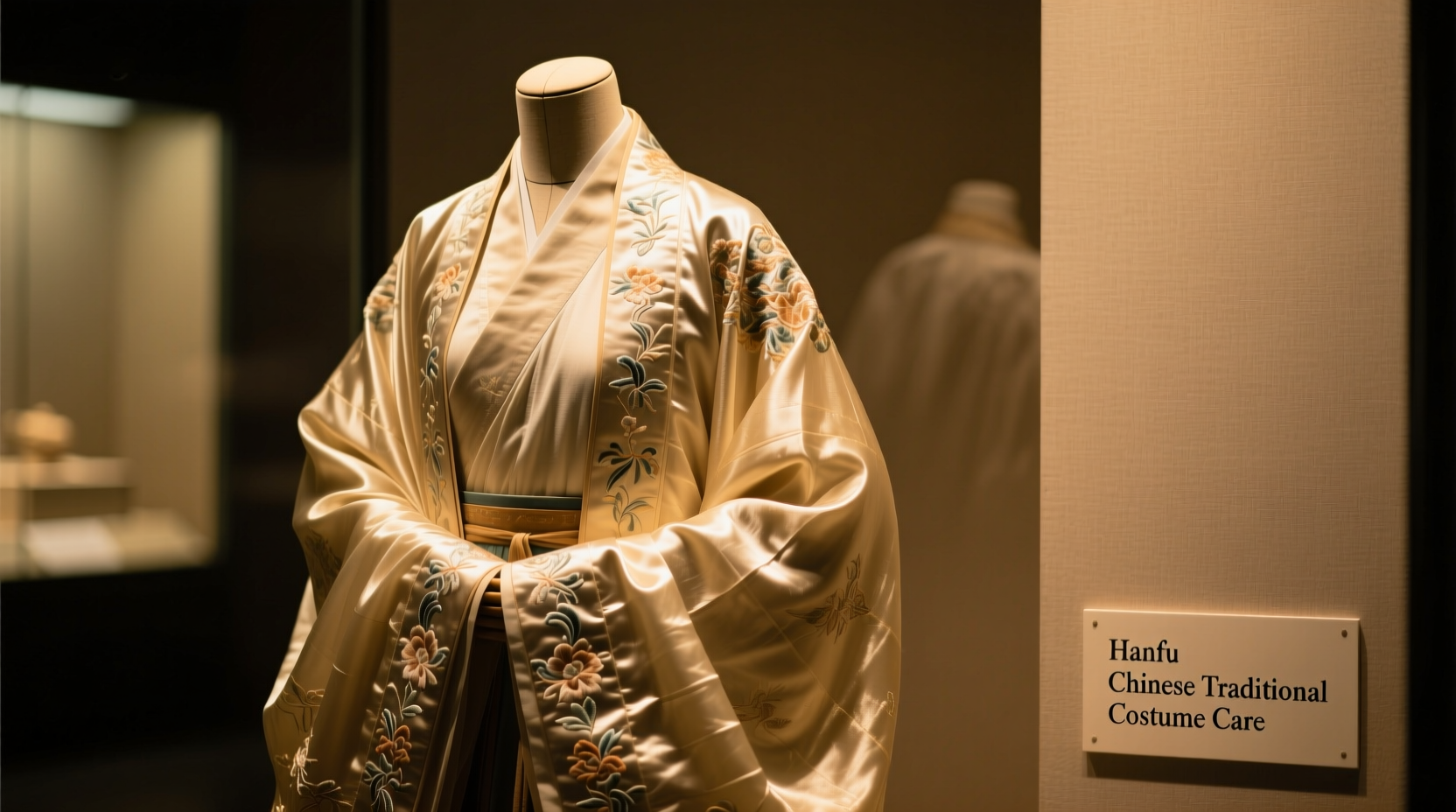
If you acquire a high-quality silk reproduction or a vintage piece, proper preservation is critical. Imperial silks are highly sensitive to ultraviolet light and fluctuating humidity. Garments should never be hung on standard wire hangers, as the weight of the heavy embroidery will distort the warp threads over time. Instead, store the robe flat in an acid-free archival box, stuffed with unbuffered acid-free tissue paper to support the three-dimensional embroidery. Maintain a climate-controlled environment at roughly 68°F (20°C) with 50% relative humidity, and utilize cedar chests or lavender sachets to deter textile pests without introducing harsh chemical mothballs that degrade silk proteins.
Preserving the Thread of History
Imperial Chinese clothing remains one of the most sophisticated systems of visual communication ever developed. By decoding the dragons, rank badges, and chromatic codes, we gain profound insight into a civilization that viewed governance, nature, and the cosmos as inextricably linked. Whether studying a fragment in a museum or commissioning a modern reproduction, engaging with these garments is an act of preserving a deeply symbolic heritage.