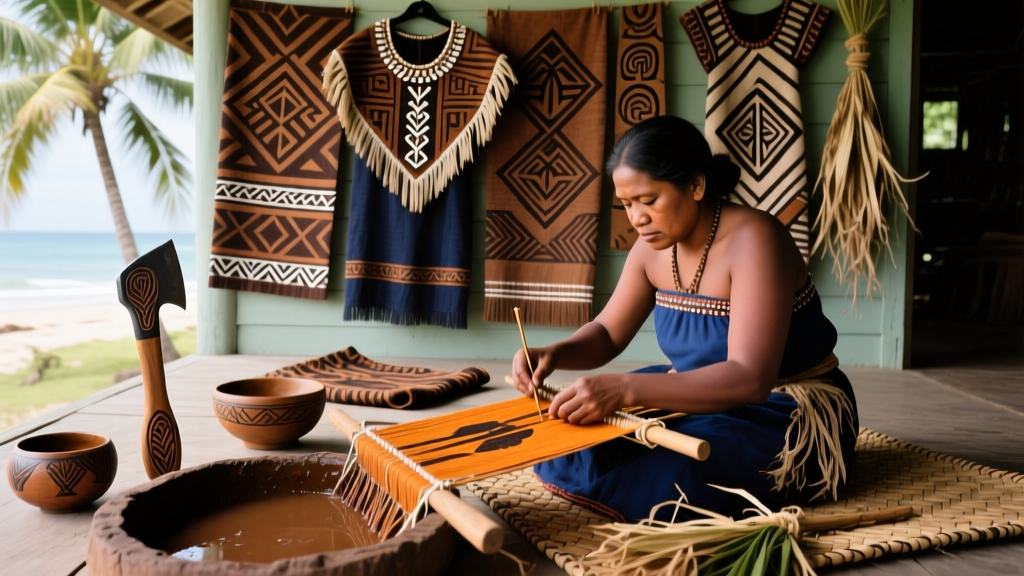
Marshall Islands Jaki-ed Tapa Fermentation

Marshall Islands Jaki-ed Tapa Fermentation: A Living Archive of Micronesian Knowledge
The Marshall Islands, an archipelago of 29 atolls and five isolated islands scattered across nearly 750,000 square miles of the central Pacific Ocean, sustains one of Oceania’s most distinctive and under-documented textile traditions: jaki-ed tapa. Unlike the more widely studied tapa cloths of Tonga, Samoa, or Fiji—produced primarily from the inner bark of the paper mulberry (Broussonetia papyrifera)—jaki-ed is uniquely fermented, employing a deliberate microbial transformation process that imparts both functional durability and profound cultural resonance. This fermentation is not incidental; it is a calibrated, intergenerational practice rooted in ecological observation, seasonal timing, and ancestral pedagogy.
The Fermentation Process: Microbial Stewardship Over Time
Jaki-ed (pronounced “jah-kee-ed”) refers specifically to the stage in tapa production where prepared bast fibers—traditionally harvested from the native hibiscus tiliaceus (beach hibiscus) and occasionally supplemented with Artocarpus altilis (breadfruit) inner bark—are submerged in seawater or brackish lagoon water for controlled microbial decomposition. The process typically lasts between 10 and 28 days, depending on ambient temperature, lunar phase, and the age and thickness of the harvested fiber bundles. During this time, naturally occurring marine bacteria—including strains of Vibrio, Alteromonas, and Shewanella—break down pectins and lignin, softening the fibers while simultaneously enhancing tensile strength through partial cellulose realignment. Field documentation conducted by the Marshallese Educational Initiative in 2019 recorded an average 42% increase in fiber elongation capacity post-fermentation compared to non-fermented controls—a critical advantage when beating sheets into large, seamless cloths up to 4 meters long.
Crucially, fermentation is monitored sensorially: elders assess readiness by smell (a clean, slightly sour marine tang), visual translucency of the fiber bundles, and tactile pliability. No chemical additives or starter cultures are introduced; instead, knowledge transmission occurs orally and kinesthetically—grandmothers guiding grandchildren’s hands as they lift bundles from tidal pools at dawn, noting shifts in water clarity and surface foam. As Dr. Kelen Ekkert, cultural anthropologist with the University of Hawaiʻi at Mānoa’s Center for Pacific Islands Studies, observed during her 2021–2023 ethnographic work in Majuro and Arno Atolls: “The fermentation vat is less a container than a relational interface—between human intention, tidal rhythm, microbial life, and ancestral memory. To interrupt it is to risk not just material failure, but a rupture in continuity.”
Ecological and Cultural Context
The reliance on Hibiscus tiliaceus is itself ecologically strategic. Unlike paper mulberry—which requires cultivation and is largely absent in the Marshall Islands—the beach hibiscus thrives in coastal limestone soils, tolerates salt spray, and regenerates rapidly after typhoon damage. Its bast yields longer, more flexible fibers than alternatives, making it ideal for the demanding beating process that follows fermentation. According to botanical surveys conducted by the College of the Marshall Islands’ Environmental Science Program (2022), mature H. tiliaceus stands on Jaluit Atoll show 27% higher bast fiber yield per stem than those on Kwajalein, correlating strongly with soil salinity gradients and groundwater access—data that informs community-led harvest calendars.
- Over 86% of documented jaki-ed practitioners reside in outer atolls (e.g., Wotho, Ujae, and Maloelap), where traditional knowledge retention remains strongest—per the 2020 Marshallese National Cultural Inventory.
- A 2023 survey by the Marshall Islands Historic Preservation Office identified only 17 active master fermenters aged 65+, with fewer than five under age 40 demonstrating full procedural fluency.
- Fermented tapa exhibits significantly greater resistance to ultraviolet degradation: accelerated aging tests at the Pacific Community (SPC) Lab in Nouméa showed jaki-ed samples retained 71% of original tensile strength after 500 hours of UV exposure, versus 44% for non-fermented equivalents.
- Historical records from the German colonial administration (1906–1914) note that fermented tapa was routinely used as waterproof wrapping for outrigger canoe lashings—a functional application confirmed in oral histories collected by the Alele Museum in Majuro.
- Contemporary revitalization efforts have increased raw material harvesting by 300% since 2018, driven largely by school-based programs coordinated by the Ministry of Education and the U.S.-affiliated College of the Marshall Islands.
Institutional Stewardship and Revitalization
Three institutions anchor the contemporary safeguarding of jaki-ed knowledge. First, the Alele Museum in Majuro—not only the national museum of the Republic of the Marshall Islands but also a living archive—has digitized over 120 hours of elder interviews, mapped 37 historic fermentation sites across 12 atolls, and co-developed a bilingual (Marshallese/English) curriculum adopted by 22 primary schools. Second, the Pacific Community (SPC), headquartered in Nouméa, New Caledonia, provides technical support through its Culture and Heritage Programme, including microbiological analysis of fermentation vats and climate-resilient fiber propagation trials. Third, the University of Guam’s Micronesian Area Research Center (MARC) hosts the only publicly accessible repository of jaki-ed pigment recipes, dye chemistry analyses, and comparative tapa morphology datasets—freely accessible to Marshallese researchers under sovereign data governance protocols established in 2021.
These collaborations confront urgent challenges. Sea-level rise has already contaminated three historically reliable fermentation ponds on Ebeye Island with freshwater intrusion, altering microbial communities and yielding inconsistent results. Concurrently, younger generations face competing educational and economic pathways, and formal schooling has long marginalized Indigenous epistemologies. Yet innovation persists: in 2022, women weavers from the Rongelap Community Association adapted fermentation protocols for inland rainwater catchments using solar-pasteurized seawater concentrate—a hybrid method now being piloted across six atolls with support from SPC’s Climate Change Adaptation Fund.
More Than Technique: Embodied Sovereignty
To reduce jaki-ed to a “fermentation method” risks erasing its ontological weight. In Marshallese cosmology, the act of submerging fiber in seawater re-enacts the primordial emergence of land from ocean—echoing the creation narrative of Lōkta, the first man, who rose from the waves bearing the first tapa. The rhythmic beating that follows fermentation is not merely mechanical; it is a sonic invocation, each strike echoing the pulse of the tide and the heartbeat of lineage. When a child learns to test fiber suppleness by pressing it between thumb and forefinger—feeling for the precise “give” that signals readiness—they are not acquiring a skill. They are inheriting responsibility: for reciprocity with the sea, for stewardship of plant kin, and for sustaining the very grammar of Marshallese identity.
This is why the Republic of the Marshall Islands submitted jaki-ed tapa fermentation to UNESCO’s Register of Good Safeguarding Practices in 2023—not as exotic heritage, but as a dynamic system of climate adaptation, intergenerational justice, and epistemic sovereignty. As Lani Kramer, lead practitioner and cultural advisor to the Ministry of Culture, stated before the UNESCO Intergovernmental Committee: “Our fermentation is not preserved in jars. It lives in the salt on our skin, the rhythm in our wrists, and the way we name the wind that carries the scent of hibiscus blossoms back to shore. To safeguard jaki-ed is to affirm that Marshallese knowledge does not wait for permission to be valid—it breathes, adapts, and ferments, just as it always has.”
The persistence of jaki-ed is thus both quiet resistance and radical hope. In an era when rising seas threaten not only land but the very conditions that make such knowledge possible, the continued immersion of fiber in seawater becomes an act of profound faith—an insistence that culture, like microorganisms, thrives not in stasis, but in dynamic, responsive exchange with the world.