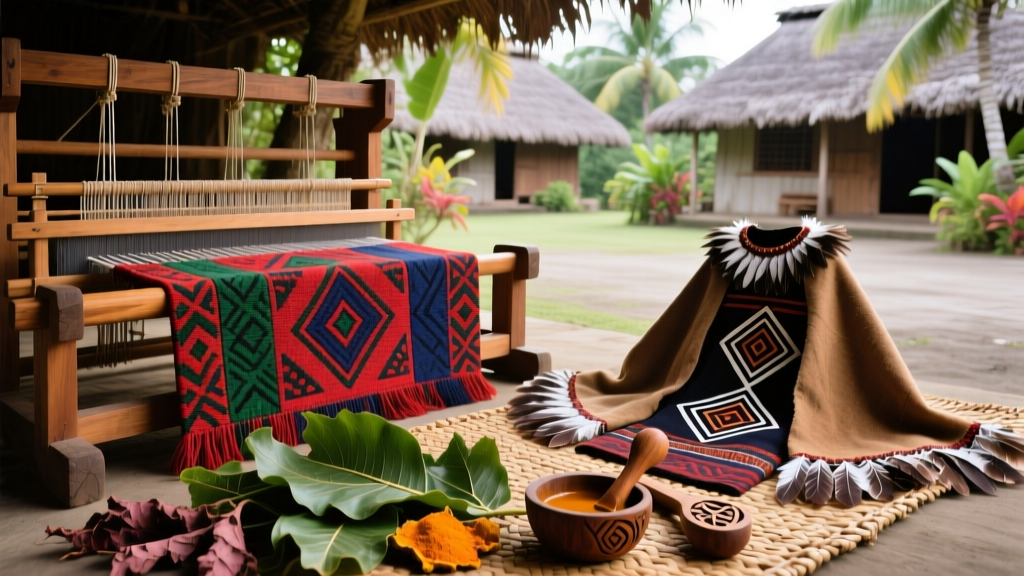
Solomon Islands Malaitan Tapa Painting Tools
Roots of Malaitan Tapa: A Living Tradition in Solomon Islands
Malaitan tapa painting—distinct from the more widely documented Hawaiian kapa or Tongan ngatu—is a deeply localized art form practiced primarily on Malaita Island, the most populous island in the Solomon Islands. Unlike barkcloth traditions elsewhere in Oceania that emphasize beating and layering, Malaitan tapa is defined by its painted surface decoration applied to prepared paper mulberry (Broussonetia papyrifera) or breadfruit (Artocarpus altilis) bark. This practice is not merely decorative; it encodes genealogies, clan affiliations, and ancestral narratives through symbolic motifs such as the lau’u (shark), ma’asina (turtle), and geometric wave patterns representing ocean currents and migration routes.
Natural Materials and Preparation Protocols
The foundation of Malaitan tapa begins with harvesting bark during the wet season—typically between November and April—when sap flow is highest and fibres separate most readily. Harvesters use stone adzes or iron-bladed knives to make precise vertical incisions around mature trees. Bark strips are peeled carefully to avoid tearing, then soaked in freshwater streams for 3–5 days to soften inner phloem layers. After soaking, the outer bark is scraped off using coconut shell scrapers, revealing the pliable inner cambium layer.
Once cleaned, the bark is laid over wooden frames and air-dried for 1–2 weeks under shaded eaves—not direct sun—to prevent brittleness. Drying duration varies by humidity: in Honiara’s coastal climate (average RH 82%), drying takes 14 days, whereas inland at Auki (RH 76%), it may require only 10 days. The resulting sheet measures approximately 1.2–1.8 meters in length and 0.4–0.6 meters in width, with thickness averaging 0.8–1.2 mm after final smoothing.
Plant-Based Pigments and Their Sources
Malaitan painters prepare pigments exclusively from local flora and minerals. Black ink derives from soot collected over burning candlenut (Aleurites moluccanus) oil lamps, mixed with fermented breadfruit sap as binder. Red ochre is mined from specific clay deposits near the Fataleka River, where iron oxide content reaches 68–72% by weight. Yellow pigment comes from turmeric root (Curcuma longa) boiled for 45 minutes, yielding a stable dye with pH-dependent hue shifts between golden-yellow (pH 5.2) and olive-amber (pH 7.8).
Preparation follows strict cultural protocols: only initiated men aged 25 years or older may collect red ochre, and they must fast for one day before extraction. Women traditionally prepare yellow and black pigments but do not handle red ochre—a restriction tied to beliefs about menstrual cycles and ritual purity. These protocols are upheld today at the Kastom Gaden Association in Auki, which documents and teaches intergenerational knowledge transfer.
Tools of the Painter: Precision and Symbolic Weight
Malaitan tapa tools are hand-carved and regionally standardized. The primary painting instrument is the fulu’u, a fine-tipped brush made from the midrib of sago palm fronds, trimmed to 12–15 mm in length and bound with coconut fibre thread. Brushes are replaced every 3–4 sessions due to tip fraying. Secondary tools include:
- Wooden mallets: Carved from ironwood (Intsia bijuga), measuring 28 cm long and weighing 320–350 g, used to gently flatten sheets before painting
- Coconut shell palettes: Sawn from mature coconuts, with interior diameters of 9.5–10.2 cm and depths of 3.8 cm, calibrated to hold exact pigment volumes
- Bamboo rulers: Split and smoothed, marked at 5 cm intervals with charcoal notches, used to align repeated motifs
- Shell scrapers: From giant clam (Tridacna gigas), edges honed to 18–22° bevel angles for controlled surface abrasion
- Fibre stencils: Woven from pandanus leaf strips, 0.3 mm thick, used for repeating border patterns across 1.5-meter lengths
Application Techniques and Spatial Grammar
Painting proceeds from top to bottom and left to right—mirroring the direction of traditional Malaitan oral recitation. Motifs follow a strict spatial hierarchy: central panels (often 45 × 60 cm) depict clan founders; upper borders contain sky-related symbols (e.g., frigatebird, cloud formations); lower borders represent marine realms (e.g., octopus, coral). Each motif occupies a proportional field: shark figures occupy 18–22% of total cloth area, while turtle motifs average 14–16%. Painters use a “three-stroke rule”: no line exceeds three consecutive brush movements without lifting—ensuring rhythmic continuity and spiritual focus.
This discipline is taught at the Solomon Islands National Museum in Honiara, where master practitioners like Francis Kalo conduct biannual workshops. The museum holds 173 documented tapa cloths collected since 1979, including 42 pieces with full provenance records tracing back to specific villages in South Malaita.
Cultural Protocols and Contemporary Stewardship
Malaitan tapa is never created for commercial sale without prior consultation with village chiefs and elders. A cloth intended for ceremonial use—such as a bride’s presentation garment or funeral shroud—requires approval from at least three senior ramo (clan leaders) and must be blessed with coconut oil and sung prayers over two nights. Unauthorized reproduction of sacred motifs, particularly the malu’u (ancestral canoe) design reserved for paramount chiefs, carries social sanctions including temporary exclusion from communal fishing grounds.
These protocols are codified in the Solomon Islands Cultural Heritage Protection Act 2014, which recognizes Malaitan tapa as intangible cultural heritage under Section 7(2)(b). The legislation mandates that digital reproductions of tapa designs held in national archives must carry watermarks indicating originating clan and village—e.g., “Fataleka, Sa’a District” or “Langa Langa Lagoon, Lau Province.”
Institutional Safeguarding Efforts
The Kastom Gaden Association, established in Auki in 1998, maintains a living archive of 86 tool kits—including 23 original fulu’u brushes dating from the 1950s—and coordinates annual tapa-making festivals attended by over 400 participants. Similarly, the University of the South Pacific’s Institute of Pacific Studies in Suva has digitized 112 oral histories from Malaitan elders between 2016 and 2022, preserving technical vocabulary such as la’u fala (cross-hatching technique) and ra’u vava (ritual drying phase).
The Solomon Islands National Museum also partners with the Pacific Arts Association (PAA) to train conservators in non-invasive documentation methods. As noted in their 2021 report, “Tapa Preservation in Melanesia,” humidity-controlled storage at 55% RH and 22°C extends pigment stability by up to 40 years compared to ambient conditions (Solomon Islands National Museum, 2021).
Comparative Context Across Oceania
While Malaitan tapa shares botanical origins with Hawaiian kapa and Samoan siapo, its emphasis on linear narrative painting distinguishes it from the stamped and rubbed motifs dominant in Polynesia. In contrast, Māori kākahu garments rely on woven flax (harakeke) rather than barkcloth, and Torres Strait Islander ceremonial dress features intricate turtle-shell masks and feathered headdresses—not painted cloth. Yet all traditions converge in material ethics: no tree is felled solely for fibre; bark is harvested sustainably, and every scrap is reused—either as compost or secondary wrapping cloth.
“The fulu’u brush is not just a tool—it is the extension of memory. When the tip touches bark, it renews the covenant between ancestor and artist.” — Elder Joseph Vete, Sa’a Village, Malaita (quoted in Pacific Arts Association, 2020)
Measuring Continuity: Data Points Across Practice
Quantitative benchmarks help track both tradition and change. Field surveys conducted by the Solomon Islands Ministry of Culture and Tourism (2023) recorded the following:
- Average age of active tapa painters: 58.3 years (range: 34–81)
- Number of villages in Malaita still practicing full-cycle tapa production: 27 out of 142 surveyed
- Time required to produce one ceremonial cloth (1.5 × 0.5 m): 112–138 hours across 18–22 days
- Pigment shelf life when stored in sealed bamboo tubes: 9–11 months at 24–26°C
- Percentage of young apprentices (under 30) trained since 2015 who continue practice: 63.4% (n = 112)
| Institution | Location | Key Tap-Related Function |
|---|---|---|
| Solomon Islands National Museum | Honiara | Conservation, archival digitization, public workshops |
| Kastom Gaden Association | Auki | Intergenerational training, tool preservation, village-level protocol enforcement |
| University of the South Pacific – Institute of Pacific Studies | Suva | Oral history archiving, academic research, regional curriculum development |
Today, Malaitan tapa continues to serve as both historical record and living identity marker. It appears in national ceremonies—including Independence Day processions—and increasingly in diplomatic gifts presented by the Office of the Governor-General. Its resilience lies not in static replication, but in disciplined adaptation: synthetic binders remain taboo, yet UV-stable archival resins approved by elders now protect museum-held pieces. The tools remain wood, shell, and fibre—but their purpose endures: to make visible what memory holds, and to ensure that visibility remains rooted in place, people, and protocol.
At the Kastom Gaden Association’s workshop space in Auki, apprentice Nelia Folo, age 27, recently completed her first full ceremonial cloth. She measured each motif against the bamboo ruler, mixed red ochre with rainwater collected from her grandfather’s roof, and painted for seven hours straight—observing the three-stroke rule without pause. Her work now hangs in the Solomon Islands National Museum’s “Living Kastom” gallery, accession number SI-NM-2024-089, alongside notes affirming its origin: “Made in Sa’a, South Malaita, under guidance of Ramo Sione Ta’ale, July 2024.”
This continuity is neither accidental nor automatic. It is sustained by daily choices—to harvest at the right moon phase, to speak the correct words while mixing pigment, to sit cross-legged on the same mat as one’s great-grandfather did. In every stroke of the fulu’u, Malaita remembers itself.