Traditional Leather Tanning Craftsmanship: A Living Heritage
Long before synthetic materials & mass production redefined the fashion landscape, leather stood as one of humanity's most essential & revered materials. The transformation of raw animal hides into supple, durable leather is a craft that stretches back thousands of years — an alchemy of patience, knowledge, & deep respect for natural processes. Traditional leather tanning is not merely a technical procedure; it is a cultural inheritance passed down through generations of artisans whose hands have shaped the very garments, accessories, & goods that civilizations have depended upon.
From the sun-drenched tanneries of Fez, Morocco, to the oak-bark pits of rural England & the chestnut-tanned workshops of Tuscany, traditional leather tanning represents a convergence of chemistry, artistry, & cultural identity. Today, as the world increasingly values sustainability & authentic craftsmanship, these time-honored methods are experiencing a renaissance — not as relics of the past, but as vital, living practices that continue to produce some of the finest leathers known to humankind.
In this comprehensive exploration, we trace the heritage of traditional leather tanning craftsmanship, examining its cultural significance, the meticulous techniques involved, regional variations that define distinct leather-working traditions, & the modern efforts to preserve this irreplaceable art form.
The Ancient Roots & Cultural Significance of Leather Tanning
The story of leather tanning is inseparable from the story of human civilization itself. Archaeological evidence suggests that our ancestors were working with animal hides as far back as the Paleolithic era, using simple methods of scraping, stretching, & treating skins with animal fats & smoke to create protective coverings. However, it was the discovery of tanning — the chemical process of converting perishable raw hide into a stable, non-decomposing material — that truly revolutionized humanity's relationship with leather.
Ancient Egypt provides some of the earliest documented evidence of organized leather tanning. Tomb paintings depict tanners at work along the banks of the Nile, processing hides using a combination of alum, plant extracts, & animal brains. Leather was used extensively for sandals, military equipment, chariot harnesses, & ceremonial items, reflecting its status as both a practical & prestigious material. The Egyptians understood that properly tanned leather could withstand the harsh desert climate, making it indispensable for daily life.
In ancient Rome, the tanning trade was organized into collegia — professional guilds that regulated quality, trained apprentices, & maintained standards across the empire. Roman tanners supplied the legions with armor, shields, sandals (caligae), & saddlery, making the craft strategically vital. The Latin word for tanner, coriarius, appears frequently in inscriptions across the Roman world, testament to the profession's widespread importance.
Across the medieval Islamic world, leather tanning reached extraordinary heights of sophistication. The great tanneries of Córdoba in Al-Andalus (medieval Spain) produced cordovan leather so refined that it became a luxury export across Europe & the Mediterranean. The word "cordovan" itself derives from this city, & the technique of creating this exceptionally smooth, durable leather from horsehide remains one of the most celebrated achievements in tanning history. Similarly, Moroccan leather goods — particularly those from Fez & Marrakech — were traded across the Sahara & into Europe, prized for their quality, color, & craftsmanship.
In many cultures, tanning held spiritual & symbolic dimensions. Among various Indigenous peoples of North America, the brain-tanning of deer hides was accompanied by rituals of gratitude toward the animal, reflecting a worldview in which every part of the creature was honored & utilized. In parts of West Africa, leather workers belonged to specific castes whose knowledge of tanning & leatherworking was considered a sacred inheritance, guarded & transmitted within families across centuries.
The cultural significance of leather tanning extends into language & metaphor. The English word "tanner" for a sixpence coin, the phrase "having a thick hide," & countless other expressions reveal how deeply leather-working has embedded itself in human consciousness. To understand traditional tanning is to understand a fundamental thread of our shared cultural heritage.
The Craftsmanship: Techniques, Tools & the Art of Transformation
Traditional leather tanning is a multi-stage process that demands considerable skill, physical endurance, & an intimate understanding of organic chemistry — even if the tanners of centuries past would not have described their knowledge in those terms. Each step must be executed with precision, as errors at any stage can compromise the quality of the final leather irreparably.
Preparation: From Raw Hide to Tanning-Ready Skin
The journey begins with the raw hide, which must be preserved as quickly as possible after the animal is processed. Historically, this meant salting or drying the hides to prevent decomposition before they could reach the tannery. Upon arrival, the hides undergo soaking in large vats of water, often for several days, to rehydrate them & remove dirt, salt, & blood.
Next comes liming, a process in which the hides are immersed in a solution of water & calcium hydroxide (slaked lime). This alkaline bath loosens the hair, opens up the collagen fibers in the skin, & begins breaking down unwanted proteins. The hides may remain in the lime pits for one to two weeks, during which time the tanner must monitor them carefully, turning them regularly to ensure even treatment.
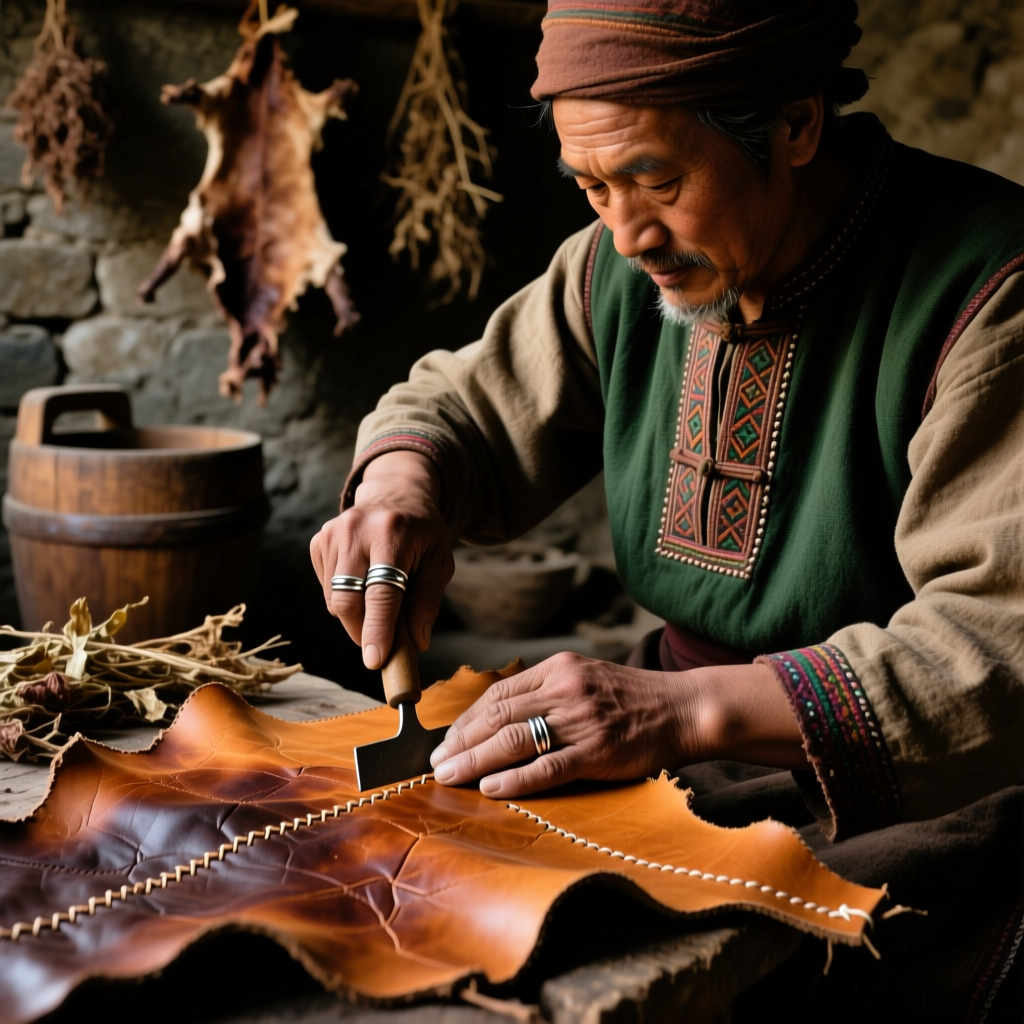
After liming, the hides are unhaired — traditionally done by hand using a curved, two-handled knife called a scudder or beam knife, worked over a sloping wooden beam. This physically demanding task requires a practiced touch: too much pressure can damage the grain of the leather, while too little leaves hair & epidermal tissue behind. The fleshing process follows, removing residual fat & tissue from the underside of the hide using similar tools.
Deliming & bating prepare the hides for the actual tanning process. Deliming neutralizes the alkalinity introduced during liming, often using fermented bran solutions or, in some traditions, dog or bird dung — a practice that, while unappealing to modern sensibilities, contains enzymes perfectly suited to the task. Bating further softens the hides & refines the fiber structure, contributing to the suppleness of the finished leather.
The Tanning Process: Vegetable Tanning & Beyond
The heart of traditional tanning lies in the tanning agents — the substances that chemically bond with the collagen fibers of the hide, rendering them resistant to water, heat, & bacterial decay. In traditional craftsmanship, these agents are almost always derived from natural, plant-based sources, giving rise to the term vegetable tanning.
The most important tanning agents are tannins — polyphenolic compounds found in the bark, wood, leaves, fruits, & roots of various plants. Different regions historically relied on locally available sources:
- Oak bark — widely used across Europe, particularly in England, France, & Germany, producing firm, durable leather with a warm, pale brown color
- Chestnut wood — favored in Italy & parts of southern Europe, yielding a slightly reddish-toned leather prized for its strength & workability
- Quebracho — extracted from the heartwood of South American quebracho trees, producing rich, dark leather with excellent water resistance
- Sumac — used extensively in the Middle East & North Africa, particularly for softer, more flexible leathers suited to bookbinding & fine goods
- Mimosa bark — common in parts of Africa & Australia, yielding a pinkish-toned leather with good filling properties
- Valonia — derived from the acorn cups of the valonia oak, historically used in Turkey & the eastern Mediterranean for producing high-quality sole leather
In a traditional vegetable-tanning pit, hides are layered with ground bark or other tanning materials in large stone or wooden pits, then flooded with water. This pit tanning method is extraordinarily slow — it can take anywhere from several months to over a year for the tannins to fully penetrate thick hides. The tanner must periodically check the progress, rearrange the hides, & replenish the tanning liquor. This patience is what gives vegetable-tanned leather its distinctive character: a firm yet supple hand, a natural patina that deepens with age, & an aroma that is earthy, warm, & unmistakable.
An alternative traditional method is alum tanning (also called tawing), which uses aluminum salts — typically potassium alum — often combined with salt, flour, & egg yolks. This produces a white, very soft & pliable leather that was historically used for gloves, bookbinding, & luxury garments. Unlike vegetable-tanned leather, alum-tawed leather is not technically "tanned" in the strictest chemical sense, as the alum bonds are reversible in water, but the tradition is ancient & the results are distinctive & beautiful.
Oil tanning (or chamoising) is another traditional technique, in which the hides are impregnated with fish oils or other unsaturated fats through prolonged mechanical working — traditionally by pounding or stretching the leather while it absorbs the oil. This produces an exceptionally soft, washable, & absorbent leather known as chamois, prized for its use in gloves, polishing cloths, & certain types of garments.
Finishing: Where Craft Becomes Art
Once tanned, the leather undergoes a series of finishing processes that determine its final appearance, texture, & suitability for specific uses. Sammying (partial drying), staking (mechanical softening & stretching), & setting out (smoothing the grain) prepare the leather for its final treatments.
Traditional finishing techniques include hand currying, in which oils & waxes are worked into the leather by hand to enhance suppleness & water resistance; board staking, which develops a fine grain pattern; & hand dyeing using natural dyes derived from plants, insects, & minerals. The deep reds of cochineal, the rich browns of walnut husks, the blacks of iron-mordanted logwood — these natural colorants give traditionally finished leathers a depth & complexity that synthetic dyes struggle to replicate.
For those interested in how these leathers translate into finished garments & accessories, our leather jacket guide explores how different tanning methods affect the character, drape, & aging of leather outerwear.
Regional Variations: A World of Leather-Working Traditions
One of the most remarkable aspects of traditional leather tanning is the extraordinary diversity of techniques, tools, & aesthetic traditions that have developed across different regions. Geography, available plant materials, climate, cultural preferences, & trade patterns have all shaped distinct leather-working identities that remain recognizable today.
The Mediterranean Basin: Cradle of Refined Leather
The Mediterranean region boasts perhaps the richest & most continuous tradition of leather tanning in the world. In Tuscany, Italy, the conceria (tannery) districts of Santa Croce sull'Arno & Ponte a Egola have been centers of vegetable tanning for centuries. Tuscan tanners developed a distinctive approach using chestnut & quebracho tannins, producing a leather known as vacchetta — a full-grain, vegetable-tanned cowhide that is firm, beautifully grained, & develops an extraordinary patina over time. This leather is the foundation of many of the world's finest bags, belts, shoes, & accessories. The Consorzio Vera Pelle Italiana Conciata al Vegetale (Consortium of Genuine Italian Vegetable-Tanned Leather) continues to certify & protect this tradition.
In Morocco, the ancient tanneries of Fez — particularly the famous Chouara Tannery — represent one of the most visually spectacular & historically significant leather-working sites in the world. Here, hides are processed in hundreds of stone vessels arranged in a honeycomb pattern, each filled with different natural substances: pigeon droppings for softening, poppy for red dye, indigo for blue, henna for orange, cedar wood for brown. The tanners work barefoot in the vats, their knowledge passed from father to son across countless generations. Moroccan leather is renowned for its vibrant colors, intricate tooling, & use in everything from babouche slippers to elaborately embossed poufs & book covers. Explore our Moroccan textile traditions article for more on the region's rich material culture.
Spain's legacy of cordovan leather, centered historically in Córdoba, represents a pinnacle of tanning artistry. True cordovan — made from the fibrous shell beneath a horse's rump — is tanned, stuffed with oils & waxes, & polished by hand over a period of months to produce a leather of extraordinary smoothness, durability, & a characteristic lustrous glow. Today, a handful of tanneries, most notably in the United States & Japan, continue to produce cordovan using methods closely related to the original Spanish techniques.
British & Northern European Traditions
In England, oak-bark tanning was for centuries the dominant method, producing the firm, pale leather used for saddlery, footwear, bookbinding, & heavy-duty goods. The tanning pits of Bermondsey in London were once so numerous that the area was known as the leather district of the empire. Today, a small number of traditional oak-bark tanneries survive in the West Country — particularly in Devon & Somerset — where they continue to use the same pit-tanning methods, with hides spending up to fourteen months in pits layered with oak bark sourced from local coppiced woodlands. The resulting leather is exceptionally strong, naturally water-resistant, & highly prized by bespoke shoemakers & saddlers.
In Scandinavia, traditional leather working intersected with Sami culture, where reindeer hides were tanned using birch bark & fish oil, producing soft, warm leathers ideally suited to Arctic conditions. Sami leather craftsmanship — including distinctive tin-thread embroidery on leather — remains a vibrant cultural tradition. Learn more about northern heritage in our Nordic wool traditions article.
Asian Leather-Working Heritage
In India, the city of Kanpur (historically Cawnpore) became one of the world's great leather-working centers during the colonial era, though indigenous tanning traditions predate European influence by millennia. Traditional Indian tanning made extensive use of myrobalan (the fruit of the Terminalia chebula tree), babul bark, & other local tanning agents. The chamar community, historically associated with leather working, developed sophisticated techniques for producing everything from heavy buffalo-hide leather for agricultural use to fine goatskin for bookbinding & luxury goods. Indian vegetable-tanned leather, particularly from the Tamil Nadu region, is known for its distinctive character & is increasingly sought after by international designers.
Japan has a remarkable but often overlooked leather-working tradition. Japanese tanners historically used a combination of rice bran, persimmon juice (kakishibu), & rapeseed oil to produce distinctive leathers. The indigo-dyed leather tradition, particularly associated with the Tokushima region, produces leather of extraordinary beauty — the deep blue of natural indigo contrasting with the warm tones of the leather itself. Japanese craftsmanship in leather goods, from sword scabbards to tobacco pouches to contemporary bags, reflects the same meticulous attention to detail found in other Japanese artisanal traditions.
Our Japanese indigo dyeing heritage article explores the complementary tradition of natural dyeing that often intersects with leather craftsmanship.
Modern Preservation: Keeping the Tradition Alive
The twentieth century brought profound challenges to traditional leather tanning. The invention of chrome tanning — a process using chromium salts that can convert hides into leather in a matter of hours rather than months — revolutionized the industry. Chrome-tanned leather is softer, more water-resistant, & can be dyed in a wider range of colors, making it ideal for many modern applications. Today, approximately eighty to ninety percent of the world's leather is chrome-tanned. While chrome tanning has its place, its dominance has pushed traditional vegetable tanning to the margins of the industry.
The environmental consequences of industrial chrome tanning have also become a significant concern. Improper disposal of chromium-laden wastewater has caused serious pollution in leather-producing regions around the world. Ironically, this environmental reckoning has contributed to renewed interest in vegetable tanning, which — when practiced responsibly — uses natural, biodegradable materials & produces waste that is far less harmful to ecosystems.
The Artisanal Revival
Across the globe, a growing movement of artisans, designers, & consumers is championing traditional leather tanning as both a cultural treasure & a sustainable alternative to industrial methods. This revival is driven by several converging trends:
Slow fashion & conscious consumption have created a market for garments & accessories that are made to last, that age beautifully, & that carry a story of craftsmanship & provenance. Vegetable-tanned leather, with its natural patina & exceptional durability, is perfectly suited to this ethos. A well-made vegetable-tanned leather bag or pair of shoes can last decades, developing character & beauty with each passing year — a stark contrast to the disposable nature of fast fashion. Our capsule wardrobe guide explores how investing in quality leather pieces supports a more intentional approach to dressing.
Cultural heritage organizations & artisan cooperatives are working to document, preserve, & transmit traditional tanning knowledge. UNESCO has recognized several leather-related traditions as elements of intangible cultural heritage. In Morocco, restoration efforts at the Fez tanneries aim to preserve both the physical infrastructure & the artisanal knowledge embedded in these ancient workshops. In Italy, the aforementioned consortium ensures that certified vegetable-tanned leather meets strict standards of quality & traditional production.
Educational initiatives are training a new generation of tanners. Organizations like the Leather Conservation Centre in the United Kingdom & various artisanal schools in Italy & Japan offer courses in traditional tanning & leather-working techniques. These programs attract not only aspiring professionals but also designers, conservators, & enthusiasts eager to understand the material they work with at a deeper level.
Collaborations between traditional tanneries & contemporary designers are creating exciting new applications for heritage leathers. Luxury fashion houses increasingly highlight their use of vegetable-tanned leather as a mark of quality & ethical production. Small-batch leather goods makers — from Portland to Tokyo to Copenhagen — seek out traditional tanneries as suppliers, valuing the unique character & story that these leathers bring to their products.
Challenges & the Path Forward
Despite the encouraging signs of revival, traditional leather tanning faces ongoing challenges. The cost of vegetable-tanned leather is significantly higher than chrome-tanned alternatives, reflecting the time, labor, & materials involved. Finding skilled artisans willing to undertake the physically demanding & often malodorous work of traditional tanning is increasingly difficult, particularly in regions where younger generations have other economic opportunities.
Climate change poses an additional threat. Many traditional tanning agents depend on specific plant species whose growth patterns are being disrupted by changing temperatures & rainfall. Oak bark, chestnut wood, & other botanical sources require sustainable forestry management to ensure their continued availability — a challenge that intersects with broader environmental concerns.
Yet the resilience of this craft, which has survived the rise & fall of empires, industrial revolutions, & sweeping cultural transformations, suggests that it will endure. The key lies in finding a balance: honoring the knowledge & practices of the past while adapting to the needs & values of the present. Traditional leather tanning is not a museum artifact — it is a living, breathing craft that continues to produce materials of unmatched quality, beauty, & integrity.
For those who wear, carry, or cherish leather goods made through these time-honored methods, there is a profound connection to the artisans whose hands shaped the material, to the landscapes that provided the tanning agents, & to the unbroken chain of knowledge that stretches back to the very dawn of human civilization. In every crease, every shade of patina, every subtle variation of texture, traditional leather tells a story — one that we are still writing. Discover more about heritage materials in our heritage collection & explore our complete garment guides for practical advice on selecting & caring for traditionally crafted pieces.
Frequently Asked Questions
What is the difference between vegetable tanning & chrome tanning?
Vegetable tanning uses natural tannins extracted from plant materials — such as oak bark, chestnut wood, & quebracho — to convert raw hides into leather. This process is slow, typically taking several weeks to over a year, & produces firm, durable leather with a natural color that develops a rich patina over time. Chrome tanning, developed in the mid-nineteenth century, uses chromium salts & can produce leather in a matter of hours. Chrome-tanned leather is generally softer, more water-resistant, & can be dyed in brighter colors, but it lacks the natural aging characteristics of vegetable-tanned leather & raises environmental concerns related to heavy metal pollution. Vegetable tanning is considered the more traditional, sustainable, & artisanal method.
How can I identify genuine vegetable-tanned leather?
Genuine vegetable-tanned leather has several distinctive characteristics. It typically has a natural, pale tan or cream color when new (unless dyed), a firm & substantial hand-feel, & a warm, earthy aroma that is immediately recognizable. When you press your fingernail lightly into the surface, it should leave a mark that gradually fades — this is because vegetable-tanned leather is more responsive to pressure & develops character through use. The edges of cut vegetable-tanned leather will show a consistent color through the cross-section, unlike some chrome-tanned leathers that may have a blueish or greyish core. Reputable sellers should be able to provide information about the tannery & tanning method. Look for certifications such as the Italian Pelle Conciata al Vegetale mark or equivalent regional designations.
Why does vegetable-tanned leather change color over time?
The color change — commonly called patina — is one of the most celebrated qualities of vegetable-tanned leather. It occurs because the natural tannins in the leather react with light, moisture, oils from handling, & environmental exposure over time. This oxidation process gradually deepens the leather's color from its original pale tone to richer amber, honey, & eventually deep brown shades. The patina is not uniform; areas that receive more handling, sunlight, or moisture will darken faster, creating a unique, personalized appearance that reflects how the item has been used. This living quality is precisely why vegetable-tanned leather is so valued by enthusiasts — no two items will age in exactly the same way, making each piece truly one-of-a-kind.
Are traditional tanneries environmentally friendly compared to modern ones?
When practiced responsibly, traditional vegetable tanning is considerably more environmentally friendly than industrial chrome tanning. The tanning agents are natural, biodegradable plant materials, & the wastewater produced does not contain heavy metals or other persistent pollutants. Many traditional tanneries also practice sustainable sourcing of their tanning materials — for example, using bark from coppiced woodlands, a practice that actually promotes healthy forest management. However, traditional tanning is not without environmental impact: it requires significant amounts of water & energy, & some traditional processes (such as the use of lime & certain organic substances) require proper waste management. The key distinction is that the environmental footprint of traditional tanning is generally local, manageable, & biodegradable, whereas industrial chrome tanning can produce toxic waste that persists in ecosystems for generations.
How should I care for vegetable-tanned leather garments & accessories?
Caring for vegetable-tanned leather requires a gentle, minimalist approach that respects the natural character of the material. Avoid prolonged exposure to water, as vegetable-tanned leather is more susceptible to water staining than chrome-tanned varieties. If the leather gets wet, allow it to dry naturally at room temperature — never use direct heat. Periodic conditioning with a high-quality leather balm or cream (preferably one containing natural ingredients like beeswax, lanolin, or neatsfoot oil) will help maintain suppleness & prevent drying. Apply conditioner sparingly & evenly, allowing it to absorb fully before use. Store leather items in a cool, dry place with good air circulation, & avoid plastic covers that can trap moisture. For leather garments such as jackets & coats, our leather care guide provides detailed seasonal maintenance advice. Remember that minor scratches, stains, & color variations are not defects — they are part of the leather's natural story & contribute to its developing patina.