Phulkari Embroidery: The Living Heritage of Punjab's Floral Textile Art
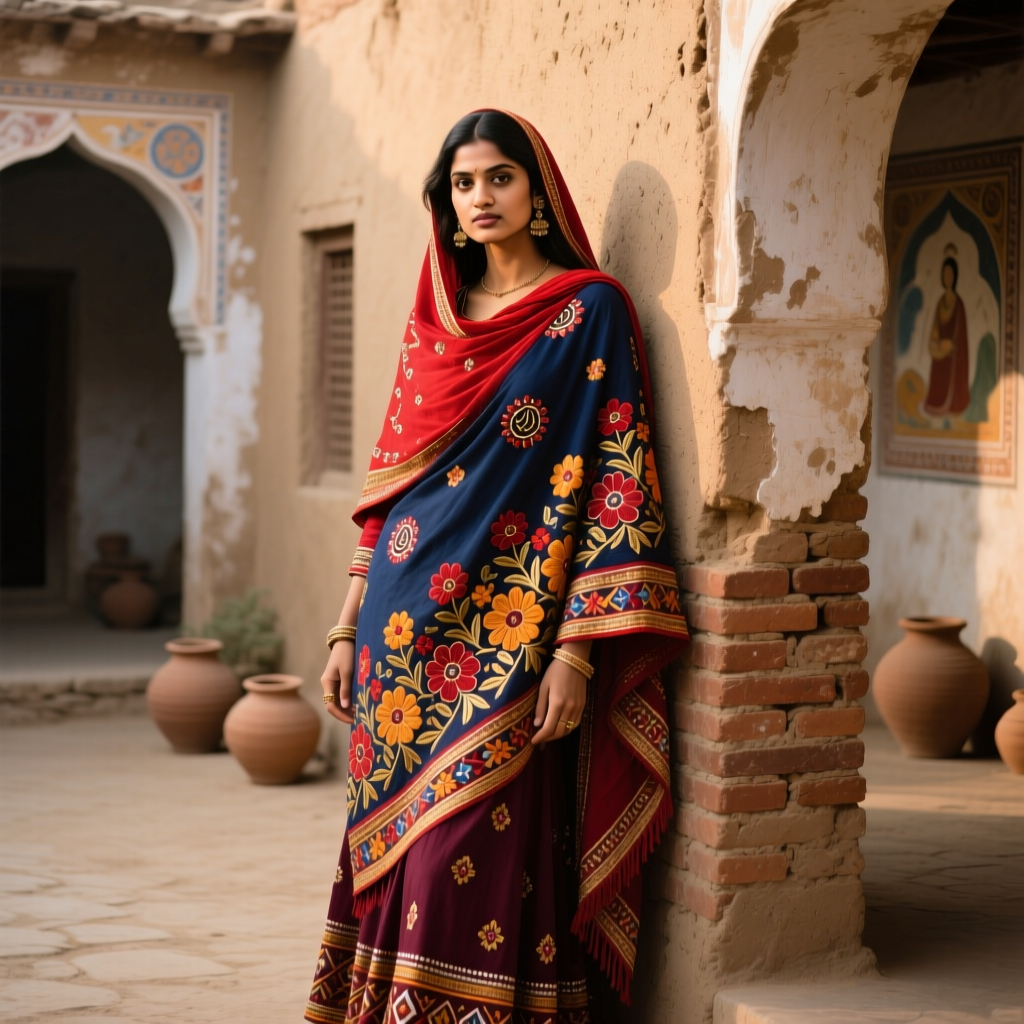
Before dawn breaks over the villages of Punjab, you might still find women sitting on charpoys in their courtyards, needles threading silk floss through handspun cotton. They are practicing an art form whose name translates simply to "flower work" — Phulkari — yet whose complexity, symbolism, and emotional depth could fill volumes. For centuries, this embroidery tradition has served as far more than decoration. It has been a language of love, a rite of passage, a dowry treasure, and a spiritual practice woven into the very fabric of Punjabi life.
Phulkari embroidery represents one of the most significant textile traditions to emerge from the Indian subcontinent. Born in the agrarian communities of undivided Punjab — a region now split between modern-day India & Pakistan — this craft transformed plain handwoven cloth into breathtaking tapestries of geometric pattern, floral motif, and narrative scene. Unlike many embroidery traditions that were practiced by professional artisans for royal courts, Phulkari was fundamentally a domestic art, created by women for their families, their daughters, and their communities. Every stitch carried intention. Every piece told a story.
To understand Phulkari is to understand the social history of Punjab itself — its harvests, its festivals, its weddings, its partition, and its enduring resilience. This article explores the deep roots of this extraordinary craft, tracing its journey from village courtyards to global fashion runways while examining why its preservation matters more than ever.
Origins & Historical Roots: Tracing Phulkari Through the Centuries
The precise origins of Phulkari embroidery remain shrouded in the mists of time, as is common with folk arts transmitted orally and through practice rather than written record. However, most textile historians trace its earliest references to the 15th century, with some scholars suggesting even earlier roots. The word "Phulkari" appears in the writings of the Sufi saint Sheikh Farid, who lived in the 13th century, using the metaphor of floral embroidery to describe spiritual devotion — suggesting the craft was already well-established enough to serve as poetic imagery.
During the Mughal period, references to Phulkari become more frequent in historical accounts. Emperor Babur's memoirs mention the fine cotton textiles of Punjab, and later Mughal records describe embroidered fabrics produced in the region. However, Phulkari remained largely untouched by courtly patronage. It thrived instead in the rural heartland, where women of farming communities — particularly among the Jat, Arain, & Gujjar castes — developed the art as part of domestic life.
The tradition was deeply embedded in the lifecycle of Punjabi women. A grandmother would begin embroidering a Phulkari the day a granddaughter was born, working on it for years until the child's wedding. These pieces became part of the bride's dowry, often numbering in the dozens for affluent families. The most elaborate Phulkari — known as Bagh (meaning "garden") — featured embroidery so dense that the base fabric was entirely concealed, creating a shimmering surface of silk thread that caught the light with every movement.
The 19th century saw Phulkari reach new heights of production & artistic refinement. British colonial administrators & travelers began collecting Phulkari pieces, recognizing their artistic merit. Museums in London, Philadelphia, & other Western cities acquired significant collections during this period. Ironically, it was often foreign collectors who first documented & cataloged Phulkari styles with systematic attention, even as the tradition continued to flourish organically in Punjabi villages.
The Partition of 1947 dealt a devastating blow to Phulkari's continuity. As millions were displaced across the newly drawn borders between India & Pakistan, countless heirloom pieces were lost, destroyed, or abandoned. Families who had preserved Phulkari for generations found themselves fleeing with only what they could carry. The communal knowledge embedded in specific regional styles was fractured as communities scattered. Yet remarkably, the tradition survived — carried forward by women who remembered the patterns, the stitches, & the songs they sang while embroidering.
Cultural Significance & Symbolism: More Than Mere Decoration
To call Phulkari embroidery "decorative" is to profoundly misunderstand its purpose within Punjabi culture. Each Phulkari piece was created for a specific occasion, carried specific meanings, & functioned within a complex system of cultural communication. The embroidery served as a visual language through which women expressed hopes, blessings, social status, & spiritual beliefs.
The Ritual Life of Phulkari
The most significant Phulkari pieces were created for weddings. A bride's trousseau typically included multiple Phulkari odhnis (draping garments), each designated for different wedding ceremonies. The Chope — a large Phulkari presented to the bride by her maternal grandmother or uncle — held particular ritual importance. Traditionally embroidered in red & gold on white khaddar (handspun cotton), the Chope was draped around the bride during key wedding rituals, serving as both blessing & protection.
Beyond weddings, specific Phulkari styles were associated with different occasions & seasons. The Thirma Phulkari, worked in white thread on white fabric, was worn by older women & widows, its subdued palette reflecting a different stage of life. Sainchi Phulkari, featuring figurative scenes of rural life — women churning butter, peacocks dancing, wrestlers grappling — served as narrative textiles that documented the rhythms of village existence.
Color Symbolism & Spiritual Dimensions
Color in Phulkari was never arbitrary. Red, the most auspicious & prevalent color, symbolized youth, fertility, passion, & the life force. It was the dominant color for wedding Phulkari & pieces created for young women. Orange & saffron represented spiritual devotion & the warrior spirit of the Sikh faith. Blue, while less common, was associated with the sky & the infinite. White signified maturity & wisdom, while green represented the natural world & agricultural abundance.
Many scholars have noted the spiritual dimension of Phulkari practice. The repetitive, meditative nature of the stitching — performed during quiet hours, often accompanied by devotional singing — bore similarities to prayer or contemplation. Some researchers have drawn parallels between Phulkari's geometric patterns & the sacred geometry found in Islamic art & Sikh religious architecture. The act of creating beauty through patient, disciplined handwork was itself understood as a form of devotion.
Social & Economic Dimensions
Phulkari also functioned within complex social & economic systems. The quality, quantity, & complexity of a family's Phulkari collection signaled social standing within the community. Women who created exceptional pieces earned respect & admiration. The exchange of Phulkari between families during marriages cemented social bonds & obligations. In many ways, a woman's Phulkari collection represented her personal wealth — assets she could rely upon in times of need.
For those interested in how embroidered textiles function within broader cultural dress traditions, our heritage textile collection explores similar traditions from around the world, each carrying its own unique symbolism & social significance.
The Art of Craftsmanship: Techniques, Materials & the Patient Hand
The creation of authentic Phulkari embroidery demands extraordinary skill, patience, & an intuitive understanding of geometry & color that is developed over years of practice. Unlike many embroidery traditions that rely on traced patterns or printed guides, traditional Phulkari was worked entirely from memory & imagination, with the embroiderer counting threads in the base fabric to ensure precise, symmetrical patterns.
The Foundation: Khaddar Cloth
Traditional Phulkari was always worked on khaddar — a handspun, handwoven cotton fabric with a distinctive coarse texture. The khaddar's relatively open weave was essential to the Phulkari technique, as the embroiderer counted the fabric's warp & weft threads to position each stitch with mathematical precision. The fabric was typically produced in narrow strips on pit looms, requiring multiple panels to be joined together for larger pieces like odhnis.
The quality of the khaddar varied by region & economic means. Finer, more tightly woven khaddar was prized for its durability & the greater detail it allowed in embroidery work. The fabric was usually dyed before embroidery began, with deep red being the most common base color for wedding pieces, while white, blue, & black served as foundations for other styles.
The Thread: Pat (Silk Floss)
The embroidery thread used in Phulkari — known as pat — was traditionally untwisted silk floss imported from Afghanistan, Bengal, or China. This silk had a luminous, reflective quality that gave finished Phulkari its characteristic shimmer. The thread was dyed locally using both natural & synthetic dyes, with the vibrant oranges, reds, yellows, & greens of Phulkari silk being one of the craft's most recognizable features.
The untwisted nature of the silk floss presented unique challenges. It was delicate, prone to snagging, & required careful handling. Experienced Phulkari workers developed techniques for managing the silk — winding it in specific ways, working with shorter lengths, & developing a light touch that prevented the thread from fraying or breaking.
The Signature Stitch: Darning from the Reverse
The defining technical characteristic of Phulkari is that the primary stitch — a long darning stitch — is worked from the reverse side of the fabric. This means the embroiderer creates the pattern on the front without being able to see it directly, working entirely by counting threads & visualizing the design from its back. This technique requires remarkable spatial reasoning & confidence, as a single miscounted thread can disrupt the symmetry of complex geometric patterns.
The darning stitch in Phulkari creates a distinctive visual effect. On the front (right side) of the fabric, the long silk stitches catch & reflect light, creating a shimmering surface. On the reverse side, only tiny stitch points are visible, making the fabric comfortable against the skin. This practical consideration — ensuring comfort while maximizing visual impact — reflects the thoughtful engineering embedded in folk textile traditions.
Beyond the basic darning stitch, Phulkari artisans employed several supplementary stitches. The holbein stitch (double running stitch) was used for outlining & creating fine linear details. Buttonhole stitch appeared in some regional variations, particularly in pieces from the Hazara region. Small mirrors (shisha) were occasionally incorporated, especially in pieces from western Punjab.
Pattern Construction & Design Vocabulary
Phulkari patterns are predominantly geometric, built from diamonds, triangles, squares, & variations thereof. However, within this geometric framework, artisans created an astonishing range of motifs: stylized flowers, wheat stalks, peacocks, elephants, scorpions, & abstract forms that resist easy categorization. The best Phulkari designs achieve a dynamic tension between order & variety — the underlying geometry provides structure while the specific arrangement of color & motif creates visual interest & movement.
Master Phulkari embroiderers often spoke of their designs in musical terms, describing how colors & patterns should create rhythm, harmony, & variation much like a composition. This synesthetic understanding of design — where visual pattern relates to musical structure — reflects the integrated artistic sensibility of rural Punjabi culture, where embroidery, song, poetry, & dance were understood as interconnected expressions of creativity.
If you are fascinated by handcrafted textile techniques, our guide to understanding handloom fabrics provides further context on the materials that form the foundation of heritage crafts like Phulkari.
Regional Variations: A Geography of Stitch & Color
While Phulkari embroidery was practiced throughout Punjab, distinct regional styles developed over centuries, each reflecting local aesthetic preferences, available materials, & cultural influences. Understanding these variations reveals how a single textile tradition can diversify across geography while maintaining a recognizable identity.
Eastern Punjab (India): Charkhi, Bagh & Beyond
In the eastern districts of Punjab — particularly around Patiala, Amritsar, Jalandhar, & Ludhiana — Phulkari developed with certain distinctive characteristics. The Bagh style, where embroidery covers the entire base fabric, was particularly associated with this region. Bagh pieces from Patiala & nearby areas often featured complex interlocking geometric patterns in multiple colors, with the base cloth completely invisible beneath the dense silk stitching.
The Charkhi style, named for its characteristic motif resembling a spinning wheel, was popular in the Amritsar region. These pieces often featured bold, radiating patterns that created a sense of dynamic movement. The Phulkari of the Malwa region tended toward larger, bolder motifs with strong color contrasts, while pieces from the Doaba area (between the Beas & Sutlej rivers) often displayed finer, more intricate patterns.
Western Punjab (Pakistan): Hazara & Multani Influences
In western Punjab — now part of Pakistan — Phulkari styles showed influences from neighboring regions & communities. The Hazara region developed a particularly distinctive style, incorporating elements from the embroidery traditions of the North-West Frontier. Hazara Phulkari often featured more figurative elements, including human figures, animals, & narrative scenes, alongside the geometric patterns common throughout Punjab.
The influence of Multani (Multan-region) textile traditions was visible in some western Punjab Phulkari, particularly in the use of certain color combinations & the incorporation of mirrorwork. These cross-cultural exchanges reflect Punjab's historical position as a corridor between Central Asia, the Iranian plateau, & the Indian heartland — a meeting point where textile traditions blended & enriched each other.
The Sainchi Tradition: Narrative Phulkari
One of the most remarkable regional variations was the Saincha Phulkari tradition, primarily associated with southeastern Punjab (around Ferozepur, Bathinda, & Faridkot). Unlike the predominantly geometric Phulkari of other regions, Saincha pieces featured elaborate figurative scenes depicting rural life, folklore, & contemporary events. Women embroidering Saincha Phulkari documented the world around them: farmers plowing fields, soldiers marching, trains arriving at stations, even scenes from popular cinema.
These narrative Phulkari pieces serve as invaluable historical documents, offering insights into how rural Punjabi women perceived & recorded the social changes around them. A Saincha Phulkari might depict a traditional bullock cart alongside a motorcar, or show a village woman carrying water beside a figure in European dress — visual records of a society in transition, rendered in silk thread on cotton cloth.
Contemporary Regional Practice
Today, while traditional regional distinctions have blurred somewhat due to migration, urbanization, & commercial production, certain areas remain known for specific Phulkari styles. In Indian Punjab, the cities of Patiala & Amritsar continue to be centers of Phulkari production, though much of this work is now commercial rather than domestic. In Pakistani Punjab, efforts to revive traditional Phulkari have centered around Multan & Lahore, where craft organizations have worked to preserve & document regional techniques.
For readers interested in how regional textile traditions compare across cultures, our exploration of global heritage textiles examines similar craft traditions from diverse communities worldwide, each shaped by its own geography & cultural context.
Modern Preservation & Revival: Keeping the Thread Unbroken
Like many traditional crafts worldwide, Phulkari embroidery faced existential threats in the latter half of the twentieth century. Industrialization, changing social patterns, the declining practice of hand-spinning & hand-weaving, & shifting aesthetic preferences all contributed to a decline in traditional Phulkari production. Fewer young women learned the craft from their elders, & the domestic context in which Phulkari had flourished — extended families living in village communities with time for leisurely handwork — was rapidly disappearing.
The Commercialization Paradox
Paradoxically, the same forces that threatened traditional Phulkari also created new opportunities for its survival. As global interest in handcrafted textiles grew, Phulkari began appearing in new contexts: fashion runways, home décor, accessories, & contemporary art. Designers both within & outside India began incorporating Phulkari motifs & techniques into modern products, from haute couture gowns to cushion covers.
This commercialization has been a double-edged sword. On one hand, it has provided economic opportunities for embroiderers & kept the basic techniques alive. On the other, much commercially produced "Phulkari" bears only a superficial resemblance to the traditional craft. Machine embroidery mimicking Phulkari patterns, synthetic threads replacing silk floss, & polyester fabrics substituting for handspun khaddar have created a market flooded with inferior imitations that undermine both the aesthetic integrity & the economic viability of authentic Phulkari work.
Grassroots Preservation Movements
Some of the most effective Phulkari preservation efforts have emerged from grassroots organizations & individual activists. In Indian Punjab, organizations like the Punjab Kala Kendra & various women's cooperatives have worked to document traditional patterns, train new artisans, & create sustainable market linkages that fairly compensate embroiderers. These efforts often focus on reviving not just the technical aspects of Phulkari but also its cultural context — teaching the songs, stories, & rituals associated with the craft alongside the stitching techniques.
In Pakistani Punjab, similar efforts have been led by organizations such as the Punjab Lok Virsa & various NGOs focused on women's economic empowerment through traditional crafts. These initiatives have been particularly important in providing income opportunities for rural women while simultaneously preserving cultural heritage. Several Pakistani fashion designers have also championed authentic Phulkari, incorporating genuine hand-embroidered pieces into their collections & crediting the artisans who created them.
Museum Collections & Academic Research
Museums worldwide hold significant Phulkari collections that serve as vital resources for preservation & study. The Philadelphia Museum of Art houses one of the most comprehensive collections outside South Asia, largely assembled by Stella Kramrisch in the early twentieth century. The Victoria & Albert Museum in London, the National Museum of India in New Delhi, & the Lahore Museum in Pakistan all hold important Phulkari pieces that document the range & evolution of the tradition.
Academic research on Phulkari has expanded considerably, with scholars from disciplines including textile history, anthropology, art history, & gender studies contributing to a deeper understanding of the craft's significance. This research has illuminated previously overlooked aspects of Phulkari's history, including its connections to trade networks, its role in women's economic lives, & its relationship to broader South Asian textile traditions.
Geographical Indication & Legal Protection
In recent years, efforts have been made to secure Geographical Indication (GI) status for Phulkari, which would provide legal protection for authentic pieces & help consumers distinguish genuine handcrafted Phulkari from mass-produced imitations. Such protection is crucial for ensuring that the economic benefits of Phulkari's commercial success flow to the actual artisans rather than to industrial manufacturers producing cheap copies.
The Role of Conscious Consumers
Ultimately, the preservation of Phulkari depends on a marketplace that values authenticity, craftsmanship, & fair compensation. Consumers who understand the difference between genuine hand-embroidered Phulkari & its machine-made imitations, who are willing to pay prices that reflect the true labor involved, & who appreciate the cultural depth of each piece, play a vital role in sustaining this tradition. Building this kind of informed appreciation is one of the most important tasks facing craft preservation advocates today.
Those interested in building an ethically conscious wardrobe can explore our guide to ethical dressing, which discusses how to support traditional crafts while making thoughtful sartorial choices. Our style resources also offer ideas for incorporating heritage textiles like Phulkari into contemporary dressing in ways that honor their cultural significance.
Frequently Asked Questions About Phulkari Embroidery
What is the difference between Phulkari & Bagh embroidery?
Phulkari & Bagh are closely related techniques within the same tradition, distinguished primarily by the density of embroidery. In standard Phulkari, the base fabric (khaddar) remains visible between the embroidered motifs — the embroidery decorates the cloth while the cloth itself contributes to the overall design. In Bagh (meaning "garden"), the embroidery is so dense that it completely covers the base fabric, creating an unbroken surface of silk thread. Bagh pieces required significantly more time, thread, & skill to produce, making them the most prized & valuable items in a Phulkari collection. Bagh was typically reserved for the most important ceremonial occasions, particularly weddings.
How can I identify authentic hand-embroidered Phulkari?
Authentic hand-embroidered Phulkari can be identified by several key characteristics. First, examine the reverse side of the fabric: genuine Phulkari is worked from the back, so the reverse should show tiny, regular stitch points rather than long floating threads. Second, look for slight irregularities — handwork inevitably has minor variations in stitch length & tension that distinguish it from machine embroidery's perfect uniformity. Third, authentic Phulkari uses silk floss thread on cotton khaddar fabric; synthetic threads on synthetic fabrics indicate commercial imitations. Finally, traditional Phulkari features geometric patterns created through counted-thread technique, where the design is built from the grid of the fabric's weave rather than drawn or traced onto the surface. If you are uncertain, purchasing from reputable dealers who can verify provenance is always advisable.
How should I care for & store vintage Phulkari textiles?
Proper care is essential for preserving vintage Phulkari pieces for future generations. Store Phulkari textiles flat rather than folded, as prolonged folding can cause permanent creases & stress on the embroidery threads. If folding is necessary, pad the folds with acid-free tissue paper & refold periodically along different lines. Avoid hanging Phulkari for extended periods, as the weight of the embroidery can distort the base fabric over time. Keep pieces away from direct sunlight, which fades both silk thread & cotton fabric. For cleaning, consult a textile conservation specialist — washing vintage Phulkari at home risks damaging the delicate silk threads & causing colors to bleed. For newer Phulkari pieces intended for regular use, gentle hand washing in cool water with mild detergent is generally safe, but always test for colorfastness first.
Is Phulkari embroidery still practiced in both Indian & Pakistani Punjab?
Yes, Phulkari embroidery continues to be practiced in both Indian & Pakistani Punjab, though the contexts & scales differ. In Indian Punjab, Phulkari has experienced a significant revival, with both domestic practitioners in rural areas & commercial workshops in cities like Patiala & Amritsar producing pieces ranging from traditional to contemporary designs. The craft has also been adopted by women in neighboring states like Haryana & Himachal Pradesh. In Pakistani Punjab, traditional domestic Phulkari practice declined more sharply after Partition, but revival efforts by craft organizations, fashion designers, & cultural institutions have helped sustain & renew interest. Contemporary Pakistani Phulkari often incorporates influences from other regional embroidery traditions, creating interesting hybrid styles. In both countries, the challenge remains balancing commercial viability with the preservation of authentic techniques & cultural meaning.
How is Phulkari being incorporated into modern fashion & design?
Phulkari has found numerous applications in contemporary fashion & design, both within South Asia & internationally. Fashion designers have incorporated Phulkari embroidery into everything from bridal lehengas & sarees to Western-style jackets, dresses, & accessories. Home décor applications include Phulkari cushion covers, wall hangings, table runners, & bedspreads. Some designers have collaborated directly with Phulkari artisans, creating collections that honor traditional techniques while adapting them for contemporary aesthetics. The key to ethical incorporation of Phulkari in modern design lies in respecting the craft's cultural origins, fairly compensating artisans, & maintaining quality standards that preserve the integrity of the technique. When done well, these contemporary applications help sustain the tradition by creating new markets & new audiences for authentic Phulkari work.
For more on how heritage textiles influence modern fashion, explore our comprehensive garment guides, where we examine the intersection of tradition & contemporary style across cultures & centuries.
The Unbroken Thread
Phulkari embroidery endures not merely because it is beautiful — though it is unquestionably that — but because it embodies something essential about human creativity, cultural continuity, & the desire to infuse everyday objects with meaning & care. Every Phulkari piece represents countless hours of patient handwork, generations of accumulated knowledge, & the particular love of women who stitched their hopes, blessings, & stories into cloth for the people they cherished.
As we navigate an era of mass production & disposable fashion, Phulkari offers a powerful counter-narrative: a reminder that the most valuable things are often made slowly, with intention, & with deep connection to community & place. Supporting the preservation of this extraordinary craft — through informed purchasing, cultural appreciation, & advocacy for artisan rights — ensures that the thread of Phulkari remains unbroken, connecting past to present & present to future, one stitch at a time.